Ep.23 - Latin American Banknotes with Andrés Cortázar of Stacks Bowers #coins #currency #collecting
Hey, folks. Welcome back to the CABG Coins Podcast. I am Tony Grokevich. I am the owner operator of CABG Coins out of Lancaster, Pennsylvania. Just a couple of things before we get into the episode today.
Tony Gryckiewicz:So first of all, tomorrow next week might be a little bit of a hiatus for the podcast. I am going to be in Italy for a couple of weeks. I'm going be looking for coins. I plan to make some interesting content when I'm over there to post to the channel, but I may not be able to post a podcast, at least right now the plan is to skip a week. So just to give you guys a little bit of a a heads up about that.
Tony Gryckiewicz:I'm extremely excited about how well the channel is doing. I love all your participation, all the comments that I've been seeing, all the likes and the subscribes. It's really growing and it's giving me a lot of really great positive feedback. So today's guest is really a special guest and I'm extremely excited about this episode. This is one of these episodes where I know absolutely nothing about the content, nothing about this particular topic at all.
Tony Gryckiewicz:This is going to be I'm going to be learning alongside you guys there in the audience. We have Andreas Cortazar. He is a senior in the Mismetist and consignment director at Stax Bowers in the Miami Gallery, and he was gracious enough to spend some time with us this evening and going through we're gonna have, I think, 11 different examples to walk through of both Latin American banknotes as well as a few coins, and we're gonna learn a lot about this area of numismatics and hopefully give you guys some education next time you get out there into a coin show and you're looking through stuff and you find some, maybe some deals and some great stuff for your collection. So Andreas, welcome to the podcast. Why don't you get started just introducing us a little bit about yourself and tell us what your role is at the at the auction house?
Andrés Cortázar:Thank you very much, Tony, for having me here. It is an honor to be here with you. And now that I know that it's the first time you're doing paper money, it's much better for me. As you already mentioned, I'm a senior numismatist in charge of consignment at the Miami Gallery. I work for Stacks and Bowers and my specialty it's Latin American paper money.
Andrés Cortázar:I started collecting paper money since I was probably four to five years old. So I've been doing this for my entire life as a hobby. Most of the time it became my career just, let's say three years ago, but I but I was working with different projects about numismatics long time ago. Like, I'm an adviser for the collection of the National Museum in Colombia. And, I was the president of, a nonprofit organization of numismatics in Colombia for five, six years until I moved to The United States, moved back to The United States.
Andrés Cortázar:So I was kind of working in the numismatics fields for a really long time, but it became like my career, my main career just three years ago. So most of the time, I've been just enjoying collecting banknotes and doing research and writing about banknotes mostly. So that's about it.
Tony Gryckiewicz:Very interesting. Very interesting. People always love to learn about the backstory about how people got into collecting. How did your interest in banknotes and coins begin? Were there any early pieces or experiences that kicked off your passion for numismatics?
Andrés Cortázar:Well, it's a really interesting story. When I was like between four or five years old, I didn't understand why at home there was like a place that I couldn't open because most of the places I could open and it was a safety box. It was my father's safety box. And he was kind of keeping there just like memories, like different memories and nothing really valuable. But for me, it was so interesting because it was locked.
Andrés Cortázar:Right? So every time he was opening his safety box, I was looking to the things that were inside. And I did this, like, going through the same things for a very long time and many times. And out of his memories, he kept like banknotes from different experiences of traveling and some some others that he kept when he was a child. And the the fact of paper mowing being so fragile, he was passing these to me in a really special way, telling me, be careful.
Andrés Cortázar:This is paper. Don't break it. And in my mind, I started to see banknotes as something special. Right? My father, he really liked to buy ancients and all kinds of things.
Andrés Cortázar:So he used to visit flea markets. And my mom hated it. She didn't like him buying stuff. So he was kind of looking for a partner to go to flea markets, and I was always with him. And since he saw that I that I had like interest on paper money, he was buying me paper money in every single visit to the flea market.
Andrés Cortázar:And I started to collect paper money when I was a kid. And he was obviously paying for all of it, so it was great for a really long time. And then we started to build up a collection when we found out about catalogs. So this was about year, probably 1982. And then we knew about catalogs, so we started to like mark down the pieces that we had and look after the ones that we didn't have.
Andrés Cortázar:And for a long time, was just like trying to fill up a space. Right? But I started to meet people. I started to know about like shows and auctions and to deepen into the numismatic world. And I had the chance to meet some of the most important numismatists in my country, Colombia.
Andrés Cortázar:Many of them are nowadays not with us anymore, but in a certain point, probably I was 15, 16 years old, I met one of my mentors and for the first time I understood numismatic items are witnesses of historical moments. And that changed all my approach about my hobby because I started to look for pieces that could talk about a moment in history. And then I started to study the pieces, to do research about them, to write and to understand and give my passion, which was collecting paper money, a different point of view. I started to deepen into history. And after that, I just enjoyed myself by, you know, working in different projects.
Andrés Cortázar:As I told you, I had the chance to become one of the advisers for the museum in Colombia. One of my other mentors asked me to replace him, being the president of Numis Call, which is a nonprofit organization in Colombia that tries to diffuse all the numismatic events and they do research and they publish. So I was the president for Numiso for about six years, until, I got an an opportunity to to work for PMG as a paper money grader. And that was three and a half years ago. And I decided to start doing that because for me it was like a great experience.
Andrés Cortázar:I really wanted to understand how was all the grading process. So I worked there until I think, I got, like, the idea of how to grade. And and then I started to work with Stacks and Bower, which was a company that I knew for a long time before. I was their customer for a really long time. I was trying to buy the pieces that I could.
Andrés Cortázar:I started collecting Colombia and Venezuela because I was born in Venezuela and raised in Colombia. And then I started to collect, paper money for basically all Latin American countries instead of, Mexico. I didn't want to, like it was basically overwhelming. So many notes from Mexico, Argentina, and Brazil. So those were three countries that I didn't, like, collect properly.
Andrés Cortázar:But the rest of Latin America, I did. But my focus was always Venezuela and Colombia. And, yeah, that's basically about it.
Tony Gryckiewicz:Yeah. I was just gonna ask you what areas within the world of Latin American money do you specialize in? It sounds like Venezuela and Colombia.
Andrés Cortázar:That is correct. I also build it up a really strong collection from Peru. And since Panama was part of Colombia, I also have like a really important collection for Panama notes.
Tony Gryckiewicz:So you brought some great visuals for us here today. Before we dive into these, can you give viewers a quick preview of what we're about to look at? Just kind of a little intro. What, what, what you got about 11 examples here. What, what kind of a, how would you describe it?
Andrés Cortázar:Well, as I mentioned, there was a point in, in my numismatic perspective when I started collecting historical moments that could be presented through paper money. So the pieces that I have here are somehow special because they represent an important moment in history. And that's why I select them. I tried to put basically all of the notes and from Columbia because it was easier, like, to have a little of a history of just one country. That was the approach.
Tony Gryckiewicz:Okay. All Well, I'm going to go ahead and then bring up our first example. Okay. So I don't know anything at all about what I'm looking at, so I might ask a number of questions here, but we're getting started with this one. This is our first one, Colombia, Republica De La Nueva Granada.
Tony Gryckiewicz:Think.
Andrés Cortázar:Okay.
Tony Gryckiewicz:Go ahead. So this is why did you choose this as being our first note and what's the significance of it?
Andrés Cortázar:Well, basically, the independence, there was like a bigger country than the called Gran Colombia, which was composed basically four different countries. It was Venezuela, Colombia, Ecuador, and Panama at that time. That started to be official in 1819, but it just went up to 1834. In 1834, these countries separated, like Venezuela became a country itself, Ecuador as well, and Panama was attached to Colombia for a longer period of time. So after 1834, when the Republic was created, the Republic Of Colombia, its first name was Republica De La Nuevo Adranada.
Andrés Cortázar:And the note that we're seeing here is one of the first examples known made by the treasury of the new country, which is nowadays Colombia. So this note is about it's about 1843. We know that there were previous notes, but we don't we just note that by decrees and written history, but this is the first actual note that we know after the Republic was created. So that's why I choose this node. Obviously, the node has an impressive design with Mercury in the center flying over Panama that you can see that it's like the it's Panama in the background because Panama obviously was so important for Colombia's economy.
Andrés Cortázar:So Mercury is there. And then you can see allegories of the most important rivers in Colombia. Like, if you if you see there is little names on those water containers, and those are the names of the most important rivers in Colombia. So Guatrato, San Juan, Magdalena, each one of the library shows like the names of the important rivers. This note was made in England.
Andrés Cortázar:This is basically a proof. We don't know any other example that is being issued. So this is basically what we have to to Yeah. To speak about this moment in history and in one of the first treasury notes that are known.
Tony Gryckiewicz:So, yeah, I noticed that the numero is empty. And so I'm assuming that is one of the signals that this is a proof not made for distribution. Exactly.
Andrés Cortázar:Yeah. So basically that part of the note was to be kept by the treasury. They know theirs. They were supposed to number these notes by hand. Like all the information that is missing is because it, it, it was made to be manually inputting to the note and the treasury was supposed to keep the counterfoil, the, like, the the left side of the note and deliver the note to the other parts of the note to the customer or to the to the person that was holding it.
Tony Gryckiewicz:So this billiete the Tesoriero Treasury note. Treasury. Okay. Yeah. Tussauder in Italian is is treasure.
Tony Gryckiewicz:So that's why I was I thought maybe this was kind of similar to that. Okay. So this is the the the reverse. Yeah. I'm sure people are are interested approximate value of something like this.
Tony Gryckiewicz:Do you are you able to give us an idea range wise about about what this is I
Andrés Cortázar:would say that it should be above $15,000.
Tony Gryckiewicz:Okay.
Andrés Cortázar:But it's difficult because like there is no other note that we can compare with, but it should be a quiet expensive note. Just putting that up.
Tony Gryckiewicz:It's gorgeous. It's very nice. It's well done. Okay. So moving on to the second one.
Tony Gryckiewicz:So the the format of this one is a lot a little bit a little bit different. And, again, and this is a. I don't know what that would mean. Yeah. I don't know what so what so tell us a little bit about this guy.
Andrés Cortázar:Well, so this is a really interesting piece and this is a really interesting piece of history because after the republic was created, one of the most important challenges was the abolition of slavery. Right? So the abolition of the slavery was kind of difficult because the slave owners, they have like a large amount of slavers and that represented a lot of money. So the government needed to finance the liberation of slaves. And they came with an idea of part of that funding so they can deliver the money that the owners needed for their slaves, whereby issuing banknotes.
Andrés Cortázar:Well, it's not actually a banknote because it's a note that is from the treasury, not from a bank, but this was paper money, let's put it in those words, created to fund the liberation of slaves. So if you see in the in the like in the back, you can start to read liberatad des clavos. You see the word liberatad and then des clavos, which means liberation of slaves. These notes are really rare to find, just a few of them exist. It's one of the earlier periods of paper money issued in Colombia, 1852.
Andrés Cortázar:The first forms of paper money in Latin America starting in 1811. So by the year 1852, there was just a few issues and this was basically created in order to finance the process of liberating the slaves.
Tony Gryckiewicz:So this I see this this '22 here. What does that in the background mean?
Andrés Cortázar:Oh, that's because there there was like a first class, which means first emission, and this is the second class. So the number two on the back means that this is like the second emission of this kind of paper money.
Tony Gryckiewicz:Oh, I see. Okay. Super cool. Wow. Well, approximately what would be the grade of something like this?
Tony Gryckiewicz:I'm assuming this is in the VF range.
Andrés Cortázar:I think it should be about I don't know if it's probably verifying 20, maybe.
Tony Gryckiewicz:Yeah. Yeah. We have 20. Yeah.
Andrés Cortázar:Oh, oh, actually actually, I would hear who's graded verifying twenty twenty five. Verifying 25.
Tony Gryckiewicz:Very VF 25. Okay. Very, yeah. Very nice. Very nice note.
Tony Gryckiewicz:Very interesting. So moving on to this one. So we have from the general treasury CN pesos. So that would be, no, that's a 100, 100 pesos.
Andrés Cortázar:Yes. A 100 Okay.
Tony Gryckiewicz:Alright. So I also I see these these holes right here. So I'll let you take it away. This is a very interesting note. Is this a little bit further later on in the history?
Andrés Cortázar:It's just a little bit further, but it's a really special piece. Probably unique. It was canceled. So that's why you see the holes. It means that the note was paid and it makes a lot of sense because Centimeters Pesos, which represented mil reales, you can see also the denomination of mil reales written on the note, was a lot of money.
Andrés Cortázar:But the reason why I wanted to show this banknote is because this was the first time when the mandatory course was created in Colombia for basically a small period of time. So like the transition for coins to paper money was really difficult because people was used to hold their money in gold coins or silver coins and changing that for a piece of paper was something too difficult. Like nobody wanted to receive paper instead of gold coins or silver coins. So in this case, the general that is that is in portrayed it in the note created the mandatory course, which means that the people was needed like to receive paper money. It was mandatory.
Andrés Cortázar:They had to. Right? So it was a way to force the transition from coins, silver coins and gold coins into paper. Name of the general was Tomasi Priano de Mosquera. And one other characteristic of the note that is really interesting is like, it was the first time that a person, like an alive person was portrayed in a And probably just a few notes in Colombian have like the governor or the president of the time portrayed in a banknote, but this was definitely the first one.
Andrés Cortázar:So that's why this note is really important in history because it represents the mandatory course, which as I explained is the transition and obligation for people to receive paper instead of gold or silver. Okay.
Tony Gryckiewicz:And so, and the reverse has these like signatures. What's all this about?
Andrés Cortázar:So basically it states that the note has been paid, right? So it kept like a track of the note being paid and the signature that you see there, like with an R and the name, it was Rafael Nunez, which after a little bit, like twenty years after became a president of Colombia as well. So now also has like important signatures attached to it.
Tony Gryckiewicz:Does that affect the value of this? Does that improve the value because of the signature that's on the back?
Andrés Cortázar:Yeah. It improves the value a lot because this is a high rated signature of a really important president in Colombia, which was Rafael Nunez.
Tony Gryckiewicz:So just give us a ballpark on this. So it's a canceled note, but it has a special signature. It's from a very unique kind of special time period within the history of Columbia.
Andrés Cortázar:A DC-one to be more specific.
Tony Gryckiewicz:Yeah. Which is right at the start of at least The US silver silver word. I don't know what was going on in in Columbia at the time. So approximately just value wise, if you could take a stab at a
Andrés Cortázar:25,000.
Tony Gryckiewicz:Wow.
Andrés Cortázar:25,000 to 50,000. This is a really important note.
Tony Gryckiewicz:Do you know about how many of these exist?
Andrés Cortázar:In private hands? Only this one, as far as I know.
Tony Gryckiewicz:Okay. Wow.
Andrés Cortázar:And the bank has a proof of the front and the back, but the bank doesn't have an issued note. This is the only issued note. Though it's canceled, the only issued note that exists.
Tony Gryckiewicz:Okay. So this is a, I guess, Panama note. So $10.10 pesos? Yeah. Okay.
Andrés Cortázar:So the person that you see there in the bank is, Antonio Planas. He created the best, like the first institutions bank banks in Panama. The reason why I choose this note was first to talk about a little bit of the establishment of private banks, which started in 1861, but it became like big about 1875. This bank specifically was creating created in 1869. But the reason why I choose this note is to point out that Panama was part of Colombia and banks were permitted to exist locally.
Andrés Cortázar:So basically this note was to be issued in Panama and used in Panama by a private bank in Panama as it happened into the other regions of Colombia. So it's not just to point out the existence of the private banks, which started in 1861, but also the fact that those banks were locally issuing bank notes and they were used just in that part. They were issued not to be used in other parts of Colombia. It means like this note was good to use in Panama, but not in other regions of Colombia.
Tony Gryckiewicz:Okay. So tell us a little bit about this image here. So Panama is pointing out.
Andrés Cortázar:Yeah. So it was the time of all the development for trains and vaporships. And obviously you see the ocean because the idea of having a canal in Panama was not like existed for a really long time. And this is also the period when Colombia started to try to make the canal. And basically, like the picture shows that development, not just the trains and the ships, but also the ocean with the intention to create a path between the the Caribbean and the Pacific Ocean through Panama.
Tony Gryckiewicz:Yeah. It it portrays to me that Panama is sort of the center of the world. That's kind of what I get from this particular image, and it's the center of
Andrés Cortázar:Yeah. They more they were trying to point out that Panama was the place to connect the world. So if you see there like an arrows, you can see not not properly arrows, but lines trying to point out that there was like a path, a new way to communicate the world.
Tony Gryckiewicz:So was this prior to the development of the Panama Canal?
Andrés Cortázar:Yes, it was prior to it.
Tony Gryckiewicz:Okay. I see.
Andrés Cortázar:So the two letters that you see on top are the name and the last name of the cofounder, the brother of Antonio, which name was Ricardo Plazas.
Tony Gryckiewicz:Ah, okay. Interesting. So he mentioned his cofounder and brother.
Andrés Cortázar:Ricardo Planas. Ricardo Planas.
Tony Gryckiewicz:Ricardo Planas. Okay.
Andrés Cortázar:And and he is Antonio Planas. They were two brothers that they were really important in Panama because they created the first institutions, not just the Bank of Panama, but other bank institutions that existed in Panama during that period of Yeah.
Tony Gryckiewicz:A very important piece here of a history. And I I gotta say, he's got a nice nice crop of
Andrés Cortázar:hair. Doubt.
Tony Gryckiewicz:Oh, and this is the reverse side of this.
Andrés Cortázar:Yeah. That's the reverse side of it. As you can see, these notes were made in The United States. Can see the differences in design. Like when you collect paper money, you start to understand the differences on the designs made in The US compared to the designs made in Europe.
Andrés Cortázar:Like France had like their own way to design notes and England, they had their own way, The United States had their own way. And you can start looking at this note as a US made note.
Tony Gryckiewicz:Yeah. It has definitely out that kind of US look to it. I I I can see that. Banco de Rio Aca.
Andrés Cortázar:Rio Aca.
Tony Gryckiewicz:Okay. Rio Aca.
Andrés Cortázar:So the reason why I choose this one is because that's that's another example of, of private banks. As you can see as is the serial number one, which makes it really special. The Riuacha at that time was a really small place, but it had like a lot of economic development. As you can see in the center, it shows like all of the agriculture products that were produced in Colombia and many of them were produced in this sector, this part of the country. So the allegory represents abundance and the two portraits that you see there, and that's another reason why I choose this note, are two of the most important players in our independence.
Andrés Cortázar:So at the left side of the note, if you can go to the left side, you will see Simon Bolivar. That's that's his that's the portrait of Simon Bolivar, and which was our libertor. And at the other side, you see Antonio Jose de Sucre, which was one of his most important generals and another of our libertors. So this note shows a period of time when most of the notes shows just people, persons that were important in history for Columbia. And so those were the reasons why I choose this note to present it today in your podcast.
Tony Gryckiewicz:Yeah. No, it's magnificent and very interesting from the historical perspective. For those that might be asking about or thinking about all of these uno, uno, unos all over here. This is an anti counterfeiting measure, right?
Andrés Cortázar:Yeah. And well, shows the denomination of the note and also makes it really difficult for people that is trying to fake the note to get into that detail because it's really small and the lines are really thin. So if you don't do that through technology, it was really difficult, like, to fake the note.
Tony Gryckiewicz:So this is banknote number one, obviously extremely rare, just being the first banknote for sure, but how common or, you know, how scarce exactly are these banknotes in general?
Andrés Cortázar:The, the, the, that denomination, the 1 peso denomination, just know probably two or three issued notes and this is one of them. So this should be a really important piece as well.
Tony Gryckiewicz:Wow. Super cool. And then the reverse side, have a signature. This obviously looks again kind of American. I mean, guess in
Andrés Cortázar:the Yes. That's also made by the American Bangla company. And then you use that. You kind of can try start to understand the different designs. But, this is an American Bagnon company note.
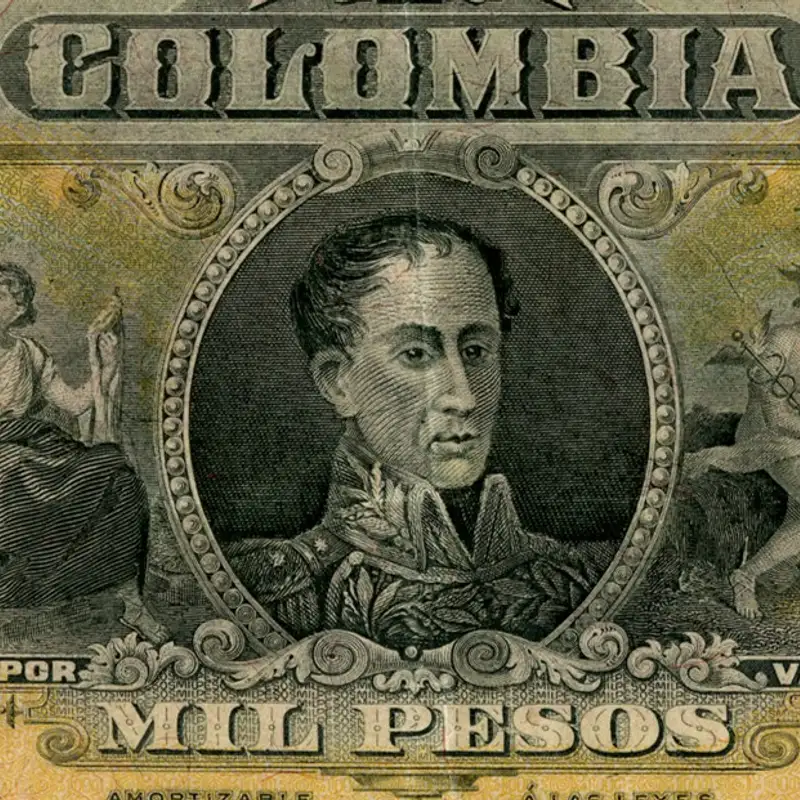
Tony Gryckiewicz:Alright. So this is a mil pesos, a thousand pesos. So that's a, it's a lot of money. Right? This is a lot of money.
Andrés Cortázar:That was like the highest denomination at the time. And the reason why I picked that note is because there was a period in history when the government wanted to control the emission of money. So the private banks were forbidden and they stopped making banknotes close to the '19 nineteen hundreds. And at that moment in history, we had like the biggest civil war recorded for the Colombian history, Dagarados Mil Dias. And right after Dagarados Mil Dias, this was one of the first emissions that existed as the government being the only entity capable of issuing banknotes.
Andrés Cortázar:And even though it's not the central bank yet, it's the transition between private banks and the central bank. And this is the highest denomination for the note. It has the portrait of Simon Bolivar in the middle. It was the highest denomination. It's the condition of the note, it's outstanding.
Andrés Cortázar:It's the best condition known to date. And the allegories, like, it all it has mercury again. And this is also an American banknote company, you can see the kind of this. Oh, I'm sorry. This is a waterloo and so on, you can see the difference on the design.
Andrés Cortázar:And the design in the back is really interesting. Can can see like the caravans and well, all the all the the representation of the country. Panama, again, in the middle, like if you can see the small mountains and the path between the two oceans, that is Panama again, the grenade that represents abundance, which is on top of it, and the condor, which is our national animal, like the Andean condor. And yeah, the design, it's so beautiful and so popular. So this note is special, not just because what it represents in history, but also because it's conditioned.
Andrés Cortázar:Because even though the note, like this is a note that sometimes appears to the market, the condition of these notes is the highest recorded and it's far away for the second or third example in terms of condition.
Tony Gryckiewicz:I would say the color of this note is incredible. It's a lot of color. Obviously extremely historically significant. And so a thousand pesos is equivalent to how many reals?
Andrés Cortázar:In this well, centimetres was equivalent of a thousand reales. At this point, because of inflation, that's a really like like it was a thousand pesos, but it was actually 100 paper money pesos. That's kind of difficult to explain, but because of the moment in history, which was right after the civil war, the representation of money in paper, they basically took one zero off out because people didn't want to receive again paper instead of coins. So this represents basically a 100, although it's written mil pesos, a thousand reals, similar to the previous note that we looked. And it was a transition period.
Andrés Cortázar:And actually the reason why this emission was out of the market for a small period of time is because after the civil war, no one in the country wanted to receive paper money instead of coins. So even though it was supposed to be a thousand pesos out of in the market, like out for the people, they were receiving the note just for a 100 pesos instead of
Tony Gryckiewicz:a basket. Okay. So it was trading at a discount to its face value because people didn't I want see. I see. It makes sense.
Tony Gryckiewicz:Makes sense now. Okay. So we have one of our first, at least we have a picture, an image of of a graded note. I know these other ones are graded as well, but what's the significance of this piece?
Andrés Cortázar:So, like, trying to like, this is basically what happened after, and it was the creation of the central bank. So if you see the holder, even though the note says Casa de Moneda de Medellin, then the holder says Banco de la Repubblica, which means Republic Bank or Central Bank. So what happened was like after the civil war in the nineteen hundreds and then the transition period from 1905 to 1915, then the government decided to create a central bank. That was a movement not just for Colombia, but for many Latin American countries. Most of the Latin American countries created their central banks in that period of time.
Andrés Cortázar:The case of Colombia was in 1923. So they had the urgency to start the bank and they created an order to make banknotes by the American banknote company, but those banknotes didn't arrive on time. So they had to use banknotes from a different institution to use them as a transitory allowance for money. So this is one of the first this is definitely the first emission of the central bank, but since they didn't have their own notes, they had to use notes from La Casa Imonea Imaging and have them issued as notes from the central bank. If you have the bank, the back of this note, you will see that it has like that overprint saying Bancola Repubblica provisional So the importance of this note is because it was issued just for a really small period of time, basically the time that they needed to receive the notes that they made in The US as the central bank notes.
Andrés Cortázar:And so as an urgency, they just used gold certificates issued by La Casa de la Munea in Medellin in the department of Antiochia to be the first central bank banknotes in 1923.
Tony Gryckiewicz:Yeah. It's a very interesting tale for sure. Central bank needing a little bit of help for a period of time to get get itself started. And, you know, for The United States, I mean, our Federal Reserve started in 1913, so this is approximately right around about that same time.
Andrés Cortázar:Actually, The United States had a lot to do with the creation of the central banks in Latin America. So it started here and they replicated the model into different countries and that was like a big intention for countries to rule and manage their own resources and issue their own money. So basically that's the importance of it. And another fact that is really curious is the amount because it's a quite weird amount. Should be 2 pesos or 5 pesos or 10 pesos.
Andrés Cortázar:Most of our emissions are 50¢, 1 peso, 2 pesos, 5 pesos, 10 pesos, 20 pesos, 50 pesos, a 100 pesos. The fact of this note having 2 and a half pesos makes it really special. It's the only note with that denomination in the in of all of the issues of paper money in Colombia.
Tony Gryckiewicz:Was there a particular reason for that?
Andrés Cortázar:No. Well, that is something that I'm not aware of because then the note was originally issued by La Casa Alemania and Medellin. It seems like it has something related to the price of gold because these were certificates of gold. Right? So it might be something related to an amount that it was common after a certificate of input of gold into the cast iron ore imaging or something similar to it.
Tony Gryckiewicz:I see. This is, I think, our our last banknote. This is a Columbia commemorative 19 thirty eight, one peso of gold.
Andrés Cortázar:So this one, it was made for the city of Bogota. Gonzalo Jimenez de Quezada was the person that created the city of Bogota. And this is a commemorative note that relates to that event. In Spanish, like in our field, the note is known as la pachanga, which means like a party, a gathering. If you look at the back of the note, you will see that it picks like a festival, like a celebration.
Andrés Cortázar:And that celebration, it's basically the celebration of the foundation of our capital city, Bogota. And so the guy that you see seated on the horse is Gonzalo Jimenez de Quezada, which was the founder of Bogota, and the people in the gathering were basically the first people that, you know, lived in Bogota. It was the creation of the city. This note is really popular because it's designed with the two angels that we saw on front. It was made by the American banknote company as most of the central banknotes up to 1959 when Colombia had their own printing company and they started to print their own banknotes.
Andrés Cortázar:So we, as a country, started to print our own money only until 1959. Before that time, most of the of the banknotes were made by American banknote company or other companies in the world.
Tony Gryckiewicz:And who is this gentleman right here?
Andrés Cortázar:Gonzalo Jimenez de Quezada is the founder of Bogota in 1538.
Tony Gryckiewicz:Oh, okay. So that was the that's the guy on the horse?
Andrés Cortázar:Exactly.
Tony Gryckiewicz:Okay. Yeah. That makes sense. I love how they got all this going on on the on the his horses down here eating some eating some some grass. He's hungry from the expedition.
Tony Gryckiewicz:Very nice. So a banknote like this, MS 67 EPQ. Do you mind just explaining really quick? I've because we've never covered this in this podcast. Does EPQ stand for?
Tony Gryckiewicz:What is that? What's the significance of it?
Andrés Cortázar:Exceptional paper quality. It means that the paper has not been compromised at all. So it's a problem free note and it has a really high, I think this is a top up note, which means it's the highest grade recorder. It has a lot to do with the centering. It means that the note is really centered compared to other examples.
Andrés Cortázar:And that's what is also special about this note. It's great.
Tony Gryckiewicz:Yeah. So what you're looking at, let's just say that one of these came across your desk and it was raw or you had an opportunity to purchase a collection and this was one of these was in it. What are the main features you're looking at before the banknote is graded? You're just assessing the banknote. What are the main features of the banknote that you are looking at to assess the quality and give you an idea of how much you should, you know, you should pay
Andrés Cortázar:for Oh, that's a great question. The first thing that drives the grade is how many folds the note have. So what you have to do in the beginning, it's kind of counting the amount of folds that the nodes have. And in order of the quantity of folds, you deliver the base grade. After that, you start looking at the paper quality, whether the note has been cleaned or if it has details like holes or graffitis or any other problem.
Andrés Cortázar:In those cases, most of the time the problems are written within the holder, in the back of the holder, if it's a graffiti or if it has holes, tears. And if the note is in a really like high grade, it means no folds or just a few folds, then you look into the centering. Like after the after you see that a note is uncirculated, which is similar to coins like from grade 60 to 70, then what you're looking is the quality of the paper and the centering of the note. So from 65 to 70, the grade is driven by the centering and the quality of the printing.
Tony Gryckiewicz:I see.
Andrés Cortázar:Every note that is 65 to 70, it's EPQ. Like, you cannot have an, you know, an EPQ note that is, like from 65 to 70 is gonna be EPQ.
Tony Gryckiewicz:It's gotta be EPQ. Yeah. Otherwise, that's kind of the threshold for a gem quality.
Andrés Cortázar:So the highest grade you can have without EPQ is 64. 64 note.
Tony Gryckiewicz:That's good to know.
Andrés Cortázar:The highest grade. Mhmm.
Tony Gryckiewicz:Okay. I think I I recognize the collection here.
Andrés Cortázar:This comes
Tony Gryckiewicz:out of
Andrés Cortázar:okay. Thank you.
Tony Gryckiewicz:No. Thank you so much for sharing these with us. So we got a couple coins. We've got a few coins to kinda round things out, and we got a little bit of time left. So I would just give us an idea here what we're looking at Americana.
Tony Gryckiewicz:So this is eighteen eighteen nineteen, and this is Yeah. A very interesting looking to realis.
Andrés Cortázar:Yeah. The reason why I started to buy coins after so many time, like, of so many time collecting banknotes is because there were periods in history that I couldn't cover with paper. So I started looking into coins. This, like the coin that we're seeing here, it's a really popular coin. Unfortunately, there is part of the coin that we cannot read, but if I tell you, you will notice it says Libertad, which means freedom, and then, means America.
Andrés Cortázar:Right? So it basically described the movement of independence of America. In the case of Colombia, we have we had like two different periods of our independence. The first one was easy and and basically free. We didn't have to pay too much for it.
Andrés Cortázar:It was around 1811 and it happens after the French got into Spain and they basically invade Spain. So it was the perfect moment for the Latin American countries to have their first independence. But right after Napoleon was defeated, then the Spain got back into ruling and then they tried to get back their colonies. So there was a second movement of independence. That second movement of independence starting in 1815, which was the year when the Spanish got back to America.
Andrés Cortázar:And it lasted until 1819. In 1819 was Simon Bolivar had, like, the first important battle that he won. It was in Santa Fe in Colombia in Bogota. And one of the first things that he did after he took over Bogota was taking to the mint into La Casa De La Monea, the place where the coins were made. And he overprinted the coins that he found at the Mint in order to issue money.
Andrés Cortázar:So this is an overprinted coin. The coin is overprinted over a rebellious coin that was no longer in use by the Spanish after they ruled for that poor period of time. And this coin is really popular, but I will explain the rest after you show us the next coin.
Tony Gryckiewicz:Okay.
Andrés Cortázar:Because the next coin, then you can see what he was overprinting. So he was for the first time changing the image of the king of Spain and replacing it by a local Indian, by our natives. So this was really unrespectful for the crown, for the king, because it was the first time that a local native was depicted on a coin. It had like obviously a social and a political intention, was to bring the vase of the society into the independent movement. He was trying to make them feel important.
Andrés Cortázar:So this coin is really popular. It's a Libertad Americana for 1819, the first year that the coins were issued after the second movement of independence.
Tony Gryckiewicz:Wow. I love the story of of a Simon Bolivar did with this coin because, I mean, there's no more clear way to assert your independence than to basically start issuing your own money immediately saying that, you know, we have a new government. We are taking over and we are issuing now money that's going be transacted by everybody in our own name and on top of which, I mean, one of the most complicated parts of creating money is going to of course being creating the planets to use to issue the money to make sure they're all the right, correct size and finest and so forth. So taking the existing ones and stamping them over with what you want for your new, you know, your your new country, whatever you want, whatever you want to call it, I think that's that's pretty, that's pretty cool. And then this is very much a show of defiance to the king as well.
Tony Gryckiewicz:What's the significance of the reverse here? What is, what is this?
Andrés Cortázar:So the grenade is a really important symbol of the independence, which means that the land itself shows prosperity. Right? So the grenade, it's a symbol, like once you open a grenade, see that it's full of seeds. So it represents abundance.
Tony Gryckiewicz:So for myself and a lot of viewers who might be asking this question right now, are you referring to a pomegranate or
Andrés Cortázar:Yeah. A pomegranate. Mhmm.
Tony Gryckiewicz:Ah, okay. Okay. Because grenades are what we throw at our enemies. You
Andrés Cortázar:know? Pomegranate. Sorry.
Tony Gryckiewicz:At least it is in, you know, in in American English, it's a grenade grenade you throw. But anyways, a pomegranate. Okay.
Andrés Cortázar:Like, if you see the name, like, if see the name on on top, it says Granada. New grenade. Or I wouldn't be able to say new pomegranate, but new grenade. That's why I was mentioning it as a grenade. But it has a lot to do with the independence movement, but also with the name of the at that moment of the name of the country itself, neo grenade, Nueva Granada.
Tony Gryckiewicz:Interesting. Okay. And so moving on to the the last one. Yeah, tell us about the significance of this piece.
Andrés Cortázar:So this is this is not this is not properly a coin. This is a metal.
Tony Gryckiewicz:Yeah. It
Andrés Cortázar:is a it's a metal that was created after an intention to kill our, Libertor, Simon Bolivar. And, it was kind of a miracle that he survived, to that intention of killing him. But the reason I wanted to show this medal is because at the back, if you go back to the back, so this is the bust of Simon Bolivar. You can see that there are Masonic symbols that are attached to it. And it is because most of our independence movement was made out of Masonaries.
Andrés Cortázar:So this was a gift given by the masons to the literature after the you know, the miracle of him being alive. So you can see the three dots and the different features of the coin depicting, like, the and the fact that the intention of killing him didn't work out, basically.
Tony Gryckiewicz:That's crazy. That's great. Yeah. Simombero Bolivar. Okay.
Tony Gryckiewicz:So I just have one question for you, and we'll kind of a wrap wrap up. And that is I mean, for people who are watching this right now, a lot of people are are are US coin collectors, and I wanted to do more world coins and world banknotes and this has been a fantastic introduction to Latin American banknotes as well as some coins. Found it super educational. What would be your advice for somebody who wants to get into this segment of numismatics that wants to start collecting some Latin American numismatics? Where would they start from perspective of books, but also maybe what particular type of period of history would you recommend that they start with?
Tony Gryckiewicz:And then lastly, I mean, there a major coin show or something coming up that you'd recommend that they go to, to, to get into it? As
Andrés Cortázar:a shows, there is a show that is held every two years. It's more like an educational show. It's an important movement of the academic part of the numismatists in Latin America. The next one is going to be happening in Argentina because they switch places every two years. They move to a different country.
Andrés Cortázar:I had the honor to be the president of the third edition, which was held in Cartagena, Colombia. It's called Conventione Internationale de Historiaoresin Numismaticos, International Convention of Historians and Numismatists. And that's that as far of a show. There are deep like, when people collect paper money, are many different approaches, but there's people that collects, for example, animals on the notes or certain period of time. I'm more focused into history.
Andrés Cortázar:So if somebody asks me, I will try to pick up the important moments in history of the different countries. I find like a really interesting topic, the independence of the countries, because those movements basically created a new identity for the country itself, new born country which is being created and all the effort that it represents. So that period of time is really interesting. But for whatever reason that there is attendance for people to collect central bank notes. So notes that are made by the central bank.
Andrés Cortázar:And I understand that from the point of view of having more information about them, how many were issued, the exact times. There is a lot of books like about central bank emissions because private banks and state banks or issues, there is a lack of information about them and people sometimes is more afraid of understanding what's going on if they don't have enough information. So there is attendance for people to collect central banknotes more over other kinds of, of, of banknotes.
Tony Gryckiewicz:Right. So if somebody out there has a collection of Latin American banknotes from Colombia, from from another country, and they want to reach out to you, get ahold of you, ask you some questions, get your advice, how do people get in touch with you?
Andrés Cortázar:Well, they can just look for my name at Stacks and Bowers here like, I'm a public numismatist and we will be more than happy to help them, understand, what they have or guiding people on how to collect on or receiving consignments in case they want to sell their notes. So you will also have my information if if somebody asks you about how can they get in contact with me or whatever, you can just give them my email address or my phone number so they can contact me and I will be more than happy to help. I love doing this and I encourage people to collect coins and paper money to understand the importance of numismatics, and I'll be more than happy to help anybody that needs me.
Tony Gryckiewicz:Yeah. Well, thank you so much, Andreas. I appreciate the the time and the expertise and all of the education here. Hopefully, are going to find this episode very entertaining and interesting. I know that I I did, and I'm gonna leave your contact information, your email Thank you.
Tony Gryckiewicz:On the video and and below for folks that want to reach out. So I hope to run into you at some local some show coming up. I don't know. Do you go to the fun show? Are you gonna be at the fun show in Yeah.
Andrés Cortázar:I will be at the fun show probably the last two days, and I'm planning to attend the New Year Inc. The, because, we have a really important auction going on. And so I'm planning to attend also the New York Inc. So I might see you there and finally meet you in person, Tony.
Tony Gryckiewicz:Yeah. That would be great. Yeah. That would be awesome. I've never actually done that that inner you know, New York International show, and I really wanna attend.
Tony Gryckiewicz:It's kinda like one of the big, biggest events of world and international, especially ancient coins as well. So if you're in New York City, it's right around, like, a week after the fun show typically.
Andrés Cortázar:It's it's yeah. It's basically the next weekend.
Tony Gryckiewicz:Yeah. Yeah. Alright. Well, have yourself a wonderful evening and Thank you. Hope to meet you meet you soon.
Andrés Cortázar:Very much, Tony. I really appreciate. Alright. Bye. Thank you very much.