Ep.39 - Part 2 Intro to Pioneer Gold Coins with David McCarthy of Kagin's #numismatics #rarecoins
Hey, folks. Welcome back to the Cabbage Coins Podcast. My name is Tony Grecovich. I am the owner operator of Cabbage Coins, and this week is gonna be part two of our survey on Pioneer Gold Coins with David McCarthy, the senior numismatist at Kagin's. I found the part one to be really super interesting.
Tony Gryckiewicz:And hopefully you guys enjoy part two as well as we dig into some additional types, some later types, we're going to look at some Pikes Peak Gold, I believe. I believe we're going get the Dubosc, which is one of the ones that David mentioned a couple of times as being super important and interesting. And a couple housekeeping items real quick. First off, we have the Central States Numismatic Society show that's coming up. I believe it is April 23 and twenty fourth or twenty fourth, twenty fifth, whatever.
Tony Gryckiewicz:It's going to be the Thursday through Friday of that week. I'll be at Table 1717. And please come by if you have anything at all to sell, would I love to take a look and get a chance to make you an offer on your coins. But also I'm going to have all of the stuff from my website as well as a couple, probably a couple other things as well at my table. So that's Table 1717.
Tony Gryckiewicz:The second thing I just want to mention real quick is somebody out there, believe sent me these incredible Ray Ban. Let's see if this focuses Ray Ban meta glasses. There you go. Ray Ban Metas. And these are these glasses for those who don't know that record.
Tony Gryckiewicz:So it's, they're really pretty cool. And I'm kind of mulling over what exactly I'm going to do with these and the content that I plan to create with them. I've already created some interesting kind of a personal video, some home videos and so forth. So, but anyways, I was just want to say thank you so much. It looks like according to the Amazon gift receipt, these were ordered in like January.
Tony Gryckiewicz:I just received them last week. So I don't know what Amazon exactly was doing, but thank you so much for whomever was out there. I have no idea who it was. I can just only assume it was somebody from this channel. So thank you so much again for that.
Tony Gryckiewicz:Without any further ado, let's take another listen and watch with David McCarthy of Kagin's.
David McCarthy:Yeah. So this is Cincinnati mining and trading company who were oddly enough from Cincinnati, Ohio. We know who they were and actually their, their trip from Cincinnati to San Francisco is incredibly well documented. They, they almost split up or actually did split up on the trip west. There, there is a story about someone from Cincinnati company using one of their copper patterns to pay for a meal on their way out west.
David McCarthy:This particular piece is struck over in Ormsby Ten. So this is like the only real twofer in the entire in the entire Pioneer Gold series, but you can see it says 10 dolls on the back and then you can see JSO. And if you look there's some stars down there. Think the dates, if you go, oh wait, no, they're not dated, but on the other side, you can also see United States Of America.
Tony Gryckiewicz:Yep. Yep.
David McCarthy:There's a basically what happened here is someone took an Ormsby 10 and it actually, you can see it's kind of got a little bit of filing right there. That was done before the coin was struck. So someone took a little bit of gold off of it and then used the Cincinnati mining and trading dyes to overstrike it and pass the coin. So there's three of these in private hands today. Again, they're worth over a million dollars apiece.
David McCarthy:Sure. Wow. You know, are some Cincinnati mining and trading company patterns. So there's a pair of UniFace $20 patterns, one of which is in, I think an MS 64 older, which is incredible. I've actually got an envelope that was mailed to San Francisco in 1849 to the clerk for Cincinnati mining and trading company that was then forwarded to them in Coloma.
David McCarthy:Just kind of a wacky, goofy.
Tony Gryckiewicz:So so Oransby was out of California, but this was this was struck in Cincinnati.
David McCarthy:No, this was struck in California. So the the patterns were struck in Cincinnati. And then they went to California. Some people left the company. Some people they actually had so much trouble.
David McCarthy:Took a wagon train to get to California and their wagons were too heavy. They had too many supplies with them. And so like a lot of people who were heading there, they had to dump a lot of supplies. One of the things that they actually talked about dumping was their their their press and their dyes. And, you know, members of the company wouldn't do that.
David McCarthy:That was their plan. They were gonna go to California and strike coins for people. Actual members of the company left over this. And I actually found an incredible resource that had, you know, kind of the whole history of what had happened because members of the company kept diaries. And so there's a real history associated with Cincinnati Mining and Trading Company.
Tony Gryckiewicz:It's wild, man, for sure. This is something I've never seen before. I have no idea what this is.
David McCarthy:That's a mass in cal. So there's three Massachusetts and California gold, $5 gold pieces, but from two different dye pairs. This example looks like a proof. It is striking gold. It's just heavily toned, which probably means it had a lot of silver in it.
David McCarthy:The guy who founded the company, I think operated a pen manufacturing company and they sold stock in the company, raised money and ostensibly were going to California to strike coins. And we're unclear about whether or not they actually made it to California and issued coins in California. But given that there's two different varieties and two of the three coins are pretty well circulated, my suspicion is that they probably did make it to California. Yeah. There are also numerous, numerous pattern coins and numerous fantasy coins made for Massachusetts California.
David McCarthy:And so there were, there were fake mass and cals being made in a variety of metals in the twentieth century. They also actually made $10 dies. And there were a couple of pattern coins struck. There's I think three $10 patterns for massive cow. Wow.
Tony Gryckiewicz:This is awesome. This has gotta be really expensive.
David McCarthy:It's yeah, it's unobtainable basically.
Tony Gryckiewicz:Alright. It's fair. This this has got to my I think one of my favorite designs. Really love this. At least the obverse for sure.
Tony Gryckiewicz:So Yeah. What is this one?
David McCarthy:So that's a Baldwin one. The story of Baldwin is really kind of an interesting one. So we talked about miners bank and Broderick and Kohler. Broderick and Kohler, who were the people who were striking the miners' banks, both had been members of fire departments in New York City. And when the fire that ended Miners' Bank started spreading on Christmas Eve of eighteen forty nine in Cal in San Francisco, in Portsmouth Square, they actually stopped the fire and they did it by taking dynamite and blowing up buildings and creating firebreaks.
David McCarthy:And so Broderick and Kohler ended up being huge heroes in the city of San Francisco. And Broderick ended up being kind of swept up. He had been involved in democratic politics in New York City, and he ended up being sent off to the, to the state Senate in, in the wake of them saving San Francisco. And Kohler hung on and ostensibly was going to continue striking coins and actually had these dies made well, the obverse die here. This die was actually designed for Kohler and company.
David McCarthy:There's a single pattern struck over a large scent with this obverse slightly earlier die state of this obverse and a different reverse that looks very much the same that says Kohler and Company. And in February or March 1850, he decided that he was going to sell the company and sells his company to Baldwin and Company who were jewelers. And so Baldwin began issuing these $10 gold pieces and a $5 gold piece. Well, this obverse die wasn't made for Baldwin and the reverse die on the $5 Baldwin was actually the reverse die that was in Kohler's stuff from Dubosk And Company, who again had come in 1849 and then went back and come back in 1850. So the earliest Baldwins were probably struck in March or April 1850.
David McCarthy:So sort of at the tail end of the scandal or just after the scandal kind of ended in 1850. And they were an incredibly popular and successful company in 1850. However, if you look at their coins, the US Mint actually published assays of all of these coins. As time went on, Baldwins were debased more and more and more. So 1850 dated Baldwin fives and tens are very, very close to being full value.
David McCarthy:By the time you get to 1851, when they strike $10 and $20 gold pieces, they're actually, I think the $10 gold piece had something like $9.17 worth of gold in it. So they were fairly well debased. Actually that leads to the second major scandal in California where they shut down private coining yet again.
Tony Gryckiewicz:So
David McCarthy:but this is Oh. Okay. Now this is a very interesting Yeah.
Tony Gryckiewicz:Look at the transition piece midway through we're actually midway through folks to our our survey here. So this is like ingot, right?
David McCarthy:It is an ingot and it's an ingot that's been mired in controversy and unfairly so, I would say. This is a Myers and Company, one tryouts monetary ingot. This was made by a guy named Frederick Myers, who was a scale and weight manufacturer from Philadelphia. And he left Philadelphia in late eighteen forty eight, early eighteen forty nine, gets to California. He's in California in late eighteen forty nine and early eighteen fifty while all of this controversy about the value of gold is going on.
David McCarthy:And so in early eighteen fifty, there's all sorts of, you know, kind of public debates about how they should be valuing California gold dust and nuggets. In February 1850, the biggest bullion buyer in the world, or at least in North America, BB Ludlow and Company increased their bid for California gold dust and nuggets to $18 per ounce. Now, when this was discovered in the 1950s, and it was discovered by Paul Franklin and John Ford, who are very controversial characters in the story of all of this. And I'm not going to get into all of that for a variety of reasons. But it was discovered in 1948 and everyone at the time believed that one ounce of California gold was valued at $16 pretty much invariably through the history of California during the gold rush.
David McCarthy:Actually in early eighteen fifty, they started valuing it at $18 So when this was initially found, there were people who criticized it. It can't possibly be real. It's it's being valued at $18 And so that for thirty or forty years was the argument used by people to say, oh, well, this piece can't possibly be true. It was sold publicly at auction probably about twenty years ago. And subsequent to its sale, that information about BB Ludlow and Company paying $18 an ounce for gold came out.
David McCarthy:And as a matter of fact, sitting on my desk because, you know, on my desk, I have all sorts of weird nineteenth century stuff. This is actually a letter handwritten by John Little Moffett of Moffett and Company. And in it, is thanking the the head of B. B. Ledlow and Company for increasing his bid to $18 an ounce for California gold.
Tony Gryckiewicz:Wow.
David McCarthy:That came out. But subsequent to that, it also came out that Frederick Meir was or Myers was actually absent from Philadelphia from 1848, late eighteen fifty. Came out that Frederick Meijer was actually sharing workspace with the guy who cut all of the dies for all of the California gold that were made in California. And while I was working on the book, was actually able to find the newspaper item that that showed Myers going back to the East Coast, having, you know, his business had failed. And so, you know, this is a very interesting thing.
David McCarthy:This is actually the only unique gold monetary item from the entire California gold rush. So, you know, every other monetary item, there's a couple of things from the company. This is the only unique one. Yeah. It still kind of gets attacked by people largely because there was a big controversy from two different sides in twentieth century numismatics about this kind of stuff.
David McCarthy:It's been incorrectly compared with assay ingots.
Tony Gryckiewicz:Okay.
David McCarthy:It's clearly not an assay ingot. It doesn't have a fineness listed on it. It's just a weight and a value. Is a pure monetary ingot, which is something that we know existed. And it's one of my favorite things from the series, particularly because it's so been it's been misunderstood for so long.
Tony Gryckiewicz:Yeah.
David McCarthy:It's currently it's in an PCGS 58 holder and it's in an advanced Ingot collection today.
Tony Gryckiewicz:Got it. Got it. Okay. Sounds good. Alright.
Tony Gryckiewicz:So this is Dubasque. Right?
David McCarthy:Back to Dubasque. So this is a die that was actually engraved by James Longacre, 1850, early eighteen fifty, personally owned the receipts. And so there were 5 and $10 gold pieces that were issued by Dubasque. So basically several members of the Dubasque family came out in 1849, turned around and went back home. And in early eighteen fifty, Sun went back out to California and began striking these coins in 1850 and struck them right up until April 1851, which is when the next really big controversy breaks out in, in San Francisco.
David McCarthy:And after that, he actually stuck around in California and died in the eighteen sixties. But these are quite rare. I mean, you know, there's a handful of them. A handful of the tens are known, probably fewer than 10 of them, I think. Yeah.
David McCarthy:This coin is in a, I think, PCGS VF 30 holder or something like that. And if you hold it in your hands, it's like got 50% original mint luster on it. It's just really, really beaten up from being in a bag. Yeah. It's really original.
David McCarthy:It's it's sort of ludicrous in the holder that it's in. But, know, if you don't know how to grade pioneer gold, I can understand where you would look at this and say VF because it's lacking detail. But that's the way it was made. I mean, it has bag marks on it, but before it had bag marks on it, I'm pretty sure it was about as flat as it is here.
Tony Gryckiewicz:I see. Okay.
David McCarthy:So if you actually, if you go back this die and the reverse die actually end up being repurposed in 1852. So hold those in your mind, the image of those two, there's a company, we won't see an example of the coin struck from these dies, but there's a company that comes around in 1852 that uses these dies and just re engraves the thing. And again, you see the SMV gold on this.
Tony Gryckiewicz:Yes.
David McCarthy:Yes. That's really a Dubasque thing that gets adopted by other companies.
Tony Gryckiewicz:I see. Okay. So these, I definitely recognize. I've yet to own one, but I think it's gonna happen in next next, you know, short little while. My business is growing.
Tony Gryckiewicz:I might be able to invest in one of these. Anyways, these are referred to as slugs. Right? This is an Auguste Humbert or something like that?
David McCarthy:Auguste Humbert. So if you remember, Moffett is sort of successful after the after the first big scandal. Moffett's kind of the only man left standing in the city of San Francisco. And in 1850, he actually gets a contract to run the assay office for the United States government. And a guy named Augustus Humbert, who is a watchmaker and a jeweler from New York City is appointed as United States Assayer of Cool.
David McCarthy:And Humbert is sent out to California and in January or February 1851, they begin striking these slugs. Now, basically starting in 1848, the people of California begged the United States government to establish a mint. And the powerful states on the East Coast didn't want to see a mint being opened up in California. And there were business people in California on the East Coast everywhere who benefited from the gold trade being really, you know, inefficient. There were a lot of people who were making money buying gold dust and nuggets, you know, buying gold coins on the on the West Coast, shipping them to the East Coast, melting them down and having them turned into US coins.
David McCarthy:And so it was almost impossible to get the mint passed through Congress. And so what they ended up doing in the 1850 is the Congress agreed to start producing these ingots. Initially these, this is a $50 ingot. It's got about two and a half ounces of gold in it. They're about a little under two inches across and a little under a quarter inch thick.
David McCarthy:And initially the idea was that these were going to be multiple thickness ingots. And so if you see here, you've got the central seal, this round central steel seal, but $8.80 and 50 are actually hand punched into that. Okay. Then on the edges, which you can't see here, they actually punch the date and then, you know, United States Assay Office of Gold or sorry, Augustus Humbert, United States Assayer of Gold.
Tony Gryckiewicz:Okay.
David McCarthy:Punched around the edge. And then on the back, on some of them, there'll be the denomination of 50 in the middle. However, after about a month, they stopped making the extra thick $500,000 ingots and we're just making $50 ingots. They stopped actually punching the denomination on the back. I see.
David McCarthy:And then after a few months, they realized that, you know, taking 13 steps to strike one of these coins was a lot. So they had Albrec Coins who was a dye maker who lived in San Francisco, make obverse and reverse dyes for slugs. And so this is what we call the lettered edge variety of slug. And then there are what we refer to as reeded edge slugs. The reeded edge slugs are struck from two complete dies that have all of the information on them.
David McCarthy:These earlier lettered edge slugs, which are more really like an ingot, were the were the first type. And these are, you know, very expensive coins. Yeah. You know, an example of this particular variety just sold at auction in a U. 50 '5 for, I think, dollars 360,000.
David McCarthy:Okay. For an AU. This particular coin, I think, is in an MS 63 holder.
Tony Gryckiewicz:Yeah. I pulled this one down from the PCGS website. I think. So this I've always wondered what $880,000 or That's
David McCarthy:the fineness of the gold.
Tony Gryckiewicz:Okay.
David McCarthy:The idea behind this again, this was more of an ingot than a coin. And so very much like the Bechlers in North Carolina, these pieces have their fineness on them and their value. They don't show you the weight. You would have to weigh it in order to determine, you know, what its value was. But the fineness of this gold is 880,000.
David McCarthy:They had both eight hundred and eighty and eight hundred and eighty seven thousand sluttered edge slugs. And, you know, that was based upon the gold that was coming in, you know, tended to be in that range. Actually, California gold on the low end is probably about 750,000. It's very, very unusual to find it that low. In 1850, they were finding 95% pure gold.
David McCarthy:Pretty, pretty typical. Like if you got a big nugget, it might very well be 94, 95% gold. And so you kind of have a range there, but because the gold had so much silver in it, it was very, very difficult to refine. And as a result, they were making coins and ingots like this that were under 900 fine, which is the standard find us for US coins, which down the road is going to become an issue.
Tony Gryckiewicz:Yeah. Yeah. Yeah. Okay. So continue to move on here in our history.
Tony Gryckiewicz:We're 1851, and this is
David McCarthy:in 1851, you have the assay office operating. However, the United States government wouldn't give them permission to make small denomination coins. In 1851, you don't see any fives, tens or twenties coming from the Assay office. Because they've shut down Moffitt and Company, you kind of have a bunch of little private companies pop up again. Scholz and Company is one of those companies.
David McCarthy:It was Scholz was the guy who was actually manufacturing all the dye steel for for the coiners. And one of the other owners of Schultz and company was a guy named Albert Koenig, who was the guy who was actually engraving all of the dies for these companies. And in early eighteen fifty one, they started making $5 gold pieces. And so there's maybe a couple dozen of these now, and they're very, very valuable coins. And, you know, kind of, you know, they come up for sale once every few years.
David McCarthy:A no grade was recently sold in the James Stack collection. But again, they started striking these in early eighteen fifty one and as I've alluded to in April 1851, there's another big scandal and all of these private coiners get shut down.
Tony Gryckiewicz:I see. Is it just me or is it gold kinda I have like a greenish hue to it.
David McCarthy:Yeah. So again, California gold naturally coming out of the ground has a lot of silver in it.
Tony Gryckiewicz:Oh, okay.
David McCarthy:And so unlike coins that are issued by the United States Mint, quite often you see unusual toning on private gold coins. And it's it's actually one of the reasons that it's very important to look at a lot of this stuff so that you know what it really is supposed to look like or what it can look like. There are a lot of people who are experts on Us numismatics who don't understand the color on pioneer gold and have very public opinions that are really, really wildly wrong about what a good piece of pioneer gold looks like. One of the things I tried to do when I chose images for the book, I tried to find coins that actually had original unusual color on them so that people could actually see what this stuff really looks like when it hasn't been messed with. Because the desire to have these coins look like common US gold coins has led a lot of people over the years to dip and otherwise process coins.
David McCarthy:And if I'm gonna collect a piece of pioneer gold, I want it to look like that Bechtler that we looked at earlier.
Tony Gryckiewicz:Yeah. Of
David McCarthy:course. I wanted to have color. I wanted to have surfaces that are consistent with a coin that hasn't been improved by people.
Tony Gryckiewicz:Okay. So moving on to this. This I believe this
David McCarthy:is done. The rarest of the rare.
Tony Gryckiewicz:Okay. Okay.
David McCarthy:This is at
Tony Gryckiewicz:Smithsonian's website. Right?
David McCarthy:Yeah. And there's, I think, two or three of these in private hands. There are only $5 gold pieces from Dunbar. So Dunbar was a banker in San Francisco who one of the things that he did was he advertised that he would buy Baldwin's companies at par. In other words, if you brought a $10 gold piece from Baldwin's, it he'd give you $10 worth of, you know, of, of legal tender coins.
David McCarthy:So kind of doing the same thing that Moffitt and Meiners Bank had been doing two years earlier. And Dunbar did this and probably figured out that Baldwins did not have enough gold in it. So he actually started striking his own coins in like 1851. Well, in late March, 1851, there's another big scandal. There's a newspaper man and sometime banker by the name of James King of William who publishes essays of all of the private gold coins then in circulation in California in one of the newspapers.
David McCarthy:And of course the person he has do this essay is none other than Augustus Humbert at the, at the assay office. Well, if you really dig into it, it actually seems as though the assay office was trying to shut down all of the private coiners to force the United States government's hand and allow them to start striking smaller gold coins. So in April 1851, there's another big scandal. All of these private companies end up being shut down. It's made illegal.
David McCarthy:And you know, the office writes to the government says, okay, we'd like to start striking small denomination gold coins now. And they're told no. So it basically decimates the local California economy for a while. And they keep asking and asking and toward the end of the year at 51 they're given permission to strike five, ten and twenty dollars gold pieces. And then the day after they receive the letter that says, yes, you can strike $5.10 and $20 gold pieces.
David McCarthy:They get a telegram saying, no, sorry, you can't. And so, you know, again, there's this really crazy thing that keeps going on in California where moneyed interests who are making a lot of money on the gold trade, who are making tons of money buying gold from people and taking advantage of the inefficiencies of the system where there's no mint, keep getting private gold coin producers shut down and keep emit from being established in California. And when you really get into the granular information and you start reading letters from people and you start reading, you know, stories in newspapers, it really becomes apparent that there are very wealthy, powerful people that didn't want the little guy in California to have his own reliable coinage. And so private companies keep on popping up in order to, you know, give people circulating medium that they can they can trust and use. And of course, there are some bad guys and some good guys.
David McCarthy:But the story is it just keeps happening again and again. And it always, for some reason, hits its peak in April. I don't know why. You know, in 1850 and 1851, the two big scandals both really erupt early in the year and, you know, by April everything gets shut down.
Tony Gryckiewicz:Interesting. Well, this episode is going to air just on the heels of, or just before April. So Yeah. I don't know if there's any tie in there at all. Anything special is gonna happen.
Tony Gryckiewicz:Okay. So you m and company, and this is another five in California. In California gold, that's kinda cool. It says in California gold. So what we have here is I think this is WMA was smelter or
David McCarthy:It is was smelter.
Tony Gryckiewicz:Okay. All right. Cool. All right. Take it away.
David McCarthy:So, you know, as I mentioned, the the assay office wanted to strike five, ten and twenty dollars gold pieces and they weren't given permission. Wass Molitor and Company was a Hungarian partnership, they probably got to California in the summer, 1851. And they were operating an assay office in San Francisco. And in January 5052, the people of San Francisco petitioned wasp monitoring company to strike private gold coins. And so in January they start striking $5 and $10 gold coins using those old leftover $10 gold, dollars 10 dies from Dubosque and company.
Tony Gryckiewicz:Okay.
David McCarthy:And there's actually a connection between Wasp monitoring company and Kohler. So he may very well have been involved in all of this. But while they were doing this, the people at the assay office were really, really upset by what was going on. And they went to their attorney and had their attorney write them an opinion saying that they could start to strike their own coins using Moffitt and Company as the entity to strike their own coin. So Wass Molitor starts striking these 5 and $10 gold pieces and the assay office who can't strike $5.10 or $20 gold pieces basically whip up new dies.
David McCarthy:And in early eighteen fifty two, start striking $10 gold pieces that say Moffitt and Company on them, but they're actually being struck in the assay office. Gosh, that's going to be the next coin that we see here.
Tony Gryckiewicz:All right. So you see,
David McCarthy:and you can see that the 1852 date on this, if you go back, compare that to the 1852 on that five. I think the dies were made by the same person.
Tony Gryckiewicz:Yeah. Yeah. Very, very same.
David McCarthy:Kind of stiff. So it's it's these are probably dies that were cut by Albert Kagin, who we've talked about before. So these are being made briefly at the assay office while they're waiting for permission from the United States government to use these dies that they've got sitting around for actually 10 and $20 gold pieces, they finally get permission, then they start striking the $18.52 over $118.52 over 100 twenties, which we don't have pictures of because if we had pictures of every significant coin, we'd be here for a week.
Tony Gryckiewicz:Yeah. So this I definitely recognize this reverse. We're gonna see one here in a second, but this is unique and kind of unusual.
David McCarthy:Well, what they're doing there is they have basically a reimagining of the eagle from the seal from the slug.
Tony Gryckiewicz:Yes. So they
David McCarthy:took the design of the slug and they shrunk it down. And, you know, they're obviously trying to communicate to people, hey, this is an issue of the Assay Office without saying it because they can't legally say that these are being issued by the Assay Office because it's being issued by this private company, Moffett and Company, which had ceased to strike coins in January 1851.
Tony Gryckiewicz:So this assay office, I actually don't know. Some people out there might be wondering too, was this a this was a US like US office. Okay.
David McCarthy:Again, the people of California are begging the United States government to establish an official US mid here. Obviously, California hasn't yet become a state in 1848 when they when they start asking by 1851 California is a state. And, you know, again, the powerful delegations from the East Coast don't want to see a mint here. And frankly, there are probably powerful people in California who are making a lot of money on this globe trade who don't want to see it. And so the way that they're able to slow things down is they agree to have an assay office.
David McCarthy:And again, initially the assay office is only supposed to be issuing ingots and they're only supposed to be $50 and up. And you know, again, the people running the assay office know that they'd be doing a lot more business and therefore making a lot more money if they were issuing smaller denomination coins, which is what the people of California really want. And they beg and beg and beg, and they're told no. They they actually, in late eighteen fifty one received dies dated 1851 for 5 and $10 sorry, $5.10 and $20 gold pieces. We've never seen the fives.
David McCarthy:They never struck those, but they they put a little two over the ones on those dies and they strike 10 and $20 gold pieces starting in early eighteen fifty two after these have been struck for a couple of weeks.
Tony Gryckiewicz:So then moving on then to this piece now, I definitely recognize these. I haven't had a chance to own one of these yet, but they're obtainable coins for sure.
David McCarthy:Yeah. Well, this isn't this is a rare variety.
Tony Gryckiewicz:Oh, okay. We
David McCarthy:were talking about fineness. The fineness on this one is 884 thousandths.
Tony Gryckiewicz:Okay.
David McCarthy:Okay. So what ends up happening with the assay office is John Little Moffett, who was the owner of Moffett and Company sells his interest in the company to Curtis Perry and Ward, who are the end company of Moffett and Company in 1852. And so in 1852, they go from having Humbert's name as the assayer on all of their coins to just saying United States Assay Office. Okay. And so the United States Assay Office of Gold, it's the same entity, it's being run by different people.
David McCarthy:And so in late eighteen fifty two, they start striking sort of a different style of coin. And part of that is that in late eighteen fifty two, they hire a member of the Eckfeldt family. You've heard of the Eckfeldts from the Philadelphia
Tony Gryckiewicz:name before.
David McCarthy:Okay. So the Eckfeldt family was basically Philadelphia mint royalty. Adam Eckfeldt was
Tony Gryckiewicz:Yes. Okay.
David McCarthy:The first chief coiner of the United States mint and or one of the one of the early chief coiners of the US mint and actually was probably he and his father may very well have cut the dice for the very first US coin. Great nephew, I think, was hired by the United States Assay Office and in late eighteen fifty two came out and completely rebuilt all of the presses in the United States Assay Office. So if you look at this coin and then you look at all the coins we've looked at before, can see this is this is a much more modern looking coin. You see the difference between this and everything we've looked at up to this point? Well, like this looks like it could have been struck at the US Mint.
David McCarthy:It's fully struck. It's got relatively flat dies. It's just, you know, it's a it's a it's a much more modern looking coin. That's the result of Curtis Perry and Ward bringing in this member of the Eckfeldt family.
Tony Gryckiewicz:I see.
David McCarthy:And he more or less takes over the striking operation at The United States Assay Office. Now, the reason they brought him in is they wanted to get the contract to have a branch mint in San Francisco. And they figured the only way they'd be able to do that is if they could actually run a modern mint. And so this is a $20 gold piece. Now we talked a little bit about fineness and we talked about how U.
David McCarthy:Coins were 900. They basically passed a law saying that in order for coins of the assay office to be acceptable for customs duties, they needed to be 900 fine. The problem with that is in order to do that, you have to be able to properly refine gold, which means that you have to have access to I think it's sulfuric acid that was being used at the time. It was either sulfuric or hydrochloric acid. And there wasn't anyone producing that in California in 1853.
David McCarthy:So they had to have it imported from the East Coast. It's incredibly dangerous to do. And they were constantly running out of, you know, of this acid. Whenever they ran out of this parting acid that they were using, they wouldn't be able to create any coins. So as an emergency issue for a couple of weeks, they made 10 and $20 gold pieces that were 884,000 fine so that people would be able to use these locally.
David McCarthy:And the tens are really, really rare. There's somewhere between ten and twenty of them in these twenties. You know, there's maybe 25 or 30 of them. So this coin here is probably a quarter million dollar coin.
Tony Gryckiewicz:Okay. So not very obtainable for somebody of mine.
David McCarthy:However, a 900 funds example that looks exactly like this. You would be able to buy you can probably buy an MS 61 for $20,000 these days.
Tony Gryckiewicz:Yep. Yep. So we're now we're all the way into 1853. See Moffitt and Company Okay. As
David McCarthy:So what happens in 1853 is Augustus Humbert loses his job and the contract for the assay office passes to Kohler. We've heard that name before he was the guy who was striking the miners' banks. And so Kohler becomes The United States Assayer in 1853. And he has his offices with Wass Molitor and Company. And in the meantime, they're switching over.
David McCarthy:So in late eighteen fifty three, they finally passed a law to establish a branchment in California and Curtis Perry and Ward are able to buy the contract to set up the mint. However, they have to do it on a shoestring. I think they they had to somehow pull off as, you know, completely outfitting the Mint for something like $300,000, which, you know, is virtually impossible. It should have been a multimillion dollar project. So they decide that they're going to convert the old assay office into the Mint.
David McCarthy:And in the meantime, Moffett and Company, they basically start striking coins using the name Moffett and Company again. And this, am reasonably certain is basically the staff of Curtis Perry and Ward, the old Assay Office striking coins while the new Assay Office is being run by Kohler and Company. And again, this is something that it's alluded to a little bit in the book, but there isn't a lot of really, really clear information about how this stuff is going on because the people of San Francisco just took all this stuff for granted. No one was keeping really great records about how all of this worked. So these are an emergency issue.
David McCarthy:They're really quite rare. Know, nice AU is going to cost you $2,535,000. Mid state, it's going to be considerably more than that.
Tony Gryckiewicz:This is a gorgeous piece for sure.
David McCarthy:And now if you look at the back of this coin, this die is used by a different company. The following year, 1854, there's a company called Kellogg and Company and Kellogg and Company gets these dyes and has a different obverse dye and actually uses this dye to strike Kellogg twenties.
Tony Gryckiewicz:All right. And that is an
David McCarthy:incredible looking Kellogg.
Tony Gryckiewicz:Amazing. Yeah. Okay. So 1854.
David McCarthy:Now you'll notice this is 1854. We have a mint in San Francisco in 1854. So what's going on? And the answer to that is parting assets. So they still don't have a distillery making parting acids in California.
David McCarthy:And every once in a while the mitt would run out of parting acids. And so John Glover Kellogg, had been the clerk at the assay office and prior to that, the clerk at Moffett and company started his own company striking these coins. It was actually prior to Kellogg and Humbert who we've heard of because of the ingots, but it was Kellogg and Houston, I think in 1854, there were multiple partnerships between him and other assayers. He was basically the guy running the company and he'd bring in an assayer. And so Kellogg strikes these coins in 1854 and 1855 when the mint can't produce coins for use in San Francisco.
David McCarthy:And he strikes $20 gold pieces in 1854 and 1855. And then in 1855 also strikes $50 gold pieces, which are, you know, again fantastically rare. There's like 13 of them known. They're identified today as being proofs and I'm not a 100% certain that they were actually made as proofs. They're they're certainly proof like and they're incredibly rare, but I'm not absolutely certain that they were making them as as proofs in the sense that we think of them today.
Tony Gryckiewicz:I mean, this is just
David McCarthy:absolutely incredible. I mean, a work of art.
Tony Gryckiewicz:Yeah. Yeah.
David McCarthy:You know, I'm assuming
Tony Gryckiewicz:you've you've handled this one in hand, I'm assuming.
David McCarthy:I've handled this one in hand. I've I've seen there's specimen 69.
Tony Gryckiewicz:Wow.
David McCarthy:That, you know, probably is there was an example that was sent to Adams and company to put on display and it probably is either this one or, or the specimen 69. And they're just, they're, they're incredibly well made. Awesome. And again, Kellogg would have had connections with all of the people who were actually in the mint. I, you know, it's entirely possible that he was having this stuff struck at the mint.
David McCarthy:You know, I don't know that he actually had a minting press. May very well have been taking gold, sending it to the mint. They may have been striking these things and giving them to to Kellogg to give to people. It's, it's really unclear as to whether or not, or conversely, he may very well have had a press that was used when he was working with Moffitt and Company in 1853. Those Moffitt and Company pieces, Kellogg was involved in those two.
David McCarthy:Is there some mysteries here waiting to be solved?
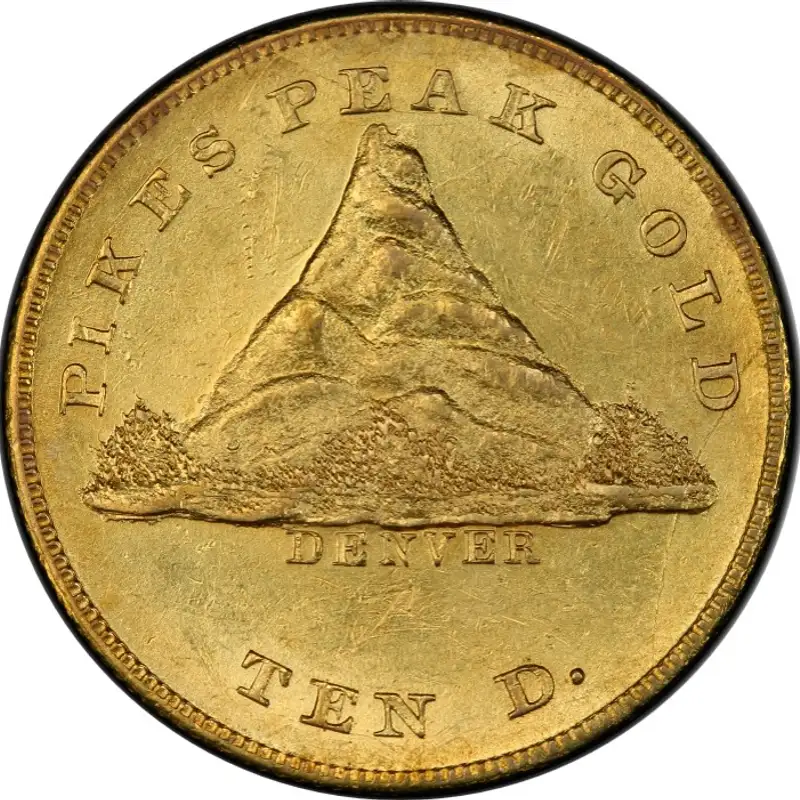
Tony Gryckiewicz:So moving on to this, I definitely recognize this piece. This is out of Denver, but this is depicting their idea of what Pikes Peak looked like.
David McCarthy:If you put two googly eyes on it, it looks an awful like a lot an awful lot like the poop emoji.
Tony Gryckiewicz:Yeah. I would say that's basically it. Yeah. Yeah.
David McCarthy:So these these dies were engraved by someone in Philadelphia who had never been Pikes Peak. Sure. And so he, you know, he engraves basically like this weird volcanic mountain, you know,
Tony Gryckiewicz:like in
David McCarthy:the cone shape and that if you've ever been to Pikes Peak, it doesn't look anything like that. So this is Clark Gruber and Company. And Clark Gruber and Company were initially grocer in in Kansas. And when gold was found in 1858 in the Denver area, they relocated and established a bank. And in 1859 decided that they wanted to start striking coins.
David McCarthy:So they contracted with an engraver in Philadelphia who, who made 2 and a half, $5.10 and $20 dies. And in 1860, 1861, and into 1862, Clark Gruber struck these these coins. And the the 10 and twenties from 1860 have this kind of fanciful mountain on them. Yeah. And they're incredibly popular.
David McCarthy:Yeah. You know, the mountain 10 is a fairly common coin. I mean, you know, relative to some of the things we've been looking at. Yeah. And they're still, you know, very, very valuable.
David McCarthy:I don't think you can find a decent graded mountain 10 for probably under $30 these days.
Tony Gryckiewicz:Yeah. Yeah. This has been a fantasy peace of mind for a long time. Yeah. It's kind of a grail piece.
Tony Gryckiewicz:When I own my first time first one, I will think I'll feel like I've finally arrived on the Yeah. In the numismatic scene.
David McCarthy:Mean, it's like it's one of the great designs. And, know, it's interesting because so many of these companies desperately wanted people to look at their coins and think of United States coins. And so they, you know, they kind of have those liberty head designs. And there are a lot of really rare, really wonderful coins that have these kind of boring designs. But then, you know, you have sort of this small group of really, really interesting pictorial things like this.
David McCarthy:And it's it's it's fascinating if you really study this stuff. What you sort of realize is when you get to the California Gold Rush, pretty much all of the designs from 1849 are interesting and different from US coins. And then Moffett comes along in 1849 and starts making coins intentionally to look like US gold coins. And that sort of breaks the spell. The very last coin in the California series that actually has an unusual design on it is that Horstman ten, which was engraved for Kohler and company who were there in striking coins prior to prior to Moffett and company.
David McCarthy:But if you look at all of the stuff that's being struck after 1849, you know, they're they're all, you know, hewing really close to that Liberty had design. Yeah. And then, you know, here we have a new gold rush and we have new designs again. It's kind of an interesting thing to think about.
Tony Gryckiewicz:Yeah. So this is another Pike's Peak piece. I don't think I've ever seen one of these before. Oh. Oh.
Tony Gryckiewicz:Sorry.
David McCarthy:This is rare. So I don't know why p PCGS had this picture with the eagle side as the obverse, which it is not.
Tony Gryckiewicz:Okay. And it goes with this. Is that right? Jay Parsons?
David McCarthy:Jonathan Parsons and company. And, basically, he was a prospector who as early as 1858 was was prospecting for gold around what's now Denver. In 1860, 1860, 1861, he actually had this. This is a six stamp ore mill. And so if you found rock that had gold in it, would feed it into one of these mills.
David McCarthy:Those if are you look at these things, this is these are basically rods with big weights on the bottom, and they're they're rotated on this axle, and they basically are used to crush rocks so that you can get the gold out of them. So he owned one of these that he brought around on a wagon and would process ore for people and he started to strike 5 and $10 gold pieces, I think in 1860. Today there's somewhere around three of these in private hands and four or five fives in private hands, although most of them have been pledged to museums. This is the only one I've ever handled in my career, like bought and sold.
Tony Gryckiewicz:Yeah.
David McCarthy:Really incredibly rare coin. Incredible design. I mean, if you know about nineteenth century gold mining, this is like, you actually will have seen one of those one of those Or mills and it's just a really cool thing to look at. Super, super rare, super cool. Really, really crude.
David McCarthy:I mean, again, you know, you look at the stuff at the end of the California gold rush and, you know, they're making coins that are, you know, worthy of a US Mint. This thing looks like it was, you know, struck by a drunken monkey.
Tony Gryckiewicz:Yeah. Sure. Sure.
David McCarthy:I mean, it's it's actually got, you know, a couple of strikes on there, which is why you're seeing some of the weird stuff in the middle, and the dies are just incredibly rough and I think super charming.
Tony Gryckiewicz:Question for you. So I know Oro is the word for gold Gold. In at least Italian, probably Spanish as well. I think what's what's the tie in here? Why he put this in a different language on the coin?
David McCarthy:I actually think one of the areas he was in Oro was was a place name. I think it might have been like in Oro County or something like that. But it's certainly, you know, it was understood that Oro meant gold.
Tony Gryckiewicz:Yeah. Yeah. Okay. Well, that's and did you mention the time with Pikes Pikes Peak?
David McCarthy:Yeah. He's he's right by Pikes Peak again. All of this stuff is happening sort of within spitting distance of, you know, Denver.
Tony Gryckiewicz:I see.
David McCarthy:And at the time it wasn't even called Denver in 1858. It was called Auraria. Okay. Which again, sort of a tie in with that. Auraria, spelled A U R A R I A.
Tony Gryckiewicz:Yeah. And today it's Aurora, Colorado, which is not the best suburb of Colorado, but I apologize to anybody out there who's
David McCarthy:who's I've been there, not that bad either. It's just it's a it's a place. Yeah. So And then right now, your Pikes Peak Coins.
Tony Gryckiewicz:Yeah. We've arrived at our final final coin.
David McCarthy:Yeah. You thought it would never happen.
Tony Gryckiewicz:Well, you know
David McCarthy:this is Conway. Conway was actually a jeweler and a banker. And he had these dies made up. I don't know by who, but they, you know, they're again, when you compare them with like the Parsons pieces, they're very modern looking. This is a two and a half.
David McCarthy:It has incredible color. Like, it really looks like this in hand. So again, Colorado gold has a fair amount of silver in it. And if you think about the way that silver tones like magenta and blue, and if you put magenta and blue on top of a yellow background rather than, you know, putting it on a silver background like we're used to seeing, this would be like a fancy toned Morgan, but it's a piece of pioneer gold. Sure.
David McCarthy:So he made 2 and a half, 5 and $10 gold pieces. Again, they're incredibly rare. Most are locked up in museums. This is one of two I've handled in my entire career.
Tony Gryckiewicz:I see.
David McCarthy:And it's so fantastic.
Tony Gryckiewicz:I think
David McCarthy:it's in a PCGS 60 holder and it should be in a 61 or maybe a 62 holder. Totally original, highly lustrous, really beautiful coin.
Tony Gryckiewicz:Yeah. Yeah.
David McCarthy:And, you know, one who's listening today will probably ever own one of these no matter how much money they there could be a billionaire watching right now, and the chances of him getting his hands on one of these are really slim.
Tony Gryckiewicz:Today, how many are in private collections versus the Smithsonian or whatever?
David McCarthy:I think there are two in private collections. Only one of which maybe will come back to market. There there are a whole bunch that are held with within a trust that was established by a collector who was from Denver. And all of those coins to the best of my knowledge are pledged to a museum in Colorado.
Tony Gryckiewicz:Okay.
David McCarthy:And so the, there, there was one guy who had multiple examples of 2 and a half fives and tens and also had multiple Parsons pieces that he hoarded. All of those are actually supposed to be going into a museum unless somehow the family that oversees the trust changes the disposition of the trust. Wow.
Tony Gryckiewicz:Thank you so much. So just to wrap things up, always ask a, you know, final question or two just to kind of close out. But I mean, the people out there, they're watching, you know, a lot of people might have some questions about how to get started in this Pioneer Gold. What would be your advice? What's I mean, would you
David McCarthy:start people buy the book?
Tony Gryckiewicz:Yeah. For sure.
David McCarthy:Now the book that you've got there is the large format version we printed. I'm not sure if that's the first printing or the second printing. Does it have a cloth cover or a leather cover?
Tony Gryckiewicz:Signed copy.
David McCarthy:But is the cover cloth or is it leather?
Tony Gryckiewicz:It the the cover? This looks I think this is leather.
David McCarthy:That's leather. Okay. So that's the second printing. We we did 250 of those. We did did 500 of the cloth bound and all of those sold out.
David McCarthy:However, Whitman basically reprinted a small format version of this as the Red Book of Private and Pioneer Gold. And you could buy those for $29 from Whitman. And it's all the same information. It's got pricing information that is you know, one word of warning with this. There is no such thing as an accurate price guide for pioneer gold because you know, I've, I've had kind of product D coins that I've sold for X and the same exact coin in the same exact holder that I've sold for two or three times X because the quality was there.
David McCarthy:You know, my tendency is to advise people who are interested in this, you know, look at a lot of coins, talk to people who really understand them and understand that if the person who is rendering their opinion, whether they're a grading service or some other, you know, service. They're not spending all of their time working on Pioneer Gold, they probably don't really know what it's supposed to look like. You know, I mean, there are a number of dealers who've devoted their entire career to this stuff, and it really makes sense to work with a dealer who, like, that's what their specialty is. And even if it's not me, but, you know, I mean, you you wanna find somebody who's actually obsessed with this stuff.
Tony Gryckiewicz:Sure. Makes sense. What is the next show that you're gonna do where somebody could walk up and and have a conversation with you and
David McCarthy:I'm doing Central States. And what is that? The twenty first or April 22, something like that?
Tony Gryckiewicz:Something like that. I I think I'll I'll put the dates on the screen here. I'll I'll have a table at Central States show as well. So come by
David McCarthy:and see really funny for years and years and years, I've always had incredible Central States. Bought some of the best coins I've ever bought have been bought at Central States. I've always done a lot of business there. And I hear a lot of people who kind of complain about the show and it's never made sense to me. Like, I don't know.
David McCarthy:You know, it's always been really, really, really good to me.
Tony Gryckiewicz:Yeah. Yeah. Well, I'm excited about it myself as well. For folks that are watching this, there's no hope for them to come out to a coin show. How can they get ahold of you to if they have some questions, they want to get into this this part of the hobby, what what's best way to get ahold of you?
David McCarthy:You know, I teach at the ANA every summer. I also teach at Witter for the Witter U program for YNs every summer. You know, it's like important to me to volunteer my time and give back a little bit. Lucky when I was coming up, you know, I was able to go to the summer seminar and it changed my life. So I try to give back that way.
David McCarthy:But I try to be as available as I can be. I mean, you know, you know how busy you become as a as a dealer in this business. Like, you know, frequently there are six to eight weeks, frequent travel. Everybody wants something and they want it yesterday. So I can be a little hard to pin down as, as you know, as well as anyone.
David McCarthy:Think, you know, we've been talking about doing this for a few months and but you know, I'm, I'm, I'm happy to answer questions and it's really interesting stuff. It's, it's certainly not like something that you would collect as a beginner generally. Although I have, you know, I have a couple of clients who really hadn't collected coins before and started with Pioneer and have done very well. You know, it's really about buying the right coins. And I, again, one of my cautions is the right coins.
David McCarthy:There isn't. There's no real shortcut to understanding what the right coins are. And you can't buy the coins based on holders or, you know, outside opinions. You really need to understand what they're supposed to look like. You need to understand what's real luster and what's enhanced.
David McCarthy:You need to understand color. You need to also be able to accept some of these coins are really incredibly rare and were produced using really primitive technology. And so, you know, if you've trained yourself to only want like perfectly struck really well produced modern coins, You know, you, you, you might drive yourself crazy. You know, you're never going to find a well struck 1861 Clark Gruber '20. They don't exist.
David McCarthy:You might find a well struck example for that particular issue. So it's also important to learn to the best of your ability what's out there and learn who you can talk to, who's going to steer you right. You know, because it's it's tricky and there's a lot of mistakes you can make if if you just forge blindly ahead.
Tony Gryckiewicz:Yeah. Well, David, I just want to express my appreciation for all the things you've taught me over the years. You are definitely a an icon in this in this hobby, I would say.
David McCarthy:Which is funny to me.
Tony Gryckiewicz:Someone I aspire to to be like one day. So alright. Well, thank you so much. Thank you. I will definitely see you at Central States and and come by and say hi.
Tony Gryckiewicz:And Yeah. Yeah. Thanks a lot for folks that
David McCarthy:I'll can start looking for mountain tins for you.
Tony Gryckiewicz:Please. Yes. Please. Definitely. I'm excited about that.
Tony Gryckiewicz:So thanks a lot folks for watching, and please leave some comments below or questions for David and myself, and we'll talk to you in the next one. See you later.
David McCarthy:Awesome. See you soon.