Ep.47 - Exploring World Banknotes with Eric Malek #numismatics #worldcurrencies #banknotes #coins
He always explained that the promised land was for these probiotics to make their way down to my colon. Oh my god. If you do this, you build such good gut health that it ends up kind of curing and healing you. He is a 100% right. I'm a firm believer of eating kimchi, eating cabbage on a regular basis.
Tony Gryckiewicz:Hey folks, welcome to the Cabbage Coins Podcast. My name is Tony Grukevich. I am the owner operator of Cabbage Coins. Today I have Eric Malek and Eric is a specialist in World Banknotes. He is most well known as being a catalog writer for Heritage Auctions, doing the world banknote catalogs.
Tony Gryckiewicz:Eric attends the fun show. He attends the Singapore show. Eric is a really fun guy, great guy. I've got to know him over the last year, and he was gracious enough to do a podcast with us on an introduction to a lot of world banknotes. We got a lot of really colorful specimens and things to to talk about different countries, countries I didn't even know existed and yet those banknotes are very highly collectible.
Tony Gryckiewicz:So first off, man, welcome to The Cabbage Coins Podcast. Maybe just say a couple words about yourself or what got you into banknote collecting.
Eric Malek:Hi, Tony. Thank you so much for having me. Happy to be here. Happy to chat with you. What got me interested in World Banknotes?
Eric Malek:I think that most people start off with coins from their home country. So I started off buying US coins, enjoying US coins. Then I started collecting world coins. And then I started collecting world paper money. And I think that most people who would identify as paper money dealers would, I guess, say the same thing, that they started off in coins, then it went to World Coins, and then World Paper Money.
Eric Malek:And I haven't lost an interest in coins. It just seems that, I guess, the journey has taken me more towards paper money at this point.
Tony Gryckiewicz:And where did you learn everything you bring to your business today, to these banknote catalogs, the auction catalogs? I mean, you are a specialist and the amount of research that you know and the things are able to write about, where did you gain all of that knowledge? How long you've been doing this and kind of where did you kind of cut your teeth on this business?
Eric Malek:I feel like I've been collecting and trading and dealing in world paper for about fifteen years or so. As far as writing the catalogs, that's been about ten years. The answer is more simple than it is exciting. Just the more you do something, the better you are at it. The more banknotes you see, the more exposure you have to World Banknotes, the better or the more comfortable you feel assessing.
Eric Malek:Wow, this is a rare note. This is a great note. The more you see, the more you do, the more knowledge that you gain. And if you have a genuine interest in it, you'll retain that information.
Tony Gryckiewicz:Yeah, it makes sense. What about your library? I think that that's one of the things I would be curious about is when you when you write, you know, these auction descriptions, you're giving them all the history. Are you do you have like this huge reference library there you're kind of looking at to to help create the the listings?
Eric Malek:I do not have a huge paper printed library. There is a fantastic, I guess, online or digital library, that's a better word, written by Owen Lindsmeyer called The Banknotes. And he has created a gigantic database based mostly just by country, and he's got an enormous amount of images, information on dates, prefixes, printers, dates of issue, when they were redeemed, values in fine, very fine, uncirculated, and that is an enormous help. Also there's tons of auction records which help determine values as well.
Tony Gryckiewicz:Okay. All right, Well, we have, I don't know how many we have. I think we have somewhere close to nine, ten or 11 different specimens or examples to look at together. Before we lead into these, there any little bit of a kind of a summary or a primary you want to mention to folks out there about how to approach world paper or something that describes kind of the general gist of what we're going look at today?
Eric Malek:How to approach world paper. Don't just assume that it's junk. I feel like many dealers, mostly in coins or in US, for decades have assumed that world paper is junk. That's not the case. There's so many rarities that are rather ordinary looking.
Eric Malek:However, there are some world paper notes that we're going to show today that are beautiful, just absolutely beautiful. And they should be saved. And I really think that as time goes on, more and more people are learning and appreciating paper, and that's a great thing for the Yeah.
Tony Gryckiewicz:A 100% agree. This stuff is pretty interesting. I, previous to meeting you, I had not really explored world paper that much and this stuff is it's colorful. It's it's large. It's it's of there's always a crazy kind of history involved in some of these notes, the more rare ones.
Tony Gryckiewicz:So anyway, so we'll take it away from here. We got the Southwest Africa, a couple notes, and yeah, man. So so take it away. Tell us kind of, you know, instruct the audience a little bit about what to look for and why these notes are special.
Eric Malek:I collect banknotes from Southern Africa. I think I started doing that when I worked in a coin store when I was a kid. There was a tin of coins. I knocked that tin of coins to the ground, and when I picked it up, there was a coin from Southern Rhodesia, which is now Zimbabwe. I asked the store owner, What is this?
Eric Malek:What is this coin Southern Rhodesia? I don't know what this is. And they said, I don't know either, but you can take it home. So that was my first piece of numismatics from Southern Africa that I remember. And since then, I've collected their coins and their paper notes, and I've been to Southern Africa at least 10 times.
Eric Malek:Anyway, the notes that you have here on the screen, Southwest Africa was the colonial name for Namibia, which is the second most sparsely populated country in the world. During the colonial days, three private banks issued currency denominated in pounds for the colony. These notes were issued from 1935 until 1961, at which time the South African Rand replaced these local notes. The high denominations which we see here, the £5 notes, are particularly collectible due to their small print totals, their rarity and the simply stunning designs on both sides. Their colors, their designs, the engravings are particularly popular.
Eric Malek:And I think you can see why. They're just beautiful. They're unusual. They're uniquely African. When you see these, I'm sure you can assume, wow, that these depict Africa and these were used there.
Eric Malek:Yeah. We can also use these two notes as a segue into paper money grading. I know, Tony, that you are interested in US coins of high grade, and you use NGC and CAC and things like that, and if you want, I can discuss a little something about how paper money is encapsulated and graded and what the terms mean and how it's similar to coins and how it's unsimilar to coins, if that would be of interest to you.
Tony Gryckiewicz:Absolutely. I think so.
Eric Malek:So as far as these two notes are concerned, they're both encapsulated by PMG, which is the leader in paper money encapsulation and These are the newest generation holders with their new logo top left. These are circulated notes. They were used. The grade thirty and thirty five is essentially the same as a coin 30 or 35. The slight difference between coins and notes is if you look to the right of the numerical grade is a designation that says EPQ, which is exceptional That paper means that this note is in the upper echelon of VF 30 grade.
Eric Malek:It displays completely original paper without any damage to the paper or the notes. No staining, no tears, no writing, no pinholes. The note has not been pressed, washed, cleaned. Everything about this note is original, taken from circulation, and not damaged along the way, or not damaged from being stored improperly. So, even though these notes were used, the eye appeal is quite good.
Tony Gryckiewicz:Yeah. Color is very good. Color is really important for collectors, They seek kind of a good vivid example in terms of the color of the note.
Eric Malek:I would agree wholeheartedly. I definitely agree. As I'm looking like if I'm looking through an auction or if I'm walking around a show or I'm in a dealer shop or what have you, when I'm looking at notes, you couldn't be more right. The colors absolutely stand out. Absolutely.
Eric Malek:There's no question about it.
Tony Gryckiewicz:Yeah. I think one good corollary for folks would be EPQ. EPQ and CAC stickers are, I think are pretty well correlated there, or I should say kind of related same concept, basically what you just described in terms of the originality, the fact that there's no issues, there's no problems is on the upper tier of the particular grade range. Hasn't been, the coin hasn't been fussed with in any real capacity. That's usually what CAC tends to look for in putting stickers on coins.
Tony Gryckiewicz:Sounds like it's very similar in terms of, you know, what the grading company does here with with with awarding EPQ.
Eric Malek:Tony, and that's right. Now let me ask something. If a coin is a VF30 with a CAC, would it trade for a higher dollar amount than one without the CAC?
Tony Gryckiewicz:Yeah, 100%.
Eric Malek:Same thing
Tony Gryckiewicz:here. It's lower supply and higher demand for those coins. Yeah, prices are higher.
Eric Malek:Okay, and the same would go here. 30 with EPQ would certainly be more desirable than a normal 30.
Tony Gryckiewicz:Yeah. Yeah. That makes sense. And then once they get to a certain grade range, isn't it like above 66 or 67? Like they all are EPQs at that
Eric Malek:Everything grade 65 or higher is automatically deemed EPQ. So if you have an uncirculated note, but that has no folds or things like that, but was either stored improperly or has, let's say, corner folds or a little stain or staple holes or something, it will grade a 64 no EPQ, and there might be some comments on the back of the third party holder. But the uncirculated grade without EPQ maxes out at 64. That's the highest grade you can get without EPQ.
Tony Gryckiewicz:Okay. Good to know. All right. So moving on to our next example here that we have. Okay.
Tony Gryckiewicz:So we have a 67 here with EPQ. These are some Bermuda notes.
Eric Malek:Yeah. So Tony, the notes I showed you before were notes from the 1950s. The notes on the screen here are brand new issues. They were released either two or three years ago, I think two years ago in 2024. So people can collect World Banknotes for a variety of reasons.
Eric Malek:There are lots of themes. People collect by country. People collect by animals. People collect by what the note is made of. So these notes here are made of polymer, which is a new hybrid plastic that I think was first used, first experimented with in 1979, 1981 or so, but has become more and more popular as countries are updating their currency.
Eric Malek:They last between three and four times longer. And as such, a country or a central bank would need to print less notes than the paper notes because they last so much longer. They're more expensive to make on the onset, but the bank or the country would save in the long term because they wouldn't need to replace the notes as frequently. The reason I selected this pair of notes is people also collect by serial number. So this pair of notes has the same serial number, so it's a matching serial number pair, plus it's a repeater serial number, 5454.
Tony Gryckiewicz:Wow. Yeah.
Eric Malek:There are people out there that when they see a note, they immediately go to the serial number and see, are there any numbers in here that I like? Are there any numbers in here that I don't like? This is a fun serial number. And in some cases, a good serial number can certainly add desirability or value to a piece of paper money. In this case, have two notes with the same number that also happens to be a repeater.
Eric Malek:So in that instance, it's doubly desirable.
Tony Gryckiewicz:Yeah. So before we go on to that, I was just going to ask you, so when you would go to sell these two, you I'm assuming you would have to sell them together because there's going be some kind of a premium or benefit from You got two repeater You got repeater notes, which first are special, but then you also have two denominations, two of the same note, different I'm sorry, two different denominations. They're both of the same exact repeater number. So this pair together must bring a premium just the fact that these two exist together.
Eric Malek:Absolutely. What are the chances of that to find two bundles of notes with the same serial numbers and one of the serial numbers in the bundle would be a repeater. A low percentage chance of finding such thing out there.
Tony Gryckiewicz:Yeah, absolutely. I am curious in terms of when these are printed, you know, because we know banknotes are printed in sheets. I know I've seen a lot of sheets of $2 bills, for example, or $100 bills or whatever. For these countries or like this, this no. Would they print the entire sheet of of $2 or a whole sheet of $5 or would these two have been on the same sheet and that's why they have the same serial?
Eric Malek:No, so Tony, that's a great question. These notes are from the newest and latest generation of banknote printing. These are printed by Thomas De La Rue in The UK. So just like paper notes, the polymers are printed on sheets. The application of the serial numbers is the final step in banknote printing.
Eric Malek:So you have your sheets and then the serial numbers are printed. That's the final step. The notes are then cut and packed. I don't know exactly how that final step works, but in the old days when notes were printed, they were bundled in groups of a 100, starting with serial number one and ending at, let's say, 100. Notes are still bundled in groups of a 100, but I've certainly seen brand new bundles from the printer where the serial numbers are not in a row.
Eric Malek:Numbers are all mixed and matched. So I don't exactly know how all notes are at the last moment cut, printed, packaged, and sent to the banks. But just an interesting chance encounter to find two different notes with the same serial number that happens to get the same technical grade on top of it. The centering is even in a way where they would get the exact same grade. So everything about these notes is the same except one's a two and one's a five.
Tony Gryckiewicz:Yeah. It's pretty incredible. Yeah. I agree. I love it.
Tony Gryckiewicz:So moving on then to Okay. So I'm I'm speaking in, like, an Italian accent right now, but this is a Somalia note. But this is I mean, this is not Italian. This is looks like Spanish or
Eric Malek:No, Tony. These are notes printed in Italy and sent to Italy's final colony, so to Malia. I picked these notes for a couple of reasons. One, because they were in Italian, and I know that you're a fan of such. Also two, I picked them because there's two pairs of consecutive serial numbers.
Eric Malek:And this is an interesting group of notes that were printed in Italy and sent to North Africa. It also kind of shows the European influence in North Africa at that time. And if you think about what you hear and know about Somalia now, these notes, I guess, are a relic from a time when the economy of the colony was such that these notes had real value. The colony at that time had a real economy, and it's a shame to see how a country's economy could have fallen so far due to a variety of things over time. But these notes, the engravings are unmistakably North African, and they're among the most beautiful notes of this region, which is known for having some really spectacular notes.
Tony Gryckiewicz:Yeah. Interesting. Interesting. Okay. So yeah.
Tony Gryckiewicz:Because I was thinking because casa means house, but casa Yeah. With two s's is kind of more like a cash register, I I think, or like a counter at, like, a store, I think, is the casa. But anyway, whatever. Interesting. Very interesting.
Tony Gryckiewicz:Yeah. Okay. 1950.
Eric Malek:These notes would started for, I think, about nine years or so. Think in the late fifties, early sixties, Somalia started to disintegrate in the colonial terms. Part of it was English, part of it was Italian. And I believe in the late 50s, early 60s, both European conquerors will say they went back home and the country became independent. Now, the Italians still printed the notes for independent Somalia for at least fifteen, maybe eighteen years or so, which is sort of interesting that their colonial rulers still assisted with the printing of paper notes- Sure.
Eric Malek:As the country got on its feet, as the independent country began its new life. But these are a remnant of relic of the colonial era of North Africa, and they're just fantastic notes.
Tony Gryckiewicz:Wow. Wow. Yeah. So do you know approximately like the value of something like this? You got four examples of 20 Somalia dollars.
Tony Gryckiewicz:Yeah. Do you know? Yeah.
Eric Malek:My estimate would be that these notes in the quality that they are would probably be worth between $700 and $1,000 per note.
Tony Gryckiewicz:Per note. Okay.
Eric Malek:Per note. Nice. These notes in any quality are scarce and they are especially scarce in uncirculated grade, which these are. They're rare in such an elite state of preservation with such good eye appeal. They're large sized notes, which were easily damaged during folding or storage.
Eric Malek:Can you imagine, Tony, later on, we're gonna see some Irish notes that are simply gigantic, and we can discuss then the logistics of carrying around some of these crazy sized notes.
Tony Gryckiewicz:Well, I'm assuming is this one of them? Say that.
Eric Malek:Is also a large sized note. Tony, the the reason I included this one here is the numismatic hobby in Southeast Asia is especially vibrant. The climate of Southeast Asia is such that most of the paper notes have become severely stained or damaged over time. This one has retained its complete originality and it has that EP2 status that we discussed earlier, which is remarkable for a region that is known for such a hot and humid weather patterns that would usually stain the notes. A lot of notes that have been stored in Southeast Asia over time, you see these brown stains, which definitely harm the value and desirability of notes.
Eric Malek:And that's unlike coins where coins can tone and due to storage can show these beautiful colors and things. Mhmm. When that sort of thing happens to paper notes, it's not a pretty sight.
Tony Gryckiewicz:Yeah.
Eric Malek:There's no such thing as toning in a good way for paper money.
Tony Gryckiewicz:Yeah. It makes, that makes sense. That makes perfect sense. What did, who, where was Ceylon? I don't know this country.
Eric Malek:Present day Sri Lanka.
Tony Gryckiewicz:Oh, okay.
Eric Malek:So South Of India in the Indian Ocean.
Tony Gryckiewicz:I see.
Eric Malek:It's a country in a region that has a long history of coins and paper notes. And they're quite the high quality examples from Ceylon are very popular now, especially when they have such good eye appeal like this one does. It's just
Tony Gryckiewicz:Very interesting. So this is printed from London. Yeah. Go ahead.
Eric Malek:Thomas de la Rue was one of the most prolific banknote printers from the early twentieth centuries until now. They still print notes for a variety of countries, both paper and polymer. They're well known in the field of collecting world paper money.
Tony Gryckiewicz:Yeah. And I should have asked you this for the earlier notes. I would love to get an idea of values. I think people out there would be super interested. So Ceylon, a note like this, approximate value range?
Eric Malek:I would say it's very similar to the Somalia ones we just saw. This is a note that I bought for myself because I was so amazed at the quality, and I think I paid about $775 for this. Because I've had this note with tears, with ink stamps, with stains, but I've never seen one so nice, so I bought it for myself. It's like, Wow, I'm not sure if I will find one in completely original quality without any stains or damage.
Tony Gryckiewicz:Yeah. Got it. Got it. Okay. So before before we go on, we're going to come back to this one in terms of value.
Tony Gryckiewicz:So this is a a modern note again. I know it's kind of reversing gears again here. Sure.
Eric Malek:It's okay.
Tony Gryckiewicz:This is a modern note. It's a sixty, seventy PQ. We got these two. We got the repeaters. We got So as a pair, what do you think these would retail for?
Eric Malek:Tony, so I'm going to give you a very long winded answer on this. These are current notes. These are current notes with a face value of 7 Bermuda dollars, which is pegged to the US dollars, $7. However, they're unusually difficult to obtain in uncirculated quality. Someone put the money in to have them encapsulated and they have the fund serial numbers.
Eric Malek:My estimate would be that these two notes would be worth between 120 and $150, which is quite nice for notes with face value of seven.
Tony Gryckiewicz:Yeah. Yeah. Okay. Alright. I actually thought they were gonna be worth a little bit more.
Tony Gryckiewicz:So pretty, very reasonable. Very reasonable. But it's very modern note. So I guess that that that does make sense.
Eric Malek:They're the current notes that circulate in Bermuda now.
Tony Gryckiewicz:Okay. That's fair. And then back to these ones before we move on, what about the value of these guys?
Eric Malek:The top one, the Standard Bank, the red one, my estimate would be that this note would be worth between 1,000 and 1,500. The quality is really, really good. The bottom note I would say is between 2,000 and $3,000
Tony Gryckiewicz:Oh, wow. Okay.
Eric Malek:Because the print totals are small, they're rare in any grade, and their engravings make them popular with a variety of collectors.
Tony Gryckiewicz:Nice. Okay. Cool. Alright. So moving on back again to Bahamas.
Tony Gryckiewicz:This is a $19.74 Bahamas note, Central Banknotes with, looks like, Queen Elizabeth.
Eric Malek:Tony, I picked this note because this is the very first expensive or very rare note I ever had. It's in quite a low grade. It's a 15. It has some repairs. It might have been torn in half and professionally put back together.
Eric Malek:But I picked this note because this is probably my favorite note I have because it's rare, and when I bought it, I was so elated. The colors of this note, I really like this note, and it took me a while to be able to afford one of these. And this was the best I can afford when I bought it thirteen, fourteen, fifteen years ago, whenever it was. And this specific note means something to me. Now let's fast forward fifteen years later.
Eric Malek:This note is still rare. This note is still expensive. Note still doesn't present itself too frequently. And it is a favorite among numerous people that specialize either in paper money of islands or of the British Commonwealth or of Queen Elizabeth. So this Bahamas note fits a couple of themes and it's desired by all sorts of people because it's darn rare.
Eric Malek:Even in low grade with a bunch of circulation with repairs along that center fold, it still is desirable and valuable. Just because a note is in low grade with damage or tears or repairs doesn't necessarily mean that it's not desirable. People have to start somewhere. This note is known in uncirculated grade, but not everybody can afford $7,500 or $10,000 to purchase one of these in pristine quality. So this is a very appealing note to someone who just wants the design and isn't necessarily concerned so much about quality, which was me at Gotcha.
Eric Malek:The
Tony Gryckiewicz:Hey, real quick. Keep some of these pick numbers here. You explain the pick system or pick what pick numbers are?
Eric Malek:Yes, Tony. Pick is the general world paper catalog that was issued for many years. They do not print it anymore, but everybody who deals in world paper has a Pick catalog. It comes in three volumes. One is the general issues up until 1960.
Eric Malek:Then there's the modern issues 1961 until about 2018, 2019, something like that. And then there's a specialized issue, which has some of the more obscure foreign issues, wartime issues, hyperinflation issues, overprinted issues, some oddball things. So there's three volumes and they're they're they're decent sized books. And that's what pick is. Each country should in theory, start to pick one.
Eric Malek:There's a Bahamas pick one, a Bermuda pick one, and this would be pick 41B. 41A would have a different signature on front of the governor of the central bank. So 41A has one central bank governor, 41B would have another.
Tony Gryckiewicz:So are pick numbers specific to the country?
Eric Malek:Each country has a pick number range, yes.
Tony Gryckiewicz:Got it. Has a number range, okay.
Eric Malek:Yep. So it would start at one and go to the end. China has probably the largest, because there are thousands and thousands and thousands of issues for China from the 1300s until now.
Tony Gryckiewicz:Good to know. Okay. All right. So I was curious though, maybe you could explain a little bit, we saw before we saw EPQ, this one says NET or NET. Can you explain what that is?
Eric Malek:NET is a designation given to a note with problems or severe problems. So due to the repairs along the centerfold of this note, that's why it was deemed NET. Net can be given to a note that has excessive damage due to rust, stains, unusually large tears, far too many staple holes or pinholes, a lot of writing, an enormous amount of repairs, pieces added. A net designation would indicate a technical grade, but with severe enough problems that the person should really pay attention to before buying the note. It would be similar to a details grade on a coin.
Tony Gryckiewicz:I see. Okay. But there is still a numerical grade here. Let me ask you, if this did not have the net designation, if that tear, that repair didn't exist on this particular note, does it have the other technical qualities to be a higher numerical grade?
Eric Malek:Good question. I think in some aspects, yes. Believe this note wasn't repaired, could it be a 20 or a 25? In some cases, yes. So not only do the folds wear and tear determine the grade, but also those added factors of pinholes, rust, damage, repairs, those things would also lower the technical grade in many aspects, yes.
Tony Gryckiewicz:Yeah. Just because relating it back to coins, net grading is a topic that's a little bit, I think, confusing because really the numerical grade on the coin would be higher if the coin didn't have this particular issue, so they basically netted down to another number. Also at the same time, I guess if those any of those issues are severe enough, they just keep putting it into a details holder for the particular coin. So it can be a little tricky. You can look sometimes look at a coin and say, why is this a VF 35?
Tony Gryckiewicz:Because it looks like an AU coin because that coin has a particular issue on it. Maybe it's a cleaning that's not severe enough to be put into a cleaned designation or cleaned holder, or it's got some kind of a mark or a tooling or something that is affecting the the coin preventing it from being at the AU grade and they net it down to a VF 35 and so it doesn't look like a VF 35 but it actually has been netted down to that. At least that's how it works in in coins. It's very confusing. I mean, I think they it is tough to understand net grading from time to time, so I want to
Eric Malek:ask you. I do like though that the net grades still do have a numerical grade as well. I think that that's pretty helpful. On the back, if you go back to the Yes. Okay.
Eric Malek:So you see where it says repaired on the flip of the third party holder, not every note that would have comments in the holders here would get a net grade. Some repairs are minor. Some repairs are innocent. So let's say as a kid, you tear a note and you put a little piece of Scotch tape on it. Sometimes repair tears don't necessarily get a net designation.
Eric Malek:It's all up to the third party grading company as to what comments are going to get on the back and how that would affect the numerical grade on the front.
Tony Gryckiewicz:Yeah. Makes sense. All right, so moving on to some more Bermuda. This is a Bermuda 100.
Eric Malek:I guess people can see that I really do like Bermuda notes. It's one of the first countries I went to as a kid. I've been there so many times. I enjoy the country and I collect their notes. I feel a lot of people collect in a similar way.
Eric Malek:The reason that I chose these notes are because there are some people that when they collect a country, region, or topic, they try to get all variations to them. Same way people, there's Morgan dollar RAM this or VAM this and that, and there's a whole bunch of different varieties of that. For paper money, there's the same thing. If you zoom in to the serial numbers so we can get a closer look here, the one note here, the top one has an onion design prefix. Was the first variation of this note.
Eric Malek:The bottom note has an A1 prefix. So if people are really passionate about notes of this country, they'll want one of the onion, one of the A1. If you also look to the side of the serial numbers, you will see two vertical signatures. You'll notice that the signatures are not the same on each note. So some people will want the different signature variations as well.
Eric Malek:There are some nuanced things in paper that will make a note valuable. And so if I had to give any piece of advice to the audience, it would be, don't necessarily assume that a piece of world paper money has no value. There are small details that can make a note desirable or valuable. In this case, in the case of this Bermuda note, the top note, the first variety of the type is infinitely more common than the second. The newer note at the bottom, the A1 note is far rarer than the onion note.
Eric Malek:That's just how it is. And in world paper money, small details can matter. That's why I wanted to discuss these notes. Small details can matter.
Tony Gryckiewicz:It's so strange. So what is an onion prefix? Why do they choose an onion?
Eric Malek:Bermuda is a small enough place where they're not really known for manufacturing agriculture and things, but one of the fruits and vegetables they grow on the island are onions, and their onions are renowned for being especially sweet and tasty. It's one of the symbols of the country. And when they adopted this banknote design, the first 1,000,000 notes of each denomination were printed with the prefix onion. Once that stop was used up, was exhausted, and new notes were printed, they started to go to a more traditional A1, A2, A3,
Tony Gryckiewicz:and so Got it. All right. I got to find the country that uses a cabbage.
Eric Malek:That'd be spectacular, wouldn't it be? Some Central European country, no doubt.
Tony Gryckiewicz:Well, I mean, one of my prized possessions is actually the the cabbage coin that was created. I forgot what the country was off the top of my head, but it was like the coin of the year in 2023 or '24. It's actually One second. One second.
Eric Malek:Oh, please find this Cabbage Coin.
Tony Gryckiewicz:Oh, I've got it right here. This is Latvia, Baccalatvia.
Eric Malek:No way.
Tony Gryckiewicz:This was the Cabbage Coins. Yeah. This was made in I call it price position at $20.24. $20.24, and let me see if I can it's gonna be tough. It's gonna be tough for you to see it here, so I'm gonna end up putting it up on the on the screen on it if you can if you can see, but there's I can't see actually
Eric Malek:but that's alright.
Tony Gryckiewicz:I can't trust if you. I put it close to my face, maybe it might come into view. But anyways, it's a €5 Latvia proof coin, and these are difficult to come by. I paid a pretty penny for this on eBay.
Eric Malek:You do?
Tony Gryckiewicz:Back yeah. I just so I needed to own the Cabbage Coin, of course, obviously. That's cool. And This is a 5 Euro 23 gram proof that's silver, and it was made in 2024. And this, I believe, this thing earned coin of the year.
Tony Gryckiewicz:So anyway, I digress here, but yes, my my prized possession, my catfish coin.
Eric Malek:Cabbage and onions, and that's a combo that goes well together.
Tony Gryckiewicz:Yeah. Love cabbage. Cabbage is great for you. Cabbage is great for the your your gut health. One of things that I I learned about years ago.
Tony Gryckiewicz:This is so off topic, got some food poisoning back in 2019 on my way through Gallup, New Mexico, moving from Denver down to Phoenix. And it was one of the most traumatic experiences of my life as I'm in a hotel room and I have all of my belongings. Because I was literally moving from Denver down to Phoenix and I was bringing everything with me. I stopped over the night in Gallup, New Mexico and I'll never forget this And I ended up getting some wicked food poisoning or either that or a really bad norovirus. And I was messed up for actually for almost over a year, I think.
Tony Gryckiewicz:Was kind of my internals were messed up from that whole experience. And I met this doctor in Phoenix who swore by me eating kimchi on a regular basis. And he said that the probiotics in kimchi, if I ate them and digested them, they would make their way all the way down through my core, my internal intestinal system. And this is so off topic. He always explained that the promised land was for these probiotics to make their way down to my colon.
Eric Malek:Oh my god.
Tony Gryckiewicz:If you do this, you build such good gut health that it ends up kind of curing and healing you. He is a 100% right. I'm a firm believer of eating kimchi, eating cabbage on a regular basis.
Eric Malek:Hey, Cabbage Caveat, did you tell this doctor that you named your business after the vegetable that cured your busted gut? Name him boo. Did you tell this guy?
Tony Gryckiewicz:No. You know what? Probably should write him an email at this point because I don't live in Phoenix anymore.
Eric Malek:So bad. Mean Tell the guy. What an influence he's had on your life.
Tony Gryckiewicz:Yeah. Yeah. Yeah. I just kind of I mean, yeah, I did it mainly in the business because of that experience and because of being interested in eating cabbage, but that was kind of just a related story that happened at the same time. So I don't know if you're watching out there and you got gut problems, I would highly recommend a diet of some kimchi, some fermented foods and work on building up that good gut health because it all helps.
Tony Gryckiewicz:I mean, this is so off topic, but like, I don't know if people realize this, the second highest number of neurons in the entire body, aside from the brain is inside the lower intestine. Inside of, Yeah. So like if you have good gut health, it ends up influencing, like giving you more clarity of thought and helping your sleep patterns. And it just overall contributes to much healthier life in my personal experience. Was the case.
Tony Gryckiewicz:It's all thanks to Cabbage. So, all right, man. Back to our regularly scheduled program. Yeah. People will people will love this segment, I'm sure.
Tony Gryckiewicz:But anyways, alright, man. So moving on to South Korea.
Eric Malek:My god. You couldn't have made a better segue if you tried. Speaking of kimchi, my god. How did how in the hell did that work out so perfectly?
Tony Gryckiewicz:I don't know. I don't know. Just alright. So we got a South Korean note. Yeah.
Tony Gryckiewicz:55 EPQ with these yeah. Tony Go ahead.
Eric Malek:South Koreans are incredibly passionate about about their own notes.
Tony Gryckiewicz:Uh-huh.
Eric Malek:And South Korean notes are probably an underrated part of the world paper money family outside of Korea, which is a shame because they made some really, really cool notes. This note here is in an unusually fantastic grade for the type. For whatever reason, this 1960 $2,100 is usually seen torn up, taped up, banged up, but this one was circulated very briefly and then saved. All its details are easily seen. The colors are are bright.
Eric Malek:The paper's fresh. Almost as fantastic an example of this note as you can find. And I would think that outside of South Korea, this is a darn rare note in any good grade. And even though it may not necessarily look as such, this might very well be the most expensive and valuable note we've seen thus far, which is another reminder to people that just because it's world paper money doesn't mean it has no value.
Tony Gryckiewicz:Well, think we've learned that for sure. This is a 101 and so approximately what do you think of in terms of the retail value of this, something like this? If you just had to guess, I know this is
Eric Malek:Okay, not a is a guess without any cabbage or kimchi and low brain function. This is be this is probably a $3,000 note.
Tony Gryckiewicz:Okay.
Eric Malek:It's just rare in that grade, incredibly popular in Korea, and hopefully increasingly popular worldwide. Because it's a darn cool note. The engraving on the front is pretty. It's cute. It's wholesome.
Eric Malek:And this note is rare in the better collector grades, especially so with complete originality.
Tony Gryckiewicz:Yeah. This is fascinating to me because this kinda reminds me of Arc De Triomphe in Paris, but this is obviously a Korean note. Is this a Korean is this a structure in Korea?
Eric Malek:Tony, what do you call a deer with no eyes? No eye deer. I don't know. I have no idea what that is. And and shame on me for not knowing, and shame for me for such a a a low quality pun.
Eric Malek:Yeah. Yeah. I apologize for that. That was clumsy.
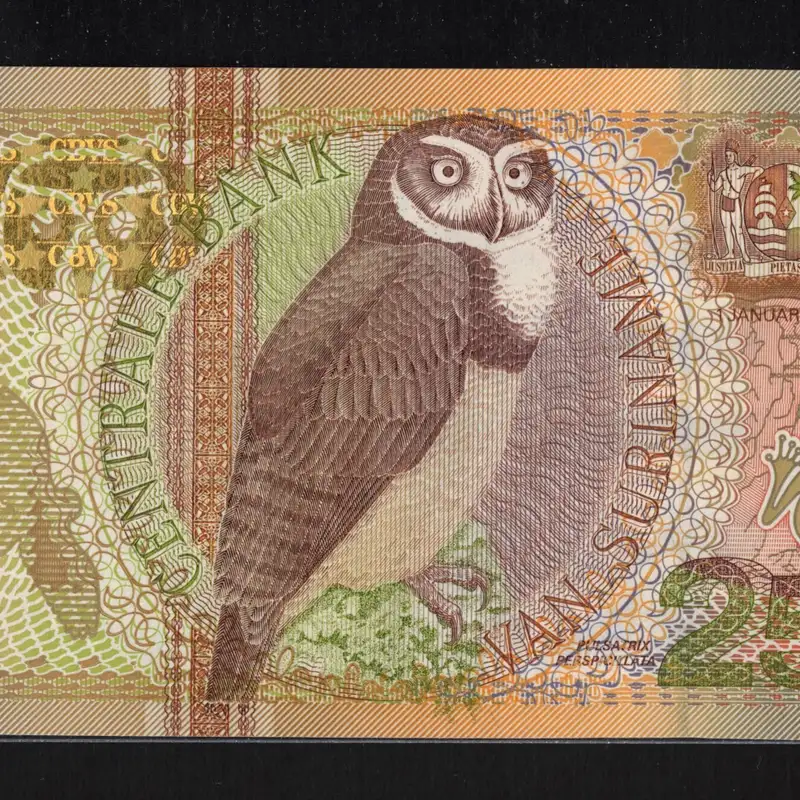
Tony Gryckiewicz:If anybody knows out there, we got a lot of viewers. We got viewers from all over the world, and I know some folks out there may be able to answer that question. So please leave it in the comments below if you know that. So moving on to this, this owl note, this is her Suriname. Suriname.
Eric Malek:This is one of the most popular of all modern notes collected worldwide from a small and how to say a country that is not on people's radar. You ask most people where a surname, they won't know what in the heck you're talking about.
Tony Gryckiewicz:I have no idea.
Eric Malek:And yet, this note is one of the most desirable of all modern issues.
Tony Gryckiewicz:Yeah. Worldwide. This is Dutch, right, down here?
Eric Malek:Yes. Suriname is a former Dutch colony on Mainland South America bordered by Guyana to the North and Brazil on the sides. Interesting. So, Tony, Suriname went through rapid inflation in the early 2000s. So the initial note, the smallest denomination note of this series is a five.
Eric Malek:So they initially printed five, ten, twenty five, fifty, one hundred. Then you see 501,000. Then you see 5,000, 10,000, and it peaks with this 25,000. I don't believe this note circulated for all too long. It had an approximate value of, I believe, 50 or €60 at the time, which was a pretty high value.
Eric Malek:In 2004, this series was suspended and an entirely new series of notes came out. So this note would have had a circulation period of maximum four years, only four years. Then they were withdrawn from circulation. They're enormously popular with collectors due to the high and slightly unusual denomination of the note, and people collect notes with birds, people collect highest denomination notes, people collect notes of exotic and obscure locations, and this note ticks all the boxes. It's everything.
Eric Malek:It's obscure. It's unusual. It's beautiful. It's high denomination. It's rare.
Eric Malek:It's all of these things. And a note that was worth 50 or €60, now this note is a thousand bucks in almost all instances. Which is surprising. Lowest denominations of this series are barely worth a dollar and the highest one's worth a thousand. It's just an oddity.
Eric Malek:It's an obscure thing. From I a country went to this country. I went there with my buddy Dennis of Stacks Bowers. God, we had a blast in Suriname. They still speak Dutch there.
Eric Malek:They have their own language. It's a melting pot of all sorts of people, of indigenous people. They have Indonesian people. They have Indian people. They have the descendants of slaves.
Eric Malek:They have some European people in this small country on Mainland South America that is probably unlike all the other countries on the continent with the exception of French Guiana and Guyana. Those those three, surnamed Guyana and French Guiana are especially unique in the world. Here's a popular note from that region.
Tony Gryckiewicz:Great. Great. Alright. So then moving on to something like this and we just scanned these earlier, so that's a little askew, but basically we've got like a six note set here from $1 or £1 or $1 I guess, up to a $100. And these are Bermuda notes again.
Eric Malek:Why why I asked you to scan these notes in Tony is because I I guess this is something similar to how proof coins would be. So when banknotes are printed, the printer would also print these specimens, which in some instances they could be used for promotion, in other instances they could be used as samples, in other instances they could be used as archive material. These are not notes to be spent, but rather printed by the printer for internal use by banks, internal use by the printer itself, or in some cases they were made for sale to collectors. You can see that these notes were overprinted specimen on both sides. They have printer ovals in the corner.
Eric Malek:They have specimen serial numbers in the bottom left margin. They're hole punched canceled on top of the signatures and the serial numbers are all zeros. So this would indicate if you went to spend this, that this note couldn't be spent. But this set of notes would have, or could have been framed in a bank somewhere as a representation of the current series, so that people who were dispensing cash could see the security features of the notes, see the colors. In case a potential forgery came in, you can compare it to something.
Eric Malek:Or these were used by inter or saved for posterity by the government of Bermuda or by the banknote printer itself. There was a couple different reasons why specimens were created and dispensed, but they're a popular, I guess, they go along with issued notes and people who collect issued notes in many cases also collect these, a set like this.
Tony Gryckiewicz:Yeah. Yeah. In terms of the comparison with proof coins, I mean, proof coins are they're manufactured in a particular way to be delivered to collectors to be a kind of perfect example of the type that particular coin. And they can also be spent. At the same time, they can be spent.
Tony Gryckiewicz:These, on the other hand, cannot be spent. These are produced for the sake of exemplifying what is the issue going to look like, and like you said, it can be used by a bank or something of that nature, but that'd be kind of the difference there.
Eric Malek:But this is something that I didn't know if there was an exact comparison with coins, but it is a worthy component or piece of the pie in the field of world paper. I thought it was worth mentioning for that Yeah.
Tony Gryckiewicz:I'm sorry.
Eric Malek:There are most banknote printers printed specimens and there are some countries where the specimens are notoriously rare or especially collectible. That's Eastern Europe for sure. There's some there's another little reason why people like specimens. In some cases, let's just pick that orange 100 for example.
Tony Gryckiewicz:Yep.
Eric Malek:That note is pretty darn rare in issued form. And in some cases, not necessarily here, but in some cases, the issued notes, so few of them are known to exist that the only way that someone could obtain the design is a specimen like this. So sometimes a specimen would be a placeholder in somebody's collection until they could either afford or they could find an issued note of the type.
Tony Gryckiewicz:Yeah. Makes sense. That makes sense. Cool. Yeah.
Tony Gryckiewicz:I mean, in coins there is a specimen strikes, you'll see SP 69 or SP 70 sometimes. And I gotta I gotta get a definition to throw up on the screen about that one because I've been confused too about why some coins do get that SP grade or designation on holders. What specifically is happening with a specimen strike versus a proof? But anyways, digress, we can move on here to our-
Eric Malek:Well, as far as that's concerned with coins, there's two mints that I know for sure. Kings Norton in The UK and Paris minted loads of either specimen strikes or trials that are pretty I mean, they're known throughout the industry. I don't know exactly how rare or common these are, but I know for sure that those two coin mints definitely produced SPs or essays.
Tony Gryckiewicz:Gotcha. All right. And so if I don't to round things out, we got a note from China. Yeah, that was my best trumpet impression right there.
Eric Malek:Anyways, it needs little bit of work, but I knew what you were doing. I used to say China. Tony, good thing you put a Chinese note on there. Yes. Chinese notes can be found worldwide.
Eric Malek:There's I'm being a little hyperbolic or I'm exaggerating a bit, but there's billions of different Chinese notes. Chinese notes are a part of this business that requires you to be detail oriented, to be patient, to be willing to do some research. A lot of Chinese notes will have English or a Western language on the back. Not all of them do. There's a lot of catalogs that help assist people with Chinese notes.
Eric Malek:There are Chinese notes that look exceptional, that you would think would be valuable, that are worth nothing. There are Chinese notes that look so ordinary, you wouldn't even pick it up if you were to step on it, that are worth a fortune. Chinese notes are an exciting field, a popular field, and if you are able to understand it and navigate the field of Chinese notes, you can be very successful in this business. You can pick up some gems as a collector, or you can be savvy as a trader dealer. If you're able to figure out which Chinese notes are the ones that are especially in demand or are very rare or the grade is quite unusual.
Eric Malek:This note here is a rare note in uncirculated grade. The quality of this one is fresh from the pack, brand new, and it's surprisingly rare. As such, oddly enough, this issuer, the Central Bank of China, is the most commonly seen and not least desirable, but the Central Bank of Chinese notes are probably the most common of all Chinese notes. This note here is from a local printer in China that actually did a darn good job. It's a high quality printing for a local Chinese printer in 1936, but for whatever the case might be, uncirculated notes of these are relatively rare and they command a significant premium overused notes of this type.
Eric Malek:This one on the screen looks awesome. It is awesome. And it is quite valuable as such. I hate using as such, but it was a way to end that sentence.
Tony Gryckiewicz:Sure.
Eric Malek:Darn good looking note though, isn't it?
Tony Gryckiewicz:Is a very good looking note. Yeah. Yeah. I love the I love this color on the reverse. I think it's very royal, very, very nice, great contrast here with the signatures.
Eric Malek:You're right. All the details are sharp, exacting. It's super good looking. It's a super good looking note, especially in this grade.
Tony Gryckiewicz:What is this company right here that produced this note?
Eric Malek:I don't know specific details about that printer other than it's a local printer in China. This is not the only note that they printed. They operated for, I believe only a few years. I could be wrong, but something in the range of about five years, you'll see notes with this printer. Maybe up to fifteen years.
Eric Malek:Let's just say between five and fifteen years to cover my basis for those who might know more about this than I do.
Tony Gryckiewicz:Yeah. Yeah. I will second that that that there's a lot of value in some Chinese, both coins and currency. Mhmm. Some of the minute details are on some coins can make them exceptionally valuable.
Tony Gryckiewicz:And people that know that stuff and identify those things, they can do very well either collecting or dealing in Chinese coins and I guess also currency, but it takes, like you said, a lot of patience and willingness to research and willingness to be mentored about what it is to look for. I recently learned about how important the number eight is. Number eight in Chinese or in China is a symbol of wealth. So, they look for the number eight, I believe on things like serial numbers and stuff.
Eric Malek:Tony, you're right. Thanks. No, you're right.
Tony Gryckiewicz:Yeah. Yeah. Yeah. Yeah. Yeah.
Tony Gryckiewicz:So, alright, man. So, just to kind of, you know, final words of wisdom out there, if people want to know how to get into currency, first off, I mean, what would be the major show for them to go out to? If they want to go out to a physical show, they want to get a huge selection of world currency to kind of choose from or whatever. What are the premier events of the year for world currency?
Eric Malek:Okay. So what I can say is the two best shows in The US, which will have the most dealers buying, selling, trading world paper would be the fun show in Orlando, which is in January and July, and the summer ANA, which rotates cities each year. Those will have the most dealers within The United States to sell world paper and the most people who will come from overseas to do the same. That's where in person you probably have your best shot of seeing the most paper. Now, not at a show.
Eric Malek:The place that I would recommend that people check for world paper is Heritage Auctions Tuesday Weekly World Paper Sale. They generally have between one hundred and one hundred and fifty notes. It's every Tuesday night at 8PM, and it has the best selection of world paper notes that you'll see weekly that all start at $1 A $50 note will start at $1 A $1,000 note will start at $1 Anybody can at least participate in that auction that happens every single week. And the notes in that auction will be worldwide, all sorts of notes. It's a remarkable product that they churn out each week that appeals to beginners, intermediaries, and the most advanced people.
Eric Malek:I buy notes in there every week.
Tony Gryckiewicz:I do want to ask you about that. That's a great little tidbit there, I'm going to start looking at myself. What shows that happen overseas? Because a lot of viewers of this podcast are in other countries. Okay.
Tony Gryckiewicz:So outside of The United States, what would be the premier shows for World Paper if people wanted to build their collections?
Eric Malek:Sure. There is a dedicated world paper money show in The Netherlands. It happens twice per year. It's in the spring and the fall. It is The show name is MIF, MIF Events, and they do a terrific job.
Eric Malek:They have hundreds of dealers from 75 countries at least, and you could find anything and everything at the show. It's almost a week long. It's Tuesday to Sunday, and it's in the fall. It's in the spring and the fall. That is the premier banknote show worldwide.
Eric Malek:If you're in other regions, there are smaller dedicated paper money shows in The UK, and there's large global shows in Germany, in Italy, Hong Kong, Singapore, and The US that have the widest variety of paper notes. Most paper notes accompany coin shows, so you would need the largest coin shows to attract the people who also want paper. However, you can find something anywhere at any time. Local shows have produced some really spectacular paper notes over the years. You never know where and when you're going to find
Tony Gryckiewicz:You just reminded Yeah. Yeah. So this show, I'm not exactly sure if this is coming out before. I think it's going be after the fun show. I'm sorry.
Tony Gryckiewicz:It's not it's going be before the fun show. I come to my table at the fun show to find some world paper, but I was just going to say that, you know, we're doing shows this summer down in Dalton, Georgia. I'm going to have a corner table and we'll have men around collectibles there. And she has a bunch of great world paper to offer. I think World's Fair Money as well.
Tony Gryckiewicz:I can't remember my table number off the top of my head, we're going have World Paper Money there. And so there are some local shows or some other domestic shows that, you know, you have World Paper. You just come see me and I'll hook you up with a good selection to look through.
Eric Malek:Nobody's better or more friendly than Tony here.
Tony Gryckiewicz:And MenRong too, you know.
Eric Malek:And MenRong too, yes. Well said, well said, John.
Tony Gryckiewicz:Alright, man. Thank you so much. This has been a pleasure. And oh, last very last thing. If anybody out there wants to get ahold of you, has questions for you, wants to purchase one of the coin the the the currency notes that we've seen here or something like that wants to contact you.
Tony Gryckiewicz:What's the best way to do that?
Eric Malek:God, Tony, I'm an uncontactable person. The notes I showed you, some of them aren't mine, the ones that I did show you that are mine are mine. I had no intentions to part with any of those. Tony, I'm gonna sound like a real cretin here, but I don't know how how should people I'm not real good at the social medias or the or the texts. How would people get in touch with me?
Eric Malek:The heck kind of question.
Tony Gryckiewicz:How about I send you an email?
Eric Malek:There you go. What do want me to do? You want me to write it? I'll put it on the screen here.
Tony Gryckiewicz:No. No. No. I can I can superimpose it on the screen? Just just
Eric Malek:Oh, wow. MLB104635@Gmail.com. What do you listen at? Always pleasure. Go with this AI.
Tony Gryckiewicz:There's no AI involved whatsoever. There's no AI. It's an email, bro.
Eric Malek:So You know what, though? Actually, people now, you can use AI to help determine some of these notes. Let's say you find a Chinese note that has no English on it. There are things on your telephone now where you could take a picture of that thing and it'll tell you, it'll translate the Chinese characters on there for you. There are tech ways now, if you're techie, that can really help you identify or evaluate world paper money in ways that weren't possible even five, ten years ago.
Eric Malek:That's a fact.
Tony Gryckiewicz:I think there's a number of coin apps that do that. Unfortunately, I don't know what the right way of saying it, but for a very good aspect of those coin apps, they at the same time create a lot of problems for a lot of people because they overvalue a lot of coins frankly. And they, you know, they're kind of crazy on the coin side and we end up getting phone calls, people that think they have error stuff that is worth money when these things are worth basically the face value of the coins a lot of the times. On the world currency side, I don't know if anything exists yet. It might be a great opportunity for somebody to design an app that because what you're describing makes a lot of sense.
Tony Gryckiewicz:You take a quick picture of a world banknote, run it through there and you can find out if you have any special serial numbers. If you find out if you have something that has a particular, the rare, you know, variety or something of that nature, as well as tell you what's on the note. If it's in another language like Chinese, tell you exactly what the note is. So, great opportunity for somebody out there.
Eric Malek:I've been with somebody and I have a good note in my hand and I'm like, Oh my gosh, I don't know what it is. They say, Here, give me And they take a picture of it and they translate whatever I can't see, or it at least gives you a starting point to then know, ah, this is a $19.23, 1,000 pesos such, such. I can now look this up. Seen people do it and I'm sitting there amazed as I still use a pen and paper for literally everything.
Tony Gryckiewicz:Makes sense. Cool, man. Alright, buddy. So thanks for doing this again and You got it. We'll we'll we'll see you soon.
Tony Gryckiewicz:Appreciate this, man. Thanks a lot.
Eric Malek:Take care, guys. See you later. See you. Bye now.