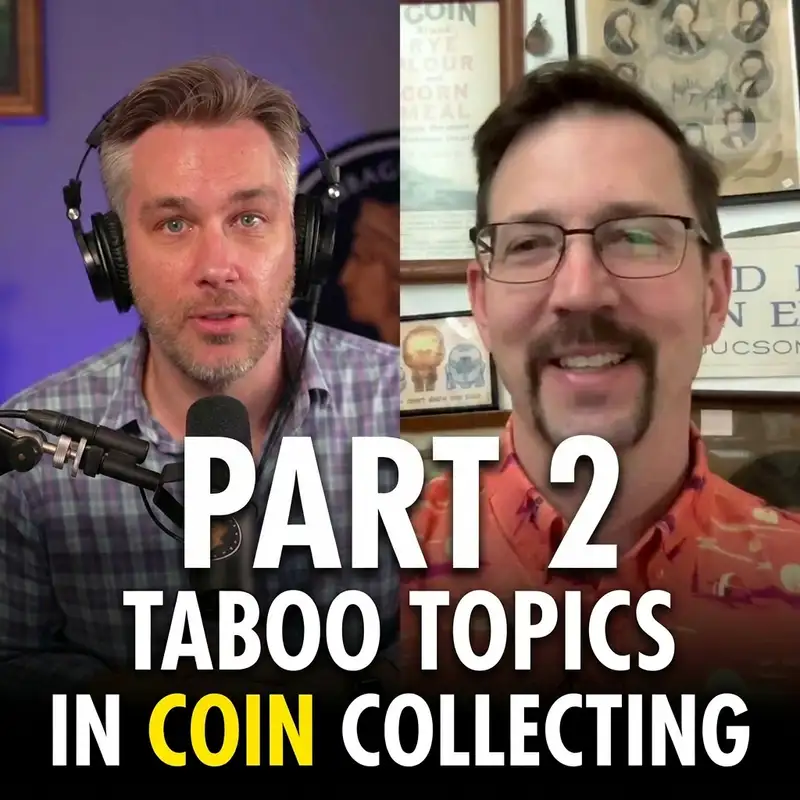
Ep.49 - Taboo Topics of Coin Collecting! (Part 2) with Ben TheCoinGeek #gold #silver #numismatics
Hey, folks. Welcome back to the Cabbage Coins Podcast. My guest today is none other than the infamous Ben the CoinGeek of Ben the CoinGeek fame. He runs a little shop called Old Pueblo Coin Exchange down in Tucson, Arizona. I think he's very instrumental in leading up a Tucson coin show that happens in January.
Tony Gryckiewicz:I'm hoping to do it this coming year. Today's topic is the taboo topics of coin collecting, coin dealing, numismatics, like what are those topics that everybody thinks about or wonders about but nobody wants to discuss or things that we maybe should or should not be discussing here in YouTube world. We're going to tackle these. All right, so greatflation, what might be the incentives behind it? What is greatflation?
Tony Gryckiewicz:Do you wanna take a stab at that?
Ben TheCoinGeek:Well, greatflation is the concept that the grading standards have loosened over time, and so coins that were previously graded 63 now would be graded 64, and coins that were graded 64 now today might grade 65. There's a lot of theories behind some of the incentives, and the incentives could be that, well, grading companies loosen their standards, because that way they'll have more coins to grade, going back to one of the very first things we talked about with the crack outs. I get a bunch of old holders, and a lot of the coins were graded 63, and now I think I can get them into 64 holders, well then, that is an incentive for the consumer to say, hey, I want the higher number, but it's also an incentive from the grading company to say, hey, we go ahead and crack some coins out and send them back into us. Why not? You know, you can, you know, go ahead and destroy that thing that we did for you, we'll do it again, you know.
Ben TheCoinGeek:So, there's a lot more behind it, I think, than that, but that's that's the concept.
Tony Gryckiewicz:Yeah. Yeah. I just think it's pretty obvious and pretty common sense. I do think that there is a particular incentive to create a level of inconsistency in grading, because if it's inconsistent, then that means one time this could grade a 62, another time it can grade a 64. And because of that, there's an actual real reason to crack out and resubmit and so forth.
Tony Gryckiewicz:If you have a very consistent surface that if they know that they never get a, you know, it comes back to 62, it's gonna come back to 62 the next four or five times. The consumers or the people out there making submissions are are less likely to keep throwing the money at the machine, so to speak, try to get that higher grade. If there's the consistency, there's less of the incentive there or for on the submitter side. If there's a lack of consistency, there's more of an incentive on the submitter side to keep trying and so forth. So that's got to be a factor.
Tony Gryckiewicz:Also, I mean, look, there's gotta be some reason why we went from putting things into details graded more holders to expanding the lines of what's acceptable for cleaning, so to speak. And at some point they, you know, maybe a grading service will look at that and say, okay, well look, if we don't call everything clean, then we call some of the light cleanings market acceptable, we're gonna get more submissions. More people are gonna submit our way.
Ben TheCoinGeek:Well, and I think the cleaning point, I think that actually gets you back to the telemarketing point, which is to say, there's there's an entire group of holders, both PCGS and NGC, especially, like, $10 Liberties, 10 Indians, maybe some twenties, that I will see pop in the store from time to time we used to see more often. And across the board, these coins will be graded m s 62, and there's, like, thousands of them. Thousands of them. And occasionally, they come in, and I you can almost recognize them as a coin dealer because if if you've seen enough of them, and you're like, oh, and half of those things look like they were run over by a cement truck. Like, they're just some of the ugliest coins I've ever seen, and so this is the opposite of gradeflation probably, but but but the concept of those coins were all graded twenty plus years ago.
Ben TheCoinGeek:Today, they would actually probably grade lower, but to your point about incentives, somebody had hundreds or thousands of those, sent them in, and on some level said, hey, can we get like just all MS 60 twos out of this thing? And the grading companies were like, yeah, you know, they probably rejected some of them, but still, yeah, there's definitely I just went the opposite way, because that's not grade creep. Something you said sent me on a tangent, I apologize.
Tony Gryckiewicz:Well, there's a clear, I think, incentive to try to be a little looser a little bit in terms of what you allow into a straight graded holder, because again, if dealers or submitters are are they send things to a particular service and they know they're gonna get details grades or they're not gonna straight grade, those coins are gonna be difficult to sell. And then this other service is also equally reputable, somewhat reputable. They put them into straight graded holders. There is gonna be a a clear, you know, desire for those other straight graded holders. So there is an incentive on the grading side to be a little bit looser, I think, in the standards, which unfortunately, I think is where some of the services have gone.
Tony Gryckiewicz:That's one of the reasons why I love CACs because they have a standard. They are very committed to the grading standard and keeping it very strict. So they're keeping integrity to the grading system, so to speak. And because of that, their coins are highly desirable, especially in today's market, people are going nuts for them. So these I could not make these questions more perfect in terms of how this randomly put it together, but Yeah,
Ben TheCoinGeek:why do we deride other grading services and then sometimes use them? There it is.
Tony Gryckiewicz:Yeah. So, yeah, I mean, I don't wanna call out specifically, but just think non PC, non NGC, non CAC, some of the other smaller grading services kind of don't really like the coins, then we still use them.
Ben TheCoinGeek:I think the legitimate answer here, there's a couple different things, right? So, when people bring coin collections in, like, and so I may be formatted a little bit different than you, because you mostly work at shows, and so if someone brings a coin to you, and it's in an ICG holder, you may just say, yeah, no thanks. You know? Or you may look at it and say, okay, this coin is, it's a decent coin, but it's overgraded, but I will offer based on what I think it is, Right? That's a real scenario that could happen with those type of coins.
Ben TheCoinGeek:I think that there's a couple things going on specifically in this current market. I still think that generally speaking, PCGS and CACG are kinda like the main two. NGC for me lately has been third place because they've been inconsistent with their service quality. Like, for me, I've always been a service quality guy, and so NGC used to be the only company I used, but they're still generally accepted in the marketplace. Then you get to Annex, and I think a lot of people use Annex for good reason, and I think Annex is a very good grading company.
Ben TheCoinGeek:I think most of the coins that we send into Annex when we do use it or when our customers use Annex are happy with the grades. I think they're accurate. I don't think they overgrade stuff. You know, but generally, they're used, to me, in a price point that's gonna be something where you're not doing a registry set comparative coin. Right?
Ben TheCoinGeek:So you're not maxing you're not going for min state 65 on a rare coin. You're not buying thousand and thousand dollar coins. Annex, they're grading coins for, like, $10 a coin, $12 a coin, so that it's a it's a good economical system that people can use, and generally speaking, if you have coins that are only valued at $75 or a $100, Great service to use. You're gonna get them in the holders. There's a market for that.
Ben TheCoinGeek:There is. It's it's just it's a different marketplace than the guy that wants, you know, an eighteen ninety three s Morgan and XF because an eighteen ninety three Morgan and an XF and an annex holder, it becomes a tricky coin for the entire, for a dealer to handle, for a collector to handle, and that's this very specific coin that I've owned. I'm like, because the guy who's willing to spend the money on that coin wants it in a PCGS holder, or wants it in NGC holder, or wants it CAC. Outside of Annex, ICG and SEGs, and what I don't even know if SEGs is still around. There's so much inconsistency.
Ben TheCoinGeek:That stuff is being pumped out. Dealers people use those companies because they're gonna sell their coins on eBay, on whatnot, on. To me, it's become kind of this other world of slabs and certification that is not consistent, but the guy who wants to use it, they're probably not selling the same products that you or I are usually selling. But I'll sell those products if they come in the store, because in the store, people bring all kinds of stuff, and we kinda buy it all, but also we try to sell it at a reasonable rate. You know, we're not trying to get rare grade pricing on a segs coin or, you know, or an ICG coin.
Tony Gryckiewicz:Makes sense. Interesting. Do you judge people by their appearance when pricing a coin? I will I'll tackle this one a little bit, get started. I a 100% do not.
Tony Gryckiewicz:I mean, all of my pricing is determined independent of who I'm selling it to because I put the coins onto my website for a particular price. Do a lot of time, do spend a lot of time in research on where the market is on the particular coin. I do stretch sometimes from some coins that I feel like are special. They they're, let's just say they're a stickered barber quarter that just have not seen many other examples in the market. I think the price guides might be a little bit outdated or behind the times in terms of where those things should price at.
Tony Gryckiewicz:I spent a lot of time pricing the coins before I ever arrived to a show. So there's no scenario where I am looking at or judging someone in terms of their appearance or whether I think they're an astute collector or not, or they're either a dealer or not in terms of what the price is gonna be on the coin. I will say that I try to work with almost everyone that I can and I especially, you know, you develop, I would say an approach with certain dealers, other dealers you've done a lot of business with, and I try to get them a price I know they can make some money on the coin because that's the reason that they're purchasing. I realize who my market is in this moment. This person is probably going to buy four or five coins from me today in front of my table.
Tony Gryckiewicz:I try to price it so that they can do something with the coin. Yeah. I forgo the opportunity to to to retail it and hold onto it for a long period of time to to sell it individually to a collector. So I don't know. I mean, you have a you have a thought on this one?
Ben TheCoinGeek:Yeah, so this one's interesting because, you know, you're answering based on how you do things, and probably how most guys that I will deal with do things, you know, so lots of times when I speak about the coin market or coin dealers or stuff, lots of times it's a bias of I'm talking about people, like my experience, I, have I seen this done? Oh yeah. So dealers who don't have things pre priced for you, you know, I mean, either they just didn't get to it, obviously, but, like, generally speaking, are there people within the industry, if you go to a show, who will price stuff based on whether or not they think you can afford it or they think, you know, you can pay a little bit extra for it. It happens, but I would say, generally, not that often. Like, if you go to a Coin show, you're gonna see most guys already have stuff priced up.
Ben TheCoinGeek:They're not really judging you based on that. I I think the opposite is true, though. When you go to a Coin Show, there are a lot more dealers that will judge you based on you know, if they wanna buy from you, that is, I think, a much more typical situation where a dealer will say, we'll we'll judge the person, size them up, and be like, okay, what can I buy this coin for? What I will say to that is, if you're going to a coin show to sell stuff, as long as you have a a fair, honest idea of what retail is, and you're willing to get two or three bids on something, and even if even even if you don't know what the numbers are, if you have decent certified coins, and you're willing to go ahead and go to three or four dealers and just say, what will you pay me for these coins? It it's it's a thing that you can actually get a good idea if, you know, bids are 202 and a quarter, and then all of a sudden, someone's like, a $100.
Ben TheCoinGeek:You're like, okay, well, that guy was kind of like, just low balling you, you know, but the other two guys were kind of in the same ballpark, so good question though.
Tony Gryckiewicz:Is grade protection real?
Ben TheCoinGeek:I I think so. That one's interesting, because it kinda ties into the concept previously about, you know, certain people getting certain grades, but are there certain coins that get protected? So grade protection is the concept of, okay, there's only five of these in this grade, and even if we see another coin that looks like it's nice enough to grade this grade and change the population from five to six, we're gonna choose to kinda keep calling that one one grade down, so it doesn't change the population. I think there's truth in this. I think that it's not as true for coins that people don't care about, so to speak, so like because I've seen lots of guys get a top pop coin on a coin that's, like, you or I maybe not look at that closely.
Ben TheCoinGeek:You know, 19 forties penny or something that is surprisingly pot top pops and 7 or something. You're like, oh, I want to know. But on coins where, you know, you wanna talk about, like, especially on Better Date Morgan dollars, you know, where it's really hard to get, like, a $92.00 or a 92 s in a certain grade, you know, in certain grades of Mid State, I do think that generally speaking, the graders are more critical on some level, but also the natural reason for that, there's a reason that it's like, oh, they're doing they, or doing that to us, but the natural reason for that is, when a coin comes in, and it goes in value from $5,000 to $90,000 if you or I were sitting in that seat like the hot seat, boy, you know we're gonna become a lot more conservative. So there's the great protection, is it real? And then there's the why, and I think that it is, but the why might be a little bit more of a natural reason than like, oh, we're actually just protecting some investor here versus I'd I'd be kinda scared if I'm a grader to look at a coin and be like, oh, I happen to know that this coin has a huge jump in value, you know, tenfold, a hundredfold.
Ben TheCoinGeek:Like, what am I gonna do with the coin? Unfortunately, I I I would much rather be super, super, you know, people not worry about that type of price point stuff. I almost wish that people didn't know what the price on coins were or they wouldn't know what a rare coin is because I think that would happen a lot less frequently then.
Tony Gryckiewicz:I wish the dealers deserve to make on a coin when reselling. I will tackle this one and say that it's a tough I don't It's not really that tough tough a topic at all. I've described this to before to clients' mind and that is that when I buy a coin oftentimes, and there are so many coins out there, there are so many things you come across and you're seeing most, a lot of the times I take a real risk and chance when buying the coin, take a real chance, a risk that I'm going to be able to resell this coin, that there's a market for it, that there's somebody else who desires it at some level greater than that, which I've just paid for it. There's a possibility I buy, I just bought this coin. I just forked over my money and nobody's in the market's going to buy it whatsoever.
Tony Gryckiewicz:I'm going to send this coin for six months. I'm going to put it on eBay at an auction. I'm going to lose $400 which just recently did happen on five of my coins on eBay. I ran some auctions, I had them finished on Sunday night just like you're told that you know, just like you're supposed to and in total on these five coins, I lost $1,700 across these five coins. I own them for almost nine months before I decided to, that these were not going to sell from my website whatsoever.
Tony Gryckiewicz:So there's considerable risk that we take as dealers by trying to buy coins every month and try to find opportunities that you're going to collate from the universe of coins out there. You're going to collate this kind of selected subset that you offer on your site. You're going to say these are the Cabbage Coins for this month and you know, this is what I'm looking for for these coins. So when it goes to pricing, in my opinion, I take a risk, take a chance to buy a coin and then I do a lot of research and I figure out that I make up a good purchase, I not make a good purchase and where is the market really trading on this coin? Being the fact that it's fresh and new, what can I kind of ask for this?
Tony Gryckiewicz:I don't want to scare people away from this coin whatsoever, but what is reasonable? What is reasonable in today's marketplace? Also in the fact that like where we're at, like right now, coins seem to be going up in value and it's impossible for me to hold on to really high quality stuff, you know, see the dollar in with a CAC sticker. It's like, I just bought one, but it's going to disappear here very soon once it gets onto the website, I guarantee it. So all of that, all of that in mind, I do not in any way markup by a particular percentage.
Tony Gryckiewicz:I look at what it is at the market where things should sell for this particular coin. And then, you know, I offer discounts off of that. That's how I approach it. I don't think there are coins that I've made a couple 100% on because I bought them right, I got them regraded or something. I got I took advantage of a, you know, large upgrade on the coin and so forth.
Tony Gryckiewicz:I mean, these things happen. Every dealer has these stories in the
Ben TheCoinGeek:course of a year. Yeah. I mean, what's fascinating about this question is that people the psychology here is that people want you know, they consider coin dealers and coin collectors to be different types of humans when they're all the same type of human. Right? So in generally speaking, it's there's things called jealousy and envy that happen with people.
Ben TheCoinGeek:People have a very hard time being happy for someone else when they get a good deal, hit a home run on a coin that certifies for a point higher than they thought it was going to, like we're talking about previously. You know, so I consider the first tactical comment about this is depending on the amount of labor involved, right, so once again, you're very specifically speaking about, hey, I'm trying to curate, you know, thousand to 5,000 to $10,000 type coins, that my margin sometimes might be, you know, three, four, 10%, somewhere in there, but also, I'm taking chances on some coins, and I lose money on them, I'm ready to do the same, I just have some stuff going to auction that I just know it's getting in the wrong auction, and it's not gonna turn out well for me, But but the labor point is what I try to like, for having a coin shop is very different when people are bringing in large quantities of big bulk stuff, and it's like, you're I'm not I'm not giving you a percentage of value based on, like, some type of, well, I'm just greedy kind of thing.
Ben TheCoinGeek:It's like, no, is all labor. You're giving me all of the work to do. Like, if you wanna take all of your proof sets and sell them one at a time on eBay for the next decade, go ahead. Let's just talk about the amount of labor that's involved with this. And so the actual percentage scale from a dealer's perspective has a lot to do with how much labor's involved in the overall work.
Ben TheCoinGeek:And and then the perspective of the consumer for this question is also, I I get consumers that go to shows, understand a little bit about how you're doing stuff, Tony, and a lot of the guys, they say, like, how do these guys stay in business? Because it's not that it's not as easy as it looks on some of that type of stuff when you look at some of the margins. Now, upward margin's great. Like, I'm happy for the guy when I talk about making money. One of my favorite stories is, I had a customer bring a coin to me that I could have bought for like, $2,500, and I went ahead and I told him, this I think is an auction coin, you know, and I said, I'll I'll, you know, I'll work off a 10% on this coin, and I'll send it to auction for you, and the coin sells for upwards of $25,000.
Ben TheCoinGeek:So I made him like $20 on this deal. Now also, I'm gonna make a couple grand on the coin that honestly, if I had bought it, I would have put it in auction anyways. I could have made all that money, and he came back to me and was like, hey, he wanted to renegotiate me to a lower percentage, and I was like, I'm like, listen, I just made you $20,000, and you want more money? Well, that's just, you know, I think, I don't know if the word is greed, or what whatever the word is there, but like, there's so much human psychology that goes into how people perceive these things, but there's, once again, I'll keep going back to the Greg Allen interview, because he lays it out, there's different types of dealers, they do different things, they do it in a different They have different labor costs, you know, am I getting everything certified? Do I never certify a coin?
Ben TheCoinGeek:Do I only buy $5,000 coins? Do I buy bulk wheat pennies? That's all in the ecosystem somewhere. Yep. Yep.
Ben TheCoinGeek:Should a dealer disclose that
Tony Gryckiewicz:the coin has been sent to CAC already? In my in my opinion, it's not a requirement in any way. I I I don't think there's any sales handbook. Mean, at at the end of the day, like, we are running a business where you are selling coins online, you're selling coins at a show, you need to become studied in the art of sales. There is no sales handbook that says, step one is to try to, you know, shoot yourself in the foot by telling people why they shouldn't buy something.
Tony Gryckiewicz:That just doesn't help you at all. That being said, everybody, somebody asks me that question directly, I give them the honest answer. Yes, I did send this. No, I did not send this, whatever. I am getting a lot more selective in what I do send where I'm really only sending things that I think have a really very, very strong shot.
Tony Gryckiewicz:I used to send kind of everything before. I spent a lot of money in submission fees that way, but nowadays, I mean, I'll be honest, I say like, I actually am thinking about this cap plus half dollar I'm thinking about sending. I haven't decided whether or not I'm going to or not And I'm on the fence about it. What I would tell people if I sent it and it doesn't stick out, tell them, look, I sent it. I think the coin is gorgeous.
Tony Gryckiewicz:I think on the right day, this coin should sticker. And it just did not. I'll be honest with you about that. I'll or our I sent this coin. Saw this particular issue here.
Tony Gryckiewicz:I was pretty sure they weren't going to sticker it and you know what? They didn't sticker it, but you know, it's up, you know, I still think it's a phenomenal coin or I'll just say like, look, I didn't send it because I see this particular area of some marks right here. I just, my gut tells me that maybe not going to sticker, but it's up to you, you know, go ahead and take the chance if you want to, you know, you want to send it in. So I don't think there's any requirement for somebody to disclose where they caught a coin from or what they've done, know, what they, where they've tried to market it already or you know, who they've submitted it to you for, for sticking or not. That's just my opinion.
Tony Gryckiewicz:There's no reason you have to say that.
Ben TheCoinGeek:Yeah. Well, there's a lot of consumers that want CAC to make a list of things that they've rejected, and I'd say a couple things from my perspective. If someone asks me if a coin has gone to CAC or not, and didn't sticker, and I know the answer, I will tell them the answer. Secondly, of course, I know, like, you and I and, like, Noah and Rarity seven, they'll make videos just showing, like, oh, this didn't sticker, and so people know already. Thirdly, if someone asks me if a coin is stickered that's in my inventory, I mean, if we've sent it off, I don't know.
Ben TheCoinGeek:Like, I don't ever remember. Right? Like, I shouldn't say I never remember. And lastly, I think to your comment about certain coins, this also I think, you know, your interview with John Albany was very good because there are coins that I don't care if it's stickered or not. It the market does, but, like, is you as a consumer or a collector or dealer sees a coin that is stunning, I don't care that it's been rejected.
Ben TheCoinGeek:If it's stunning, it's stunning. And he may not like it for a certain reason. There are I do get stickered coins in once in a while that I look at and I go, wow, I I'm surprised, but generally I like the coins, I mean honestly, but that's an interesting good topic, yeah.
Tony Gryckiewicz:Why do we say don't clean your coins and then we have a grading service do it for a fee? My opinion, this is obvious, which is that most of the time you're gonna screw it up. You really I'm gonna screw it up. I mean, I I recently had a coin that I was on the fence about having conserved and I mean, I'm this I've been doing this professionally full time for a year. I handle a ton of coins.
Tony Gryckiewicz:I've recently gotten more comfortable with cracking coins out myself and and using some acetone to remove some gunk that might be on the surface of coin. I've recently gotten more comfortable with that. If there's a copper coin that needs some kind of something to remove some fuzziness that's on the surface, some haze or whatever, I don't feel comfortable and confident doing that. So I'm either gonna pay another dealer who does feel confident or I'm gonna send it to the grading service who does it for a higher fee, but it's definitely professionally done. So that's my answer to this question.
Ben TheCoinGeek:Yeah, I know, I think that's spot on. I don't know that I have anything to add to that. It's, It is you tell people not to clean coins because they're gonna screw it up and and damage their coins, and I know guys that are long time collectors that do a real nice job conserving their own coins. Great. But when someone asks the question, the real answer is, let's not try that yet.
Ben TheCoinGeek:You know? That's and then, you know, in generally speaking, sometimes I will conserve coins myself. There's not a whole lot out there that's worth conserving and getting graded. I mean, not a lot comes in the store that I'm, like, gonna conserve it and get it graded based on the overall volume of what we see, and NGCP suggests their conservation, generally on certain things I know that I can't do that they can, so, kinda the same thing you said.
Tony Gryckiewicz:This is one of my favorite questions, which is, is anyone actually trading fractional bullying in the apocalypse? I just get on my soapbox here and I'll just say that I don't think this is a reality, but it's used as marketing fodder or marketing, whatever you want call it, BS I guess. A lot of the times, I mean, you have little gold bars that are broken off into little little pieces, so that's going to help you, you know, in case you're you're trying to buy your bread and and water or whatever in the apocalypse. No. I mean, if there's any scenario in which we have a breakdown of civilization, I mean, there are other things that are gonna be a lot more valuable that would be useful, know, ammunition or bullets or whatever, whatever that are in my opinion than will little tenth ounce pieces of silver or gold.
Tony Gryckiewicz:Those things, I mean, if we, you do have a civilization, a civilization that has stood back up, there is going to be a governing authority that would put their stamp of approval and issue an issue coinage anyway, if that's really where we get to in terms of what people will actually accept it in that scenario. So my point was that this is something that people talk a lot about, the crap hitting the fan and the reason to to stock silver. My personal feeling on this is that it's just hogwash. It's just a lot of marketing BS that is not realistic whatsoever. There's not a reason to stack constitutional silver.
Tony Gryckiewicz:What's your thoughts?
Ben TheCoinGeek:Well, going back to the concept of, you know, studying history and just kinda understanding history and maybe some economics, you know, first of all, you have to believe that there's an apocalypse. Second, you have to assume that the apocalypse has the four horsemen. The apocalypse has only one scenario in which that actually happens, right? Like, you know, all this very specific stuff. So you're tell me that there's an apocalypse and there's bread available.
Ben TheCoinGeek:Like, that's one. Two, if you wanna look at real emergency issues where people are without actual economics, like stat, you know, standard economics, You know, you look at, like, a hurricane Katrina or something where entire civilization's lives are disrupted in a real way for a period of time. Bread, food, water, potable water. You know, I would have rationed food, you know, that's in the MREs or whatever, you'd be good, you know, maybe a good generator and a lot of toilet paper, apparently. Those are the things that are hard to get, you know, but they're very different scenarios.
Ben TheCoinGeek:If you just wanna dream cast what the scenario is versus, like, an economy falling apart over a short period of time, or a rapid period of time, you know, look back anywhere from Roman history through stuff from the last 150, two hundred years of American history or European history, you'll see lots of things go on that suck because humans can suck. So having said that, bullying, for me, it's always something that's been a demarcation for inflation. More recently, I don't know how I feel about that, but traditionally, that's what I would have told people. You know? And it's just inflationary protection, which I'm cool with, but also, you're not gonna actually be trading it to the point of the actual question.
Ben TheCoinGeek:You're not actually gonna be trading it, in my opinion, for bread. But anyways, that's that's you we both had a soapbox, I guess. Yeah.
Tony Gryckiewicz:Oh, we I'm glad we tackled this one before the end of the year. Folks are still hanging around at this time stamp, but our Coin Podcast made to entertain, educate, or really just promote sales.
Ben TheCoinGeek:Sell, sell, sell. Hey, everybody. I think I've probably made some videos that are, like, very shticky, like, buy yeah. I think I've I'm sure I've made some videos where I'm just pretending to be a telemarketer. Okay.
Ben TheCoinGeek:You know, like, so our tagline has been, you know, history, you know, history education. It's what we try to do. You you end up you know, and honestly, if you're interested in educating and entertaining, which, by the way, I think good education is entertaining, I think a bad educator doesn't entertain because they don't they don't engage the mind at all. Education and entertainment kinda go together. And if you happen to have a business model after that, you can sell through that because of that.
Ben TheCoinGeek:You know, we entered this market because of COVID, and we had time, and I found great positive feedback. I realized that there was really a void in the numismatic area on YouTube. There was a whole lot of stuff up there, and it was garbage, and so we just got into it, and now today, we do a lot of business because of it. The problem is a lot of people try to put the cart before the horse, so to speak. You will see people that they wanna be on YouTube because they wanna be famous, or they wanna be on YouTube because they wanna make sales happen.
Ben TheCoinGeek:They want notoriety, and that just stinks. Like, you can smell that person. You can smell that Like, when you watch it, you're like, you're just here for you. You're you're that's it. And, you know, in general, people that are like that.
Ben TheCoinGeek:You you know the people in your life that are, you know, really wanna be around too much. The good thing is, on YouTube, you can kind of avoid them if you spend five minutes with a video, and you're like, yeah, this guy's just blowing smoke. Hopefully, you learn to avoid them, so.
Tony Gryckiewicz:Yeah. I mean, I'll talk about the genesis of my podcast. I was searching in the middle of twenty twenty five or beginning of twenty twenty five. I was looking for an avenue to deliver something of value to viewers, clients, prospective clients, prospective customers to my website out there. And I was inspired by the story of the Michelin Guide where they I don't know how factual the story is about
Ben TheCoinGeek:Michelin Michelin Tires. Yeah. So Michelin tires, so the Michelin stars that you'll see at restaurants are actually literally related to the Michelin tire company, and Michelin would go, they would publish a list of places to travel, because they knew that there was a tie in between their tires and tire companies, and so they created roadmaps, and on these roadmaps, they had a star system for restaurants to go to, and the star system was designed to say, okay, it's worth driving the extra half an hour to this place. It's worth driving two hours here. It's worth driving three, like, that was the genesis of the Michelin STAR system.
Ben TheCoinGeek:History in your hands. Go ahead, sorry.
Tony Gryckiewicz:Yeah, well that was inspiring to me as the way it was framed when I was learning, when I read about that was that this was something of value that this Michelin company developed to provide to people that were buying their tires. And I said, all right, well, I'm going to deliver some kind of a podcast, think. I'm going try to get on YouTube and make some educational videos. If you go way back in the history of my channel, mean, there are other educational videos I attempted to make that some were interesting and got some views and others completely flopped and eventually I landed on this format of something I always wanted to do. Now in the process of that, I would say that this business has really kind of grown and blown up.
Tony Gryckiewicz:I want to say a large part of that is that folks are getting familiar with me and the company through watching this podcast. So it goes hand in hand. I think you completely nailed it in the sense that there are folks who do get onto YouTube because they do want to sell and then they're thinking about how to make a video that ultimately leads to customers. I think you can sniff that out, but so my thoughts, but Alright. So wow, we are we're a little ahead in time, but this is very interesting stuff and we'll try to keep this one fairly brief if we can.
Tony Gryckiewicz:The US presidents dead or alive belong in our coinage?
Ben TheCoinGeek:Well, you know, I wanna be very demonstrative here, just say, no, not ever, never, dead or alive, I don't want them. It's the opposite of the Jon Bon Jovi song. So I guess I know that historically we've had presidents on coins. This is something that I think the genesis of is, you know, gonna be really honestly, what is this, less than a 150 years old? You know, everything that's gonna be post civil war, when we really started getting presidents, you know let me see.
Ben TheCoinGeek:Is that Lincoln first in o nine? Is that how that works? And then after that, we had lots of other people hopping on. Right? It's a funny question.
Ben TheCoinGeek:Like, I haven't even thought about it, and I see you thinking about it too, like, wait a second. You know, and it's like, Lincoln was the gateway drug, and then you end up with, like, Roosevelt on a dime. Like, how is that a thing? So, but anyway, like, I I just think there's a couple different things here. First, I love coins from all over the world, from all throughout history, and obviously, a lot of ancient coins had the rulers on them, and I have some philosophies around that where I'm like, you know, I don't want rulers, I want us to just have, you know, allegories.
Ben TheCoinGeek:I love allegories. I love looking at coins from different times that are allegorical, and that's my preference, and so I would be happy if we never had another president on a coin ever, personally, and by the way, if you wanna put humans on coins, okay, but there's a lot of very interesting humans on coins that you can draw attention to without putting presidents on coins. Same with paper money. We can do it all without these guys, to be honest with you. That's just one man's really strange opinion of, I don't need presidents on coins or paper money.
Ben TheCoinGeek:Give me something else.
Tony Gryckiewicz:I tried to tackle this topic in a in a side video I made while was saying in front of front in front of Mount Rushmore. The video got like no views whatsoever, but I do It's
Ben TheCoinGeek:a link to watch.
Tony Gryckiewicz:Yeah. I'm gonna definitely pepper this video with a few links. I'm with you on the allegorical images. I I wanted I tried correlating kind of like the shift towards presidents with a period where we we the size of our executive branch and the government in general kind of grew through the nineteen nineteen forties. But at the same time, I don't know.
Tony Gryckiewicz:I don't know how much, you know, reason facts there are behind that, but I would love us to just get back to something that's more allegorical. Everybody agrees. I think a lot of people agree to collect coins that all of the old images of Liberty were better. We do have our high relief series today. The US Mint does still produce coins that have the image allegorical image of Liberty on them.
Tony Gryckiewicz:But the major coins, the coins that, you know, it's so funny how it all coincided also with like taking the metal content out of coins, all of that. I mean, there's, I don't know something to be something to be said that, I mean, the reason why your Fiat currency, this currency has zero intrinsic value, has almost zero metal value, why that has an image that's a very governmental image as opposed to a liberty based image.
Ben TheCoinGeek:Thank
Tony Gryckiewicz:you. Maybe there's something to that.
Ben TheCoinGeek:Think if I'm getting actually to the real philosophy behind the idea behind allegory versus something that is presidential, it has very specifically to do with kind of the understanding of liberty is aside from the idea of having a a governmental branch that dominates. And so, you know, I would actually go back to you know, you said nineteen twenties, but, you know, post civil war, I mean, all of the power got concentrated in the federal government starting then. To me, that's like the genesis of when things really changed for what America is today, which is, you know, it's its own thing. People can I'm not here to try to make someone have a debate about, like, this caused that, and that caused this. The idea is, hey, allegory versus that concept of federal government, liberty versus federal government.
Ben TheCoinGeek:To me, those two things are kind of I know that there's a crossover there, but they're kind of different positions from how I think of things. So anyways, I'm all about the allegory. I don't need dead presidents or alive presidents. Yeah.
Tony Gryckiewicz:Alright. Two final ones and we'll do we'll we'll skip this one. I feel like this one yeah. We'll we'll we'll skip that one and we'll just kind of round it out in a very interesting little topic. I'm sure we could both get on some soap boxes on this one.
Tony Gryckiewicz:Are we chasing stickers today rather than looking at coins? That's why I feel like things are going towards, but I'll let you crack I think crack first.
Ben TheCoinGeek:Well, I I don't I don't know who we is exactly, but in the coin market, I guess if we wanna use the ubiquitous we, then probably. One of the things that I've harped on, and I'll continue to, is just everyone should train their eye to coins and coin collecting. There's people for whom they can't train their eye well because their visual skill set is different. It was one of the interesting things from the Albany's interview that you did. You know, the concept of someone can have the visual, the almost like a gift the same way someone can have an auditory gift towards music, like an ear for it, and then there's people who are literally tone deaf.
Ben TheCoinGeek:So when it comes to the overall big concept, there's people who need stickering and need grading because they just can't do it on their own, but also, please, a consumer, train yourself to understand, I like this coin even if John Albany's doesn't. I like this coin very much so the way it is. I'm confident in the coin. I like the coin. The big are we chasing stickers, that is also the same question from the last twenty years of are we buying the holder instead of the coin, which the answer is the general marketplace is probably yes.
Ben TheCoinGeek:Guys will just buy things based on what the holder says, but the fun in coin collecting is understanding that when you look at a coin, you know it in and out as a collector. You're like, oh, yeah. Check how this coin does this versus how most coins do that. And, like, you understand this coin has superior strike, or it has superior luster, or this color is really nice color for the coin. Those are all things that the consumer can do, and we have a lot of great collectors who do that, but in general, coin grading has done to the collector's ability to grade what calculators have done for the average person's ability to do math.
Ben TheCoinGeek:It's just, it's become something that we rely on instead of actually knowing how to do ourselves.
Tony Gryckiewicz:Great. That's a great answer. That's a really great answer. I will just say my answer to this question is yes, but I'm going to step away from the opportunity to get on a soapbox in this way because I do have a couple episodes coming up on sort of this topic. I have one episode where we're going to look at some auction results and we're going to kind of compare CAC stickered coins versus some non coins, non stickered coins from the same collection really that that recently came to auction and have a kind of a little bit of a philosophical discussion about when it makes sense to chase the coin, chase the sticker versus not.
Tony Gryckiewicz:And then I know that we have another one coming up, but think with Larry Shepard eventually more towards the later part of the summer or beginning of the fall, we're going to look at peace dollars. I think one of his main things is trying to get people to step away looking at just chasing, looking at looking for green stickers or gold stickers and looking specifically at the coins themselves. I do think that there's a lot to learn from folks that have been around the industry for a very long time and know how to look at coins and how to teach people how to look at coins. Really, once you are taught or you learn how to look at coins, you end up developing this eye and appreciation for what you want. And sometimes you end up finding stuff that, you know, let's say it doesn't have a sticker that you still think are, you know it went to to the company, but you think it's a fantastic, phenomenal coin, and I'm hoping
Ben TheCoinGeek:know dealers who can't I know dealers who I know can't grade coins that are actually very good coin dealers and actually buy nice coins. It's really this other fine maybe this is like some weird middle line. I've got friends that, Mike, I know they can't grade coins, but they deal, but they always have nice looking coins. I'm like, it's totally subconscious with them. They've got an eye for it, and they don't even know it.
Ben TheCoinGeek:So Yeah. Anyway. Alright, man. Well, hey, thank
Tony Gryckiewicz:you so much for doing this. Been great to have you again on the program.
Ben TheCoinGeek:Yeah. I appreciate it.
Tony Gryckiewicz:Hope to have more in the future, and good luck out there in Arizona land. And what's like the next major show you're doing?
Ben TheCoinGeek:So depending on when this airs, I'm assuming this is airing during the summertime here coming up. I'm I'm actually probably gonna walk Pittsburgh. Probably not gonna set up there. The fall schedule, Carson City, Indianapolis, US Max show in Scottsdale. I might send a couple of the guys up to the Denver Show in October, so but we'll see what it how it all comes out, but I think probably, because I got a lot of moving parts this summer, I think it won't be till August for the Pittsburgh Show, where I'll get to walk around and say hi to people.
Tony Gryckiewicz:Alright. Take care. We'll see you at the August show, and appreciate it. See you. Thanks.