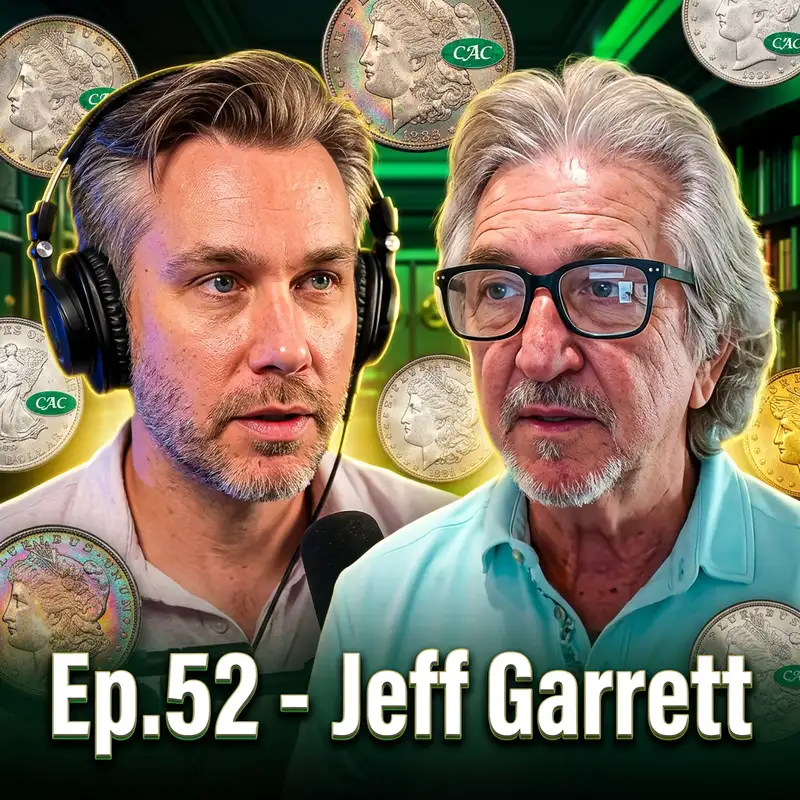
Ep.52 - Jeff Garrett on Eye Appeal in Collecting Coins #numismatics #investment #gold #silver
Folks. Welcome back to the Cabbage Coins Podcast. My name is Tony Grokevich, and I'm the owner operator of Cabbage Coins. And as I mentioned so many times, kind of the the mission of this podcast is threefold. One is we wanna educate viewers out there.
Tony Gryckiewicz:Second, we wanna inspire some new collectors. And third, we wanna elevate the quality of everyone's collection. And today, have a real treat for you. I have a gentleman who, his resume is long, and he's been in this industry forever. And I'm sure you guys recognize Jeff Garrett.
Tony Gryckiewicz:He is the president of Mid American Rare Coin Gallery out of Lexington, Kentucky. Jeff is a senior editor of The Red Book. He has written numerous NTC articles as well as articles for Coin Week, And you may recognize him if you ever watch television. There's a show called Pawn Stars, and Jeff has been a guest on Pawn Stars numerous times talking about rare coins and things that he he presents over to to Rick over at Pawn Stars. Super cool.
Tony Gryckiewicz:Jeff, welcome to the Cabbage Coins Podcast. Tell us, just what kinda got you into coins way back when? When did you start in this hobby?
Jeff Garrett:Well, thanks for having me on. I started a long time ago when I was, like, about nine or 10 years old. Someone gave me a Whitman folder for Lincoln pennies. It was 1941 to date. And at that time, I was fairly short because it was, like, in the 1969, 1970.
Jeff Garrett:And I started filling those holes out and became obsessed by wanting to fill the holes out. And then not just filling the holes out, but also I got intrigued. I was interested in history. I started looking up about Lincoln pennies. I probably got a Red Book and just became fascinated with coin collecting in general.
Jeff Garrett:And I was really lucky. I grew up in Tampa, Florida area, and there were a lot of coin shops. Back in the late '60s, every town had two or three, four or five coin shops. It was really a lot more than there are today. And I was able to ride my bicycle.
Jeff Garrett:I'd go down, and then I would, you know, hang out and, you know, help out. And then eventually, I started going to coin clubs and doing a little bit of hustling and kind of realized that you could make money doing coins. And by the time I was like 16 or 17, I was doing it full time pretty much as a job, barely getting through high school. I told my parents I would complete high school because I figured that was the right thing to do, but I definitely skipped college and went right into being a coin dealer. So by the time I was 17, I was working full time for a coin shop in Tampa, Florida Coin Exchange.
Jeff Garrett:And a couple years later, I was a partner and kind of the rest got me, you know, kind of launched into coins.
Tony Gryckiewicz:Wow. Fascinating. Yeah. A very interesting, career for sure. You are the embodiment of like the coin dealer, the professional full time, you know, lifelong kind of coin dealer.
Tony Gryckiewicz:You've done everything in the hobby. You do a lot of stuff. I mean, just between, I think when I first got into the hobby at one point, you were president of the ANA. You've of course written all these articles. You've been on television.
Tony Gryckiewicz:You go to a lot of coin shows. I mean, you are there, you know, like in the middle of this, of the coin business on a daily basis. What is your favorite aspect of what it is you do today? What's kind of the most dream part of this dream I job would for say
Jeff Garrett:my favorite part of the business is when I go to work in the morning, my routine is I get a cup of coffee and I start going through emails and also sometimes during the day. And you just never know what the next phone call or next email will be about. You know, I just had recently this is actually a funny story. I'll kind of give an early reveal for it. Recently, I had an email, April 22, I don't remember it real well now, a guy sends me an email and he said that he inherited a large group of silver dollars from his grandfather, and he went to a local coin shop and when he put his offers into AI, AI said the offer was not high enough and they should call Jeff Garrett.
Jeff Garrett:So I kind of got a lead from AI and I met with a guy and I have 9,000 Morgan dollars in BU. I have three or four mint sealed bags of Morgan dollars because of that. And right now I'm in the process of doing those. So, you know, that got me excited. So, you know, I've been doing this for fifty years and I still get like I get goosebumps sometimes when some of these deals come up and it's like, Oh my God, I can't believe something like that shows up out of So the that's what I definitely like the most is the discovery of what, you know, it not even be something I handle.
Jeff Garrett:It may be a coin dealer calls up and he has a chance to do something, but he needs advice or needs some research done. I just love, you know, digging in and, you know, getting into the weeds and, you know, learning about stuff. And I still am learning every day about coins. I tell people one of the reasons I like doing articles and the books I write is I like what I learned by doing those because you have to take a deep dive when you do those things, and you really learn a lot yourself. And I'm 68 this year, and I'm still learning.
Jeff Garrett:So I really like that part of it.
Tony Gryckiewicz:Yeah. That's that's fascinating. As you've just given me now a grid, yeah, I'm gonna I'm gonna spend the afternoon talking to Claude and Gemini and Chad TBT and, like, injecting Cabbage Coins into the conversation a bunch so it drains their
Jeff Garrett:It's it's, you know, I don't even know the how profound a change that AI is going to have a big impact on the hobby for sure.
Tony Gryckiewicz:Yeah, yeah, it's right now running a lot of my website development, a lot of the things that I'm doing to enhance my business is run is is really development from I use AI. But anyways, the point of this combo, we're gonna be talking today about IPO. I think that, we talk a lot about grading coins in this podcast. We talk about what to select in particular series, what to look for, And you can correct me if I'm wrong, but I feel eye appeal is kind of the number one highest priority for a collector when they build a collection. Yep.
Tony Gryckiewicz:Would you agree with that? And and and also just yeah.
Jeff Garrett:I did a podcast recently, and someone just asked me, what's your number one advice for for collectors? And I had to think about that for a little bit, and I and I thought because from experience, I bought coin collections of every shape and size, you know, for fifty years, And the guys who bought coins based on price and didn't really pay attention to quality are much less successful than someone who bought a coin based on what it, you know, how nice it is and then not as sensitive about pricing. And then twenty years later, that intention to quality makes a big, big difference in your result as a successful collector. So I can tell you, it's not a theory. I've seen it many, many, many times.
Jeff Garrett:Guys will have a set of Dahlonega Gold, but all he bought was clean, no grades, but he bought them, But they were now they're worth a third of what an ice coin that would grade would be worth. So it's much better to get new quality. I've seen it, just empirical evidence, paying attention to quality is a big difference. And if you're watching this, understanding quality is probably your biggest responsibility as a collector because it is not, you know, it's not black and white. It's not a number on the slab.
Jeff Garrett:You need to be able to understand that every MS65, Morgan dollars, is not the same. I mean, they're vastly different.
Tony Gryckiewicz:Yeah. A 100% Agree with you on that. So maybe, I guess that actually works really well as a good lead in for the presentation today on on iAPEAL. So this is a presentation that you gave along with the, I guess, as part of the the ANA. This is one of the things that you instruct.
Tony Gryckiewicz:Jeff was actually my instructor for advanced grading the first time that I took it last year. Fantastic course I took with him, Don Kettling, and Kent Park. And yeah. So I guess, why don't you take it away here? We'll get to our first first slide and just let me know as we keep
Jeff Garrett:going. It's a PowerPoint I do, you know, because we're in the class for like four days and we're looking at coins and, you know, as you know, you're trying to get the grade and stuff, but we want to break it up a little bit. So I wanted to do a PowerPoint on the importance of IAPL because it is such an integral part of being a successful collector. And I started off the PowerPoint by mentioning that over the decades that I've been doing this business, fashion has changed. So the current near obsession with quality in the past has not been nearly as prevalent.
Jeff Garrett:In the 1960s, B rolls and proof sets were like the prevalent, overwhelming part of the coin market. I have in my back of my office here, I've got a complete set of numismatists going back to the early 1900s. And if you go to like, pull them off the shelf in the 1960s, you wouldn't even think a rare coin existed. You would look at it and there'd be ads for proof sets and B rolls those kind of things. And that was just the market was obsessed with that.
Jeff Garrett:And it was because it was almost like a mania for investors. It was like an investment thing. Of course, in the late sixties, that crash and all that stuff just, you know, fell out of bed. In the 1980s, when I got really involved in it, generic gold was real, real popular. So that was when there was companies, and the origin of that was kind of when gold and silver had taken off, And there had been a few companies like Blanchard.
Jeff Garrett:There was companies up in Minnesota, like five or six of them. And there were companies, a few others, who were doing telemarketing and they were selling generic gold coins for investment. It was all for investment. And that was before coin grading. So, you you could make so much money back in those days.
Jeff Garrett:Gosh, I'd buy a 5 Indian for $500 and I could get $1,000 for it. It was like popcorn. As long as it was BU and they were putting them in capital plastic holders, but it was all in an investor driven market and the people buying the coins had no idea what they were getting. They were just being told that these were a good investment. And then starting in the 1990s, kind of to present, rarities have become a much bigger deal.
Jeff Garrett:Like, you know, now you'll see, you know, on Coin World, you know, million dollar coins trading hands is not an unusual thing. I mean, used to be totally, like that'd be a front page huge story. Know, Heritage might sell, you know, their fund sale this year, they probably sold four or five coins for over a million dollars. So it's just not the headline it was now. And that's mostly because of the wealth effect.
Jeff Garrett:Now there's so many billionaires and guys with tons of money that are buying rare coins. So that's kind of what kind of market is kind what we lead into today.
Tony Gryckiewicz:Yeah. Yeah. That makes a makes a ton of sense. That's fascinating actually to hear. I I know that a lot of these generic gold coins kinda got really crazy in the nineteen nineties.
Tony Gryckiewicz:I mean, I I've heard of prices on very common generic gold coins being kinda astronomical in the nineties. I guess it was all driven by this.
Jeff Garrett:Yeah. Like, the MS sixty five Saint would sell for, five times its melt value. Now now you can buy one for about 15 percent above melt, so it's crazy. The the premiums have absolutely collapsed on a lot of this stuff back in those days that, you know, And also, one thing that's changed a lot in the last ten to fifteen years, there's been gigantic amounts of US gold that's come out of Europe, like the Fairmont collections are just the tip of the iceberg. There's been a lot of generics.
Jeff Garrett:Sometimes now when I go to a coin show and I see five libs in a case, they look like sovereigns to me. They're just a bullion coin. Back in the 1980s, you could buy a $5 lib and if you got up to, know, dip down nice and it was BU, you could make $500 on it. Now you're lucky to make $20 so it's just So, totally
Tony Gryckiewicz:just moving on to a little bit of visual example here, we got these 75 quarters, two very different states of preservation.
Jeff Garrett:Yeah, yeah, this was, I pulled this, this PowerPoint's probably about eight or nine years old. This was just an example, like a snapshot, but this happens all the time. Like, you know, and that's one of the reasons, you know, I can tell you that ceded coinage has, you know, ceded coinage really seems like vastly underpriced. I mean, there's a coin that probably has a minutet of around 1,000 pieces, there's one that's sold for $750 That coin today is probably more of $1,000 The other coin's probably more like 1,500. But those coins you think would be 4,000 or $5,000 with how low the minage is.
Jeff Garrett:But I think they're held back because the vast majority I'd say 75% of seeded coins that you're going to encounter are going look more like the coins on the left. They're going be kind of dark, they're going to be unattractive and maybe rare and everything, but they're not something people are going to race to buy. Also, seeded coinage has another big caveat there where there's cameos and deep cameos that have to be considered. That plays into it. But this is just like a visual where you can see and you could see this evidenced in almost any auction that happens.
Jeff Garrett:I think I told you when you took my class that I really recommend to anybody watching this is go to an auction and sit there and look at lots, study the lots, and then more importantly, later, study the prices realized and you really learn a lot, you know, especially if you're specializing in the series like Morgan dollars and you're really getting into it and you can kind of like see why some bring more than others. You know, why would an NGC bring more? Why does a PC1 bring more? What's a PC CAC bring more? Old green holder.
Jeff Garrett:You can kind of like, you know, quantify that in your brain by actually looking at coins. And I can tell you, I've been doing coins for fifty years. I almost always look at auction lots whenever time permits because I'm still learning. And I may just want to be also seeing what the grading line is, how the grading services are grading them today. So, you know, that changes.
Jeff Garrett:So I can be like looking and it's like, Oh, here's what a 65 constitutes now. It's different than it was, you know, ten years ago. So I want to know that.
Tony Gryckiewicz:Yeah. Yeah. What do you think about I I find working with a lot of folks that people are using CAC stickers as being basically a signal of of this concept of quality, high appeal, and being a very good place to park their money. They're almost looking at those stickers irregardless of what the coin itself kind of looks like. What would be your thoughts on that?
Tony Gryckiewicz:Is that a good strategy? Is that Well, c a What are your thoughts?
Jeff Garrett:CAC stickers are for people who really don't understand quality possibly or want to like, you know, try to learn that. You know, it's kind of like doing the work for you. But the downside on it is that the coins bring a lot more money and they can be, you know, they bring more money because CAC is looking at 100 coins, let's say, and I'm not sure what the percentage is. Let's say it's an average of 40% or my average is less than that. I don't know what, you know, I think it's more like 20%.
Jeff Garrett:But they're not looking at the coins as an upgrade, they're looking at a coin that has the best eye appeal, originality, solid for the grade. Know, it's not undergraded because if it was all undergraded, people would possibly crack them all out. So, it's more the coins are looking for good eye appeal. And also, you think about it, there's a lot of CAC coins out there, so they're not being cracked out. Sometimes, it's not worth cracking them out because if you've paid a 30% premium, this next spread up, you could crack a let's say this coin was a Proof64 CAC and you cracked it out and you paid X amount of dollars for it, it may not be profitable to even go to the next grade with a non CAC coin.
Jeff Garrett:So that's all about mathematics you consider have as well. So, if CAC coins were priced the same price as other coins, it'd be an obvious no brainer because you've got a really brilliant grader telling you what the best 20 or 40% of the coins are in quality than those holders, but you do have to pay a premium and that has to be factored in. So that's, you know, if you do the math on it and, you know, keeping on it and that's, you know Yeah. There's a lot of great coins and holders that are not CAC. That's that's also a bottom line as well.
Tony Gryckiewicz:Yeah. Yeah. I mean, price in any market is always a function of of supply and demand. Looking at, the CAC's website just this morning, because I did a submission this morning, I think their number was 43% of all the coins that they see, they have put stickers on. Now granted the denominator in that is just anything that's been sent to them.
Tony Gryckiewicz:It's not all coins that have been, you know, graded by PCGS or or NGC. There's a lot that, you know, haven't been submitted. But what I think what we've seen is this incredible new demand, and and I there's a number of people I talk to who are hunting pretty strong for those for those stickers. That's where they wanna park their money, and I think it plays well into this next slide about investors and collectors. Right now, I mean, collectors were in control of the market, but it seems like investors are now, you know, coming
Jeff Garrett:Let me into listen the market big time. I mean, twenty years ago or twenty five years ago, Heritage had an auction or Stacks Bowers had an auction or whoever it was at the time had an auction. Dealers bought 80% of the coins. I mean, maybe more. And that's flipped now.
Jeff Garrett:If Heritage just had an auction or Stacks Bowers just had an auction, collectors probably bought 80% of the coins. So that's really, that's a gigantic shift in a twenty year period where, you know, there was being, you know, that was a completely different kind of a market. You know, now it's so easy to bid. I mean, they've, you know, people, you know, it still like blows me away. People will buy a $500,000 coin that's never seen it.
Jeff Garrett:They just only have seen a photograph. They've really trained people to do that. You know, and also the CAC gives people another layer of trust. But collectors in general are more discriminating and kind of, you know, if you're really a specialist in something, you probably understand market. You'll pay more for a coin with I mean, a coin with great toning will bring you can't even make up a price sometimes what it might bring.
Jeff Garrett:It brings to crazy prices. And those are collectors that don't really care about price as much as they want to have that coin. And then if you want to take it to another stream, you've got the set registry competition, which is like a whole another crazy thing. That's what people do in Investors are I do have an old saying about it one time is, you know, collectors buy coins, investors are sold coins. And that's just a big, big difference.
Jeff Garrett:You know, investors really don't know what they're buying. It's based on who they bought it from and the trust they're putting in the person that's selling them coins. So in general, investors don't do as well as collectors long term because you haven't taken the time to learn whatever you're buying. You know, it'd be like me trying to go put my money in racehorses here in Lexington. You know, if I was just an investor, I mean, they would take it would take it wouldn't take that long for my money to all be gone.
Jeff Garrett:But if I wanted to really take a deep dive, you know, give me give me five or ten years, I could probably learn enough about horses that I'd have a chance. But it it would take it takes some education.
Tony Gryckiewicz:So it sounds like the the collector is one who is a bit more knowledgeable about the coins that they are selecting, from the series and what they're the type of collection they're they're trying to build, that they're taking a little bit more of the driver's seat compared to the investor in your perspective is somebody who's being sold coins because they want to park money in Numismatics basically.
Jeff Garrett:Right. Yeah. And it's actually been more there is a big push right now. I mean, there are people buying more coins for investment. I get people call about it.
Jeff Garrett:They, you know, could I buy this, buy gold, buy silver? Because, you know, we all know that, you know, the federal government is on an unsustainable path as far as this, the deficits. And people are worried about having their money in tangible objects and things So like there are to invest people more, and I think more companies are kind of getting into the business to fill that need. So I think you will we will see the investor part of the market grow. Not that I recommend doing that, but it's it's a fact of what's going on.
Jeff Garrett:I think people will be buying more coins for investment purely.
Tony Gryckiewicz:So you mentioned a little bit about how the the grading services adapted to this hot market and to the demand for eye appeal?
Jeff Garrett:Yeah. Yeah. Well, one thing they did, you know, a while back, they started doing the plus grading. So PCGS and NGC both, you know, I think did that as a reaction to CAC to try to, you know, their products. NGC actually does a star thing, which means good eye appeal.
Jeff Garrett:Generally, means toning. For some coins, it may mean proof like on one side has really good eye appeal and not both sides. And also, I can tell you how the I think you ask any professional. PCGS and NGC in the last five or six years, especially now that CAC has started their own grading company, CACG, both PCGS and NGC have tightened somewhat and, you know, they don't wanna see CACG coins sell at auction for twice what their coins sell for. So they're gonna tighten up on their they've tightened up on their grading standards, in my opinion.
Jeff Garrett:Yeah. Yeah. In a in a in a competitive reactionary mode to do that.
Tony Gryckiewicz:Mhmm. So what is the what is the star? NGC specifically put the star as part of the grade.
Jeff Garrett:Yeah. Yeah. Star. That means read eye appeal. Ancient coins, actually put the star as well.
Jeff Garrett:And those brings sometimes bring twice as much at auction as a coin without a star. So people really, really like that. You know, I think more in ancient coins, the star is more appreciated than US. Think star used to get, you know, more more like a coin will have this really, really great toning or or might be, you know, like I say, proof like on one side. You know, something that makes it it's it's not just a regular coin with a greatest.
Jeff Garrett:It's got something about it visually that makes it stand out. That's what the star is for.
Tony Gryckiewicz:Yeah. NGC is the only one I think yeah. You're right with that. You with with the star, but it's on the ancients as well as the as the moderns. You with ancients, maybe I mean, this is a little bit off topic, but I I think it all revolves around the concept of I I I appeal the fine style designation for an ancient coin.
Tony Gryckiewicz:Why is that important to collectors?
Jeff Garrett:Well, for the ancient coin collector, so ancient coins sometimes trade not just on their rarity because rarity is kind of like an unknown. Mean, like how many Alexander the Great Tetragrams are there? There's thousands of them, you know, tens of thousands of them, but they're not all the same. And they were actually engraved by different artists when they were made. You're almost like buying a piece of art when you're buying the coin.
Jeff Garrett:If the coin's been hand done, it's not just like a mechanical thing with mechanical dies. These guys are actually sitting there carving the die out and some guys were much better than others. So the coins would find style. That means the coin just has a it's more from its artistic standpoint. And a lot of people in the ancient world I mean, a coin I mean, you can have a very common ancient coin, but if it's really beautifully engraved and it's gorgeous, it's like a miniature sculpture from the ancient world.
Jeff Garrett:It is a miniature sculpture from the ancient world, and it brings a lot of money. You can study that and see the difference. I mean, some of them are just absolutely stunning and beautiful, especially the Greek coins. I think they're underappreciated pieces of fine art. Really unique Yeah.
Tony Gryckiewicz:The analogy I I would use, if you ever walk through, for folks out there, I mean, you ever walk through an art gallery and you go through, like, let's say, the Renaissance painting section, you start to realize that these all kinda they all painted a lot of the same scenes. They all painted kind of a lot of the same subjects and imagery and so forth.
Jeff Garrett:My daughter Two reasons Jesuses. A lot of baby Jesus.
Tony Gryckiewicz:Yeah. Yeah. A lot of baby Jesuses, for example. Yeah. For sure.
Tony Gryckiewicz:But if go to Uffizi in, in Florence and you see, Leonardo da Vinci, you see that his rendering of the Virgin Mary and the baby is so much better. It's so much more lifelike. That's why it's so expensive.
Jeff Garrett:That's some serious fine style.
Tony Gryckiewicz:Yeah. Yeah. It's the it's probably the the ultimate.
Jeff Garrett:They just they just they they they are that's one of the reasons I like ancient coins. They're miniature works of art. They're just they're you know, some are just super stunning.
Tony Gryckiewicz:Yeah. Yeah. Absolutely. I agree. So, yeah.
Tony Gryckiewicz:So what about the balance here between quality
Jeff Garrett:You know that Go I explained a little bit earlier. I mean, CAC coins were the same price, it'd be a no brainer, but you do have to, you know, use a little bit of common sense on, you know, paying the premiums and studying the premiums. And why does Saint God in 20s bring such a giant premium over, like, Morgan dollars sometimes don't even bring that much of a premium in the CHC sticker. So there's a lot of nuances even in the CAC game. Know, they're hopefully weeded out, coins are cleaned or artificially toned and unattractive.
Jeff Garrett:But, you know, my bottom line is I like CAC coins. I like the profit I make when I make one with a sticker on it. Of course. CAC gold stickers are like, they're uncollectible now. Know, people pay really crazy money because they're not even, you know, they'll pay $500 for a Mercury diamond that's worth $10 if it's got a CAC gold sticker.
Jeff Garrett:So it's its own collectible. You know, I'm a big fan of CAC. I think you had to use a little bit of common sense on what you pay for them.
Tony Gryckiewicz:Yeah. Yeah. Yeah, I agree. So, just kind of keep things moving, guess we'll move into like the concept of tone coins.
Jeff Garrett:Yeah, tone coins, like I mentioned earlier, sometimes they bring crazy prices. So, when I try to explain tone coins to people, so if I had to give you my fifty year experience, observation of rare coins, of tone coins, probably 60% of them are unattractive or negative toning, like dark, cloudy, just unattractive. Another like 20% of coins or 25% of coins or more have been dipped or they're brilliant, you know, there's frosty white, you know, which a lot of people like that as well. And then only like five or 10% of coins have what I would call attractive toning, and then even a smaller percentage of it have what we call wonder toning, where a coin would just be like, I mean, just so beautiful. Commemorative $0.5 are really popular with spectacular toning.
Jeff Garrett:I think it's also that the reason they bring so much money is people love them because, like, you look at that coin, it's just a beautiful coin from an artistic standpoint. And then if you add layers of gorgeous toning, it's like just a fantastic canvas to make the coin just like a piece of art. And they trade like pieces of art. Like, that coin bought $4,800 but without toning in 'sixty eight, it's probably worth $1,200 or $1,000 and this was in 2019. There's other cases where some of these coins bring $50,000 And I mention to people, there's two things that you probably won't find in my showcase ever, would be a spectacularly toned coin because I'm going to auction it because I can't confidently price it because I have no idea.
Jeff Garrett:I don't want to sell a coin for $2,000 to see it bring $10,000 in a heritage auction six months later. And also a Top Pop coin. So if a coin is only like, you know, one graded, I made one or it's two graded and it's the highest graded, I'm gonna put that in option because if two, you know, set and registry guys go to Mortal Kombat on the coin and I could tell you, I've had some experiences where I've made tens of thousands of dollars more than I could have sold a coin for or tried to sell a coin for where it sold at auction where two guys went to illogical battle on it in a set registry competition. And there are lot of So examples of I think Tone Coins are but they're just super rare and to see them attractive is even rare. But people love Tone Coins.
Jeff Garrett:And especially it's interesting phenomena is you probably see at Tony's, like, these young guys, they love Tone Morgans. I mean, they're really into toners. I that's like I think there's probably like five or six or 10 face rib groups about Tone Morgans. I mean, it's a thing. And I think they like it mostly because there's no gray sheet to establish values.
Jeff Garrett:You can just make up your own price.
Tony Gryckiewicz:It is very subjective. Now what about frosty white coins? So, I mean, a lot of people love them. They look great. What's kind of been the trend on these?
Jeff Garrett:Yeah. Well, you know, people, you know, so I did an analogy, an article I wrote a long time ago about people, if you ask a coin collector, they'll say, you know, what kind of coin do you want? They want, I want an original coin. I don't want anything that's been cleaned. And then I go to a coin show and I put out my Morgan dollars, for instance, and the coins that are original with, you know, been dipped and has that little bit somewhat toning on it, they don't sell.
Jeff Garrett:I got a coin that's out like that one there, Frosty White, sells instantly. So people, it's kind of like one of my friends who tried to have a restaurant where he tried to have healthy options, because I like to eat healthy, I said, Why don't you put more healthy stuff on the menu? And he says, because no one orders it. So everybody wants a juicy cheeseburger with bacon on it. And so consumer, you know, what they say they want and what they do is not always the same.
Jeff Garrett:And people basically like frosty white coins. So that's kind of like a consumer, if a coin's not attractively toned, mean, it's not premium toning, then most coin dealers are gonna look at a coin and say, What would this coin look like dipped? Would I be better off having a coin white? Because that's what would sell better.
Tony Gryckiewicz:Yeah. Yeah. Like, you compare these three, we got the super attractive one, That's it. In the middle would be a candidate.
Jeff Garrett:You know? It's like there's there's frosty white, then dipped, obviously. The middle coin is what you see a lot of coins. That coin's, you know, I think unattractive. Then on the far right was that Newman collection I was telling you about where they've been in envelopes and they had rainbow, like, you know, monsters where they just bring, you know, and it's kind of like I said, are frosty whites, 50% of the market, unappealing coins, 50%, then attractive coins are like, you know, less than 10%.
Tony Gryckiewicz:Yeah. Yeah. I yeah. I could go off on the end because I've always tried to figure out where the market is for these unattractive, unappealing coins. I mean, they they still trade.
Tony Gryckiewicz:They still have a value.
Jeff Garrett:Oh, yeah.
Tony Gryckiewicz:It's fascinating to Yeah. Me They have a value market for them.
Jeff Garrett:Everything has a value in coins. That's one thing I like about coins. No matter what you get comes across your counter, you can still sell it to somebody. Yeah. And, actually, I think the next next one will be an interesting thing to talk about.
Jeff Garrett:So
Tony Gryckiewicz:Sure, sure, sure. Well, fixing And the coins,
Jeff Garrett:like I said earlier, it's like, you know, it's a real art and a science to look at a coin and say, okay, you know, can I dip this coin? I've had so many train wrecks over my career. I mean, I learned, I mean, if you're watching this, if you're thinking, oh, I'm just going to buy unattractive coins and dip them and make them attractive, if a coin's tone and it's not bad, a coin I paid $4,000 for that I dipped it and it had a rubber band mark on it. I think I had it in my class, you guys got to see it. I still save it today.
Jeff Garrett:It's in my put away collection just for a reminder of the tragedies And that can happen to I've had many of my professional friends that have lost tens of thousands on coins that were bad dips, not every coin dips out the way you think it will. And a darkly toned coin will most likely turn out that gray yucky look. So it's, you know, it is it is it's an art form to know what coins to dip and not to dip.
Tony Gryckiewicz:Yeah. You remember what you what you did wrong with this when it says improperly clean?
Jeff Garrett:When did it, I didn't realize that it had that rubber band streak on it. I thought it was toned, thought it would come out frosty white, but when I dipped it, it had like a rubber band streak on it, which is, if you guys are watching this, don't know what that means, I mean, at one time it had like a piece of plastic or something was on it that ate into the coin, and it blended in with the toning and I couldn't see it. And also it was the 1980s where like everything was rocking and rolling. Probably was being careless and didn't look at it carefully enough to realize, you know, 4,000 you think you'd look pretty carefully, but you know, I probably had 50 of them that day I was doing something. Wow.
Tony Gryckiewicz:Well, 4,000 in the eighties too.
Jeff Garrett:In the eighties, dollars 80. And, you know, commemorative and that coin is funny. It's like even if that coin was worth $4,000 in MS65 in 1980s, today that coin is 300 or $400 So commemorative $0.5 have really they they collapsed after the nineteen eighties market and still haven't recovered.
Tony Gryckiewicz:Interesting. Interesting. Well, that's a whole another topic. I mean, that would be a a good one. We've had Larry Shepard on talking about his commemoratives, but his coins were like Yeah.
Tony Gryckiewicz:Are top ones. Yeah. They're so cool. They were so good.
Jeff Garrett:Yeah. They're beautiful. Art pieces of artwork.
Tony Gryckiewicz:Yes. Yes.
Jeff Garrett:These are some examples of like some of the beautiful toning that you see, and that's why they call it target toning, which if if you're watching this, it's kind of where the toning comes from the outside in and then the middle kind of stays frosty white, and it's of thing called target toning in general. It really can be spectacular.
Tony Gryckiewicz:Well, we've just had a number of these on the right hand side here, these proof barber quarters and halves come to auction at Stacks in June, and they brought incredible numbers, this kind of toning.
Jeff Garrett:Yep. Yeah. People love people absolutely love it. And also, a lot of those coins were CAC, if I remember. Right?
Tony Gryckiewicz:Yeah. They were. They're the young Dakota. Yeah. It was really nice.
Tony Gryckiewicz:So crescent toning, these are always pretty good.
Jeff Garrett:Thing where you see that that comes from being in a dollar bag. So and that's unusual. That's an $86.00, which is a really rare coin. So that's that would be really I mean, there's probably lots of 83 point zero's like there, but to find an 86.0 with crescent toning is like super rare because that would have been like a, you know, you fantasize that was a bag of 86 point Morgan dollars. That's pretty cool to think about.
Jeff Garrett:And that was one coin that was laying over the other coin and it caused a crescent of toning to develop. Yeah.
Tony Gryckiewicz:Yeah, definitely very cool. And this is now more like the monster tone kind of color,
Jeff Garrett:right? Yep. That's a monster tone. And also, I learned something I didn't notice. I sold this for a client in 2012 for $3,700 He paid like $1,000 for it.
Jeff Garrett:I thought it was out of his mind when he bought it, like in 2006 or 02/07. And I found out that monster toning on both sides is really a rare thing to have it be uniform like that. And that's kind of like a more of a we'll call it like a unicorn of toning to have it on both sides like that. That was that fourteen years ago that coin brought $4,000.
Tony Gryckiewicz:Yeah. I was just gonna ask you, what do you think today? I got an idea, but what do you think this would bring today? It's only a 64,
Jeff Garrett:but I wouldn't be surprised to see it bring 7,500, something like that. I think quite 10,000 just because it's held back. You know, I mentioned the dollar hoards at one time. I a, oh, I think about ten years ago or so. I bought 13 bags of Morgan dollars called the New York Bank hoard, and I sold it.
Jeff Garrett:And I kept one coin and I kept a, let's see if you can see it here, it's a $84.00 dollar MS 66 plus with the cataskets.
Tony Gryckiewicz:Yes. Nice.
Jeff Garrett:So that's what I kept as my my one my souvenir from the from the hoard that I handled, but it was just one beautifully toned coin. But it's only on one side. I wish it was both sides, but it is 66 plus. So it's a special coin to me. I would never sell it, but it's just really neat to see a, you know, just a monster toning on one side of the coin.
Tony Gryckiewicz:Mhmm. Yeah. So here's a commemorative, this time, huge dollar some
Jeff Garrett:of these things will bring $50,000. That was 2,014.
Tony Gryckiewicz:2,014.
Jeff Garrett:Yeah. That's a coin that's worth, you know, $200 in MS 66 or 65 or '66. It's a super inexpensive coin.
Tony Gryckiewicz:Yeah. I wonder what this will bring today. This is a 68 plus CAC with toning. Oh, that top hop.
Jeff Garrett:It'd interesting to do a little research and see if a coin's resold or not. I don't I don't know if it has or not. I'd have to do some research.
Tony Gryckiewicz:Okay. Well, for the tickets tickets, guess, I can always we can do that later.
Jeff Garrett:Yeah. And also, I'll tell you, you know, auctions, I just wanna mention, they said you can throw out the price guides. Sometimes they just bring breezy prices and that's why it's good to look at auction lots. So if you guys are watching this, you know, do yourself a favor and spend two hours in whatever series you collect, go study them and, you know, where do you have a chance to go when someone will show you $20,000,000 worth of coins and, you know, not not ask for a for your for your tax return? So this anybody can sit and look at coin you know, unbelievable coins.
Jeff Garrett:It's it's a it's a great learning experience.
Tony Gryckiewicz:Yeah. So, you know, I I've so I have a copy here of the of the Red Book. This is a 2026, Red Book, and Jeff is a senior editor of the Red Book. And John Fagabob, we've had him on the podcast talking a little bit about the concept and the methodology behind pricing. From your perspective, so people you know, a lot of people may how do I ask this question?
Tony Gryckiewicz:Where do the prices come from? When you come up with all of the prices, there's like 30 some odd thousand prices, I think.
Jeff Garrett:Right. Well, so the Red Book, just so everybody knows as a basis, is for a theoretically average coin. And, you know, you know, how many coins really are theoretically average? I mean, not that many of them. Most of them are high end, low end, something else.
Jeff Garrett:But you have to come up with a number. So, if you're gonna put MS64 high relief, you're gonna kinda look at auction records, see what they brought more recently, kinda throw at the high end, throw at the low end, and it's kind of like you still want to praise your house. It's kind of the same process. They throw out the outliers, they throw out the lowliers, and they kind of come up with an average. So the grace sheet is John does a fantastic job.
Jeff Garrett:Red Book pricing's better than it's ever been. He does it because he's kind of you know, he does it on a daily basis, and when he read Red Book, it's kinda like a snapshot of what was going on at that time. But I would think John would tell you that when you when you guys talked about the Red Book pricing, it is the job is to kinda not to not to represent the highest the coin's ever brought, it's to kinda to tell you what, like, what would an average coin bring if it was sold retail or at auction.
Tony Gryckiewicz:Okay. Okay. Interesting. Alright. Well, moving on then to, I guess this is another example of fantastic IPO.
Tony Gryckiewicz:This is a Yeah.
Jeff Garrett:I'm say this is a couple of outliers. That coin, you know, that coin was one of the crazy coins that brought, like, it was a set and registry where it was a tone coin and a set and registry battle. I don't have the numbers, but the coin brought 6 figures for a coin that's worth, like, you know, dollars 20. You dipped it, it'd be worth $20 and it brought 6 figures. It was one of those coins that was just like, you know, the whole world was like, oh my god, how can that possibly bring that much money?
Jeff Garrett:And I don't I think it was in a Legends auction when she was doing auctions a while back. Had to do a little bit of research, but it brought just an insane same price.
Tony Gryckiewicz:And then we have the temptation to recreate some toning.
Jeff Garrett:Yeah. I wanna mention that. So a lot of coins are, you know, you will see coins are artificially toned people because people, you know, a coin will bring a lot of money for toning. I know a lot of guys that they even do things like, Oh, I'm not artificially toning them. Just putting it in an envelope and putting it on a shelf for two years and let it tone naturally.
Jeff Garrett:You know, they want to speed up the natural process. One thing I'd do is give you a pro tip for anybody watching this is if you have a coin that you think might have been artificially toned, don't dip it because that artificial toning is probably covering up something ugly and you would be unpleasantly surprised once you dip it. I've had it happen to me several times where I'm like, Oh gosh, this coin, it looks so nice. Gosh, it's got to be okay dipped. Then there's the hairline that was covered up I didn't see.
Jeff Garrett:You know, serious hairlines. So usually, even like there's a debate, there was a really healthy debate that was going on when CACG started. They said they're not going to grade toned silver eagles because they think that coins haven't been out long enough to acquire natural toning. I don't know if they reversed that, but it caused a little big online thread with, I think, Ronnie and Jabbiscuit put that on there and then everybody said, Well, Why not? And then they went back and forth.
Jeff Garrett:But it was kind of like there's just so many you go to a coin show and you see so many Silver Eagles with all this toning on it. I'm like, I don't know how that happened. The coin's 20 years old. So it's, you know, the the temptation for cashing in on toning is gonna gonna create, you know, a lot of artificial stuff being out there. So you gotta watch out for that.
Tony Gryckiewicz:Yeah. Yeah. Yeah. Some people ask a question like, well, why do you bother sending coins to one of the conservation services? All they're doing is paying them to go and dip the coin.
Tony Gryckiewicz:But they also assess the coin about whether it should be dipped or not, whether it should be conserved or not. Right? Right. It can redo these things.
Jeff Garrett:Yeah. Definitely. You know, definitely. That's you know, it it takes an it really does take an expert eye that has to learn the hard way. You had to mostly learn by experience.
Jeff Garrett:I I don't I think a lot of these young people have even been around long enough to even understand what I'm talking about. It takes experience and learning the hard way to, okay, that's a risky situation if you dip it. And everything about coin business is mathematics. If you look at a coin and it's in a holder and it's like a thousand dollar coin and if it dips out nice, it's worth $2,000 so there's your 2x risk. What if it doesn't turn out?
Jeff Garrett:If it's going to be worth $100 if it turns out crappy, that's a big risk. If it's only worth $800 it's a big mathematical equation that we all go through when we're buying and selling and working with these, trying to get a coin in its ultimate holder or doing what we do. That's probably be So you could do a podcast on the mathematics of numismatics because it is a big part of the hobby.
Tony Gryckiewicz:Oh, yeah. Yeah. I think we could talk a lot about the, yeah, the game the game, so to speak, that we that we all play when we figure out what we're gonna do with the coin and upgrading and CAC submissions and cracking out and so on and so forth. It's good
Jeff Garrett:to do it and all that stuff.
Tony Gryckiewicz:Yeah. Yeah, you mentioned here a little bit about the consequences of upgrading. What did you mean by that?
Jeff Garrett:Okay. What I mean by that is so the trading services started in 1986. All these coins got graded. They're fresh. You know, and even now, forty years later, I mean, the grade from, you know, priced for maybe $10,065 and $20,066 So coins that are really nice, people have over forty years, you know, tried to get the ultimate grade on the coin.
Jeff Garrett:So when you go to a coin show, you know, there's not that many undergraded coins that are sitting in holders because, you know, it's like water seeking its level. I mean, people are going to do what they're incentivized to do and people are incentivized. Twin dealers have been incentivized for forty years to try to get the ultimate grade on a coin. And that's why I appeal is important because do you really wanna buy an MS67 commemorative $0.5 that last week was in an MS66 holder? You know, it's probably maxed out, super, super maxed out, and it's probably going to sell for a discount.
Jeff Garrett:But last week it was in a 66 holder. And you know this is going on. You go to a coin show and there's guys giving them $102,103 100 coins and they're paying $100 apiece to get them graded at the coin show trying to get the ultimate grade. So just the reality of knowing that a lot of coins and I get guys that sometimes some collector will want me to go through his coins looking for upgrades. And I'm like, I can tell you probably most of these coins, that's already been done to these coins you know, many, many times over.
Jeff Garrett:You know, you're let's just a fresh old collection. If you've just been buying the last few years, you know, you're not getting underrated coins sent to you from the Internet.
Tony Gryckiewicz:No. No. That's fair. It does pay to well, I was gonna ask you here, I mean, this next this next slide right here about going to a grading class and so forth. I mean, there's things that people can do to to arm themselves properly that
Jeff Garrett:Yeah. You need to I think, know, like my advanced coin grading class, a lot of it's people who want to be dealers and they're more concerned. They want to learn, like, you know, how to be a smart submitter, for instance. Because I mean, you submit coins, it's thousands of dollars every time you do it and, you know, you need to avoid, you know, you don't want to get, you know, the classic thing come back, you know, no grade cleaned. That's a waste of money.
Jeff Garrett:Don't want to get downgrades. You don't want to understand that process. And I think it's a learning thing. I don't want to make the hobby seem too complicated for collectors, but there's a lot of nuances in it, a lot of money involved, and you owe it to yourself to be a successful collector. You need to understand quality.
Jeff Garrett:I think that's the bottom line. There's a lot of ways I to learn about think my grading class, they filmed it a couple years ago. I don't know it the one you were in or another one, but it's actually online on the money.org. You can watch the class online. It's part of what they offer.
Tony Gryckiewicz:That's cool. I did not know that.
Jeff Garrett:Yep. You can watch the class online. It was either two or three years ago, it was one of the first ones they actually filmed one of the because I told them, I said, you know, I'm going out to a summer seminar. I'm spending a week of my time to teach the people. I mean, you know, you guys gotta need to film some of this stuff because I want 2,000 people to see it, not 20, you know, because that's a lot of effort on my part to get out there.
Tony Gryckiewicz:Yeah. I've taken grading now at the ANA seminar four times in the different levels, of course. The next time I've kind of committed to myself on going back to doing counterfeit detection, I I need to take that course. I need to take that course.
Jeff Garrett:Yeah. That's a really good that's a that's a really good course to have because it's still it's you know, there's still a lot of that out there.
Tony Gryckiewicz:Yeah. For sure. For sure. Yeah. So I guess we have a couple examples here of kind of what to buy, what not to buy.
Jeff Garrett:Yeah. People, especially in gold and southern gold now, people love what they call crusty original, gold. You know, the corner on the right's been dipped at one time, kind of, you know, I wouldn't say clean, but obviously conserved or some version. People love frosty CAC Dahlonega gold. I mean, it brings like 2x of what these other coins bring.
Jeff Garrett:You know, that's what they call the crusty gold. Another example of that was a good thing to look at was when the Fairmont Collection was sold, that stuff was all, like, crusty original. They came literally out of bags and people paid a lot of money for it. They paid big premiums because they loved the originality of those coins.
Tony Gryckiewicz:Yeah. Yeah. We have a comparison here of some standing Yeah,
Jeff Garrett:with there's three quarters as coin with, I'd say average, you know, I like the coin on the left. It's not unattractive, but the coin on the right, frosty, been dipped, you know, that's kind of like before and after one of those might look like. People love them. You know, some people like the one on the left, some people, you know, only buy like a coin on the right. But, know, there's a visual of like, you know, what you're going to encounter, like seeing different coins look like.
Tony Gryckiewicz:Yeah. I agree. The one on the right is, in my opinion, a far better coin. It's a lot more frosty. Frosted got got more luster.
Tony Gryckiewicz:And and just in general, I think the strike is a lot sharper on the the one on the right. And then Here's a really good east one.
Jeff Garrett:These coins come in different looks. They have the some of these coins in MS65, these are both from Heritage Auctions where the one on the left is great as 65 red, but it's got that what they call like a wood grain in it.
Tony Gryckiewicz:Yeah, a little bit behind that here, yeah.
Jeff Garrett:Yeah, that grainy look, and a lot of people don't like that. Also, another thing to be careful about Lincoln pennies is twenty years ago, if a Lincoln penny was, even a remote chance had been dipped, they would no grade it, you know, AT. Now they're a little bit more permissive on that, so you're going see a little bit more pinky Lincoln pennies out there in MS65 red. And also, if you're buying copper, just remember any coin that's MS65 red someday is going to be red brown and someday it'll be brown. It may not be in your lifetime, but it ain't going to stay red forever.
Tony Gryckiewicz:Yeah. Well, especially in Sarasota, Florida.
Jeff Garrett:Yeah. That's right.
Tony Gryckiewicz:Someplace, where it's humid, but yeah. Alright. So 21 piece dollars. This is okay. Great example.
Tony Gryckiewicz:A 66 is
Jeff Garrett:Big difference. That's something you need to understand about coins. Series, when they made these, the first groups of them they made, the dyes are real strong and they have nice strikes, and sometimes they have really weak strikes in the middle. A lot of times they won't even grade them MS66 if it does have that kind of weakness in the centers. But if it has almost no bag marks, it might achieve that grade, but I would much prefer to have one with a nice strike.
Jeff Garrett:I'd rather have an MS65 strongly struck 21 peace dollar than an MS 66 weak strike.
Tony Gryckiewicz:Yeah. Completely agree. This one, the the strike is super important, and really the thing you're most looking for, folks, is this this collection of hair kind of right above the the ear. This is the very high point
Jeff Garrett:of This the thing in the center. This coin is really one of the most one of the more beautiful pieces of art that was made by the US Mint, in my opinion, over the years, and to get one in full strike, it makes you really appreciate the full art of what the guy was trying to achieve with his artistic designing the coin.
Tony Gryckiewicz:Yeah. And then I think this is our final slide, so this Yeah. Think fun.
Jeff Garrett:You know, I've done a lot of work at the Smithsonian. I'm on the board there, I help raise money for them and stuff. And The book I did, Encyclopedia of Gold, is based on their collection. And when I was there, we photographed almost all the important gold coins there. And I encountered this $19.00 $7.10 Indian that came directly from the US Mint.
Jeff Garrett:It's from the Mint collection. And the coin to me is, I think, one of the finest gold coins I've ever encountered. It's just virtually it is essentially a perfect $10 gold coin. So to me, it's the ultimate eye appeal, unbelievable, great pedigree, unbelievable strike, and just it's a wonder to behold. So if you wanna end your day with some eye candy, there's your some eye candy for my talk.
Tony Gryckiewicz:Yeah. Yeah. Yeah. The Smithsonian visit visit is fun. It's in the American History Museum, and they got a whole exhibit of US coins and some of the most rare stuff, the stuff that's kind of in the instant uber rare stuff that, you know, winds up in the Smithsonian collection.
Tony Gryckiewicz:A fun day if you're in the DC DC area. Okay. So
Jeff Garrett:Just to mention everyone. Yeah. The I found out recently that the the Whitman show is gonna be in DC in in February or March of next year. Oh, okay. That'll be kinda cool.
Jeff Garrett:So when you're going to the Coins show, you can swing by and see the see the exhibit.
Tony Gryckiewicz:That's really good news. That's fantastic. I did not know that. Cool. Changing venues, I think that's, that's gonna be good for the show.
Tony Gryckiewicz:So the question I have for you is, you know, given your perspective and and, all the years you've done been doing this, right now in the present day market, if you wanna take a stab at what do you think what are the segments that you think maybe are are hot? Because the market's kinda hot right now. What is, in your opinion, maybe getting a little bit too hot, and what do you think is a little bit undervalued if you are so bold to make a prediction and take a stab at that. What's kind of your gut feel on that one?
Jeff Garrett:Well, think, you know, I do, like I mentioned earlier, I mean, the set registry competition is gonna be crazy, so I, you know, I'd be careful. Think that's get overheated sometimes. You know, I don't know what's really gotten hot as far as, know, some of the Tone Coins, they bring crazy prices. I know they're strong and those things are really good, but if you're gonna be a most successful investors, and you say collector investor, are contrarian, so I would try to look for series that, you know, like I love MS-sixty four piece dollars. I just bought a collection that had a bunch of them in it, And I was looking at like 1924S's or, you know, 700, dollars 800 in MS64 and they're 8,000, dollars 10,065.
Jeff Garrett:I love those big spread coins. So I'm a big fan of those. So if you're looking at series, you know, look at coins that are, like, really nice quality, but they go, like, you know, five or 10 x the next grade up, and that's kind of a fun way to collect coins. So if I had give some advice, if you really want to put money in the hobby, look for those kind of coins.
Tony Gryckiewicz:Okay. Yeah. I always look at the the spread between particular grades to see if there's any upper up upward potential. So Yeah. Cool.
Tony Gryckiewicz:So what's the best way for people to find out about Mid American Rare Coin Gallery or, what you do, get ahold of you, have You questions even for
Jeff Garrett:reach me at jeff@rarecoingallery.com. So I'm always available. If anybody's got questions, shoot me an email. I go to every major coin show. I have a table at every show, and I'll be at ANA with like five tables.
Jeff Garrett:So anybody wants to stop by in Pittsburgh, see me, love to talk to you. And I'm definitely accessible. So anybody wants to reach me, I'm always happy to help. And I think if you just Google Jeff Garrett, it'll come up pretty easily. You find my website see if he can reach out to me.
Jeff Garrett:And I love helping collectors and I love, you know, there's no dumb questions. I'm always happy to help out with people. And if you happen to have like this amazing something to make my day, I'd love to hear about that too. Yeah. I I mean, I kept coffee.
Jeff Garrett:Make me make me choke on my coffee. That'd be great.
Tony Gryckiewicz:Yeah. Yeah. Yeah. Yeah. Well, we have, well, thanks a lot, Jeff.
Tony Gryckiewicz:Appreciate you doing this. We have AI's favorite coin dealer here, Jeff Garrett. Thank you so much for, for joining us This week. Cabbage Coins Podcast. And, yeah, I'll see you at the ANA show in, in Pittsburgh.
Jeff Garrett:I enjoyed it. Thanks for having me on the show.
Tony Gryckiewicz:Alright. Thank you.