Ep.54 - Valuing Colorful Morgan Dollars Pt.2 w/Jacob Matiyevsky #coincollecting #silver #rarecoins
Hey, folks. Welcome back to another episode of the Cabbage Coins Podcast. My name is Tony Gryckiewicz, and today I have Jacob Matiyevsky. For long time viewers and listeners, you might recognize Jacob. Jacob was one of my first guests.
Tony Gryckiewicz:Jacob is the owner of a business called Monster Toned Morgans LLC, and you might see him at any major coin tool really, and he's the guy that's got all the really crazy toners. Thank you so much again for for joining us. So today we are going to talk again about tone Morgans, but I thought it'd be really interesting to give folks an education about how to approach toning in terms of the expected premium that the color should bring. And so, I believe we've actually we got 35 examples today, and we're gonna walk through everything from the lower end of premium all the way to the higher end of premium. Is that a pretty good, summary?
Tony Gryckiewicz:What else would
Jacob Matiyevsky:you add? That's I got together examples that really range from almost no premium to the color, just something very, very light all the way to what people would consider a full on monster tone Morgan.
Tony Gryckiewicz:Awesome. Alright. So we're moving on here to this 81. I'm assuming this a u n s.
Jacob Matiyevsky:A s.
Tony Gryckiewicz:Yeah. So this coin Yeah. Go ahead.
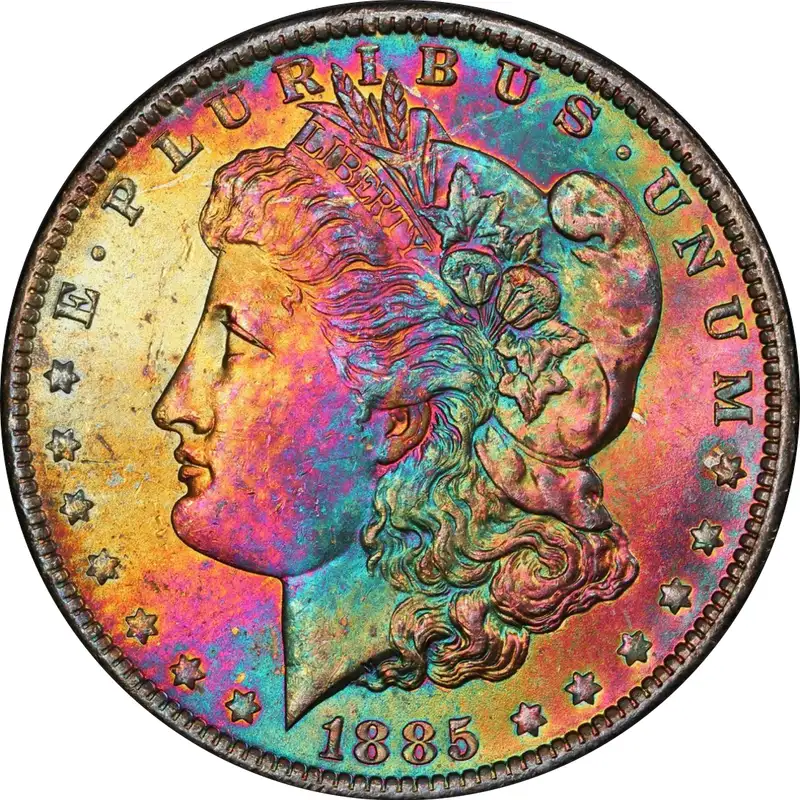
Jacob Matiyevsky:Now we're adding in luster to it. So, again, it has a lot of green. It has really all the colors you want. Even the blue on it is very dynamic and pretty vibrant. And, yeah, look at the liberty on this coin as an example.
Jacob Matiyevsky:Yeah. That's that's really cool. So this one, once we start to add in luster, we're really now well within the high end range for toners. So I would say Yeah. This example and the one before that would definitely be considered high end toners.
Tony Gryckiewicz:Okay.
Jacob Matiyevsky:And something like this is now gonna probably command three to thirty five hundred, 3,000 to 3,500. And, again, that is a lot of money for a 64. Remember, this is a $100 coin without the color.
Tony Gryckiewicz:Yeah.
Jacob Matiyevsky:So this is a work of art.
Tony Gryckiewicz:Yeah. No. It absolutely is for sure. And you're gonna have people that agree with you in the comments. You're gonna have people that strongly disagree with you in the comments.
Tony Gryckiewicz:Absolutely.
Jacob Matiyevsky:That is But very, very true of toners. No no matter what, you and and that's kinda the cool thing for Mhmm. The people that like to hunt around for for neat things and and just collect what they what they really enjoy. Just pick what you like. It's maybe you really like a certain color.
Jacob Matiyevsky:Maybe you like having a lot of luster on a coin. Just buy what you like, and you might you know, sometimes you might get lucky and buy it for way less than what you think it's worth just because there is that subjectivity to it.
Tony Gryckiewicz:Yeah. Yeah. It's another little nugget for coin dealers out there that are watching this. We talk a lot about my on my podcast and in my other videos about arbitrage, which is the concept of moving basically coins valuables, collectibles from one market where they're valued less into another market where they're valued more. And with often the case, I mean, beauty is in the eye of the beholder, one man's trash is not a man's treasure.
Tony Gryckiewicz:So like, you can move around the market, you can find pieces that are in your opinion undervalued where you say like, you know, given the luster here, given the colors that are present, I think there's there's a market for this coin at another higher level. And that is really the essence of what you can, you know, build a business sometimes around and, you know, there's expenses to go and find these things and you curate all of this stuff and you put them together on a website. But that's the concept of arbitrage. So hopefully, folks can get a bit of a lesson here about how this market works so you can participate in it. And, Jacob, they'll have more competition.
Jacob Matiyevsky:Definitely. No. It's great. The it's it's such a fun world. I think we always welcome more people to to join into it because, honestly, the more people that join into it, the more exciting toners become for everybody.
Jacob Matiyevsky:And and it's Yeah. Really opportunity for everyone to appreciate this really, really, really cool niche of the numismatic world.
Tony Gryckiewicz:Okay. So moving on to a very interesting piece. Got a lot going on here. We got some textile, I think I see, and got some interesting colors all throughout it.
Jacob Matiyevsky:Yeah. So this this coin is very, very cool. Absolutely a character coin. There's a lot of textile a lot of textile over much of the coin. There's a lot of bright green that that's the green that you want right there, the the kind of blue green, emerald green that you see in front of the face, and it's in front of the face, which is a great area for that color to be.
Tony Gryckiewicz:She talked about this green right through here.
Jacob Matiyevsky:Yeah. So that's that's beautiful. That's actually some what I personally really like is that color. Now some of the downsides to this coin, it does also have a lot of toning that's getting towards the terminal range on the right hand side. It's better that it's on the right hand side than than in front of the face, but Yeah.
Jacob Matiyevsky:It does have that. So this coin, it probably would not even it may not bring as much as the one we just looked at Even though it has textile and it has really nice smooth color, it's depending on who you ask. Again, someone might absolutely love this and pay 3,500 for it. But, typically, something like this may bring a little closer to the $27.50 to to $32.50 range, I would I would say. But, again, it's gonna range.
Tony Gryckiewicz:What so where are you seeing the terminal, Tony? Are you referring to this kind of patch right here?
Jacob Matiyevsky:There and sometimes we'll refer to terminal not not just referencing actual jet black color, but even this maroon darker purple color that you can see over more of the the right side. So there's actually really a good chunk of it where it's where it's no longer green. That dark dark purple color will sometimes refer to that as terminal even though it's really not, but it's it's just so much darker. It's almost closer to a brown that it it starts to detract a little bit from the overall eye peel.
Tony Gryckiewicz:Yeah. I see. I see. Well, yeah, I would say that the color of the blue is pretty nice through here. Yeah.
Tony Gryckiewicz:Blue is want. The one I do like it. Yeah. Okay. So moving on to this coin, I think this coin is better put together from a color perspective.
Tony Gryckiewicz:Smoother, it's more even. This color is this color is cool, but it's kind of like you got kinda splashes of color in different places. Mhmm. This one's oh, I'm sorry. Wrong direction.
Tony Gryckiewicz:This one's a little bit more even and put together in a nice pattern.
Jacob Matiyevsky:Yeah. So this coin you can see is very, very bright. The colors are extremely vibrant. You can have you can have so many different greens. It can all be the same exact hue of green, but this green just appears so much brighter than some of the other greens that we've looked at previously.
Jacob Matiyevsky:And same with the the fuchsia on this coin. So that is a really, really big plus to it. Now the only minus is a lot of the coin is light blue on the towards the right hand side, especially the upper right. So that's Yep. That's not as amazing, but the that bright rainbow is in the in the spot that we want.
Jacob Matiyevsky:It's very, very vibrant. The color is smooth and clean. So that's a that's a great plus to this coin. This is also probably something that would fall in a relatively similar price range just because it's so neon. So, again, around that 3,000, maybe up to 3,500 range.
Jacob Matiyevsky:Okay.
Tony Gryckiewicz:I'm actually I'm surprised it's not now a little bit more. I mean, just given how vibrant you don't see stuff like this very often. Yeah.
Jacob Matiyevsky:Yeah. We're we're really at the the high end level now for sure.
Tony Gryckiewicz:Yeah. Yeah. I mean, this this kind of this redness here, it's very like hot fire red. I mean, it's really kind of, wow. It's pretty something.
Tony Gryckiewicz:Yeah. Okay. So we have another a one. I'm assuming this is an s. This is pretty well saturated.
Tony Gryckiewicz:64, and I mean, go ahead. Take it away. So what am I looking at here?
Jacob Matiyevsky:So this coin, now we have a lot of the vibrant green. It's all over the coin, and we can just we can tell that the colors have a lot of underlying luster to them just because Mhmm.
Tony Gryckiewicz:Of
Jacob Matiyevsky:how how that how those colors are flowing over the coin and how they're highlighted in certain areas. You can see that green in certain areas gets really, really bright. And that's because when this photo was taken, that's where the luster was shining most on it. So if you were to twirl this coin around in your hand, the luster is gonna really catch all those colors and make them pop out. So that we're we're getting very close almost to what I would consider a monster.
Jacob Matiyevsky:I think that term gets overused a bit these days. I'm pretty I'm a little bit picky about what I really consider a monster, but I think this coin is getting very, very close to that range. So something like this, it's just so dynamic. It's probably gonna jump this coin. Again, even as a 64, which is it's a $100,120 dollar coin.
Jacob Matiyevsky:It's gonna jump this into probably on the low end $37.50 and could probably bring $4,547.50 for for something like this.
Tony Gryckiewicz:Okay. Interesting. So what, in your opinion, are the like, if you had to name the the top three reasons why this is a $4,500 coin, what what would you just name those three reasons to be for this coin?
Jacob Matiyevsky:The number one thing is it's actually the combination of the right colors. So we have a lot of bright colors, greens, blues, fuchsia, even some purple, but we don't have really any of the wrong colors. So we don't have any light, like, light blue that's not really exciting or any terminal. So it's the combination of the right colors with really great luster. That's the magic sauce that makes this coin so expensive and also so beautiful, especially when you look at it in person.
Tony Gryckiewicz:Gotcha. Gotcha. So this is not yet a monster, but it's a caproaching monster. Really close. Alright.
Tony Gryckiewicz:So is this a monster?
Jacob Matiyevsky:This one, I think a lot of people would call it that. Would I would probably still call this, like, so, so, so close to a monster.
Tony Gryckiewicz:You need another term. You need monster, and you need, like, maybe dwarfs on the lower side. You get like a Balrog on, like, the upper upper end. I don't know. You Yeah.
Tony Gryckiewicz:Like, different creatures.
Jacob Matiyevsky:And it it's gonna be subjective. Some people are gonna see this coin, and that is a 100% a monster, and it's it's really awesome. This coin has a lot going on. It's got a really neat pattern and actually looks like it may have toned in a fold in the bank bag just based on the speckling and the lines that we can see.
Tony Gryckiewicz:Yes. Definitely some some Yeah.
Jacob Matiyevsky:Something really interesting going on there that's usually from a fold in a bank bag. So it's always cool when you can see how a coin toned based on the pattern that it has. It has a lot of vibrant green. It's got all the right colors. I think the only reason that I don't call it a full on monster is it has just a little hint of darker color on the bottom left.
Jacob Matiyevsky:Wow. Just a little
Tony Gryckiewicz:Very high standard.
Jacob Matiyevsky:Yeah. Yeah. But, otherwise, the rest of the coin is is very, very cool. It's probably not as flashy as the one we just looked at before, and that's just by the nature of it not being a estimate. Actually, oh, this is an estimate, but it's not an 81 s.
Jacob Matiyevsky:It's a 79 s. They don't Yeah. Tend to come as flashy, but still an awesome coin. So this this is probably going to fall in a pretty similar price range. I would say this one could range anywhere from 3,500 on the low end to 4,500 or so.
Tony Gryckiewicz:If this was 3,500, I'd buy it every day of the week and twice on Sunday.
Jacob Matiyevsky:Yeah. So Me personally. Sounds like probably 4,500 is is more so for this football.
Tony Gryckiewicz:I think so. It's just that spec
Jacob Matiyevsky:that's special. Fellow and, you know, based on fellow dealer Tony here, because everybody you know, the more of these that you see and buy and sell or collect, you kinda start to learn what what the market likes a little bit more. So
Tony Gryckiewicz:Yeah. Yeah. Yep. Alright. So we are now looking at another reverse, but this has got that special green, though, right all over the eagle.
Tony Gryckiewicz:Right?
Jacob Matiyevsky:So this coin is interesting because it's a reverse toner, and we talked about how those are typically not as not gonna bring as much of a premium. So this coin would probably fall in a similar price range as the ones we looked at before. However, the colors on it are just absolutely gorgeous and super bright super bright neon green. Even the the maroon color on it is really, really vibrant, and that's quite rare. The color that almost looks terminal on the left, that's actually a teal a teal green.
Jacob Matiyevsky:And because the coin is so vibrant, it doesn't look terminal. Sometimes that color can look terminal if it's not bright enough. And then you can see, yeah, the outlining of kind of purple and fuchsia running all through the arrows and through the wreath. It's really gorgeous.
Tony Gryckiewicz:Yeah. I mean, this is I mean, the the the green and the blue and the mention of the fuchsia. Yeah. It's pretty awesome. So what are we looking at in terms of value on on this, this being a reverse toner?
Jacob Matiyevsky:So being a reverse toner, it's oftentimes going to fall again in in a similar range around 3,500 to 4,500 probably for this coin. But because it's so bright, it's this is this is what I would start to consider actually a a monster, a monster reverse toner. Now if this exact same color were on the obverse of the coin, there's really no doubt in my mind that this would be a 5 figure coin, so over $10,000.
Tony Gryckiewicz:Okay. Wow.
Jacob Matiyevsky:Yeah. Just because of the price.
Tony Gryckiewicz:Okay. Alright. So moving on to our next example here. This is another 81 s, I'm assuming, and wow. I mean, great color all throughout.
Jacob Matiyevsky:Yeah. So this coin, I would say the photo really doesn't entirely do it justice, but it is extremely lustrous, and the color is actually very, very vibrant. It's a beautiful coin. It has a lot of fuchsia to it. So all that kind of purplish color.
Jacob Matiyevsky:You can see compared to the one we just looked at, it's a little bit of a step down in in brightness to the color, but that's just because the other one was a reverse toner. This coin would bring in towards the top end of that earlier price range we would talk we were talking about. So this is probably a solid $4,500 coin. Maybe could bring even a bit bit more than that just because it's so bright and flashy in hand. It's a lot of luster to it.
Tony Gryckiewicz:Yeah. Yeah. So about 4,500. I mean, depending on what the reverse looks like, I was booming assuming it's just coming completely white. I mean, I can see I can see that.
Tony Gryckiewicz:I I I mean, just the incredible color, especially all throughout here. I'm feeling I I I think the estimate is is accurate. It might be a little bit light. It may be possible somebody who is gonna pay over 5,000 for this for this coin possibly. I mean, but yeah, it's hard to it's hard to say.
Tony Gryckiewicz:And then this color through here, this is gonna be that green we're looking for right again. Right?
Jacob Matiyevsky:That actually is not. That's more that's actually more blue, but it's pretty Oh. It's pretty attractive and and dynamic. So and there's even textile to it, which is also cool.
Tony Gryckiewicz:Oh, okay. Gotcha. Alright. So about 4,500 and moving on to this. Now this, I recognize as being an end of roll toner.
Tony Gryckiewicz:Can you explain a little bit what that means for folks?
Jacob Matiyevsky:So a lot of banks, what they did way back in the day was they would take bags of Morgans, and they would actually roll them in in paper rolls. And some sometimes the banks would would roll them in machine wrapped rolls, and sometimes they would roll them in hand wrapped rolls. Occasionally, a customer of the bank may also would also, you know, get a bag of silver dollars and then end up just hand rolling all these coins. And if you've ever coin roll hunted or or maybe even seen someone maybe at the grocery store open up a roll of coins that they may have gotten from the bank, sometimes those rolls are just a tube of paper, and the ends are folded over on either side. And that paper fold is what can sometimes create a pattern on the coin that looks something like this.
Jacob Matiyevsky:Now this is a really awesome example. They very rarely come this bright.
Tony Gryckiewicz:This yeah.
Jacob Matiyevsky:Yeah. A lot of end roll toners have more muted colors and little kinda dirtier look to them just because of paper toning versus mint bag toning. It's there's more oxidation that tends to occur that way. But this is a beautiful coin. You can see that there's so much going on.
Jacob Matiyevsky:The pattern is really interesting to look at, and there's nothing but bright vibrant colors. There's really no no terminal. There's nothing dark. The colors really stand out. So something like this is probably going to start at 5,000 and can certainly go up from there.
Tony Gryckiewicz:Yeah. Question for you. Do you think that any of this color occurred within the mint bag and then was also put into the roll and, like, the roll end of roll toning, like, added another kind of layer layer complexity to it?
Jacob Matiyevsky:So that can happen. It's it's not common for sure, but it can happen. This coin, because it looks so uniformly toned, and what I mean by that is all the colors and the patterns make sense. So directly where the paper was, like, we look at the center square, that part is light because it was it had very little air. That paper was laying directly over the face.
Jacob Matiyevsky:But right on the peripheries, you start to get a lot more color. You start to get the bands forming. And then in the areas where there was a little bit of air gaps between the folds is where you see all the greens and blues because there was a lot more, you know, paper surrounding that that was able to deposit some trace amounts of sulfur on the surface and form the silver sulfide layer, which is what toning really is. It's just a thin layer of silver sulfide. So you can kinda see that all over the coin.
Jacob Matiyevsky:There's other areas where there was some paper folded over, and you can see the light color, and it starts to expand into the bright colors. So for that reason, I would say this one was probably blast white when it went in, but you could get something that had a little bit of toning to it, and then it toned again in in a roll, but it would look a little more varied. And you might see, like, a more distinct mint bag pattern and then enroll over it.
Tony Gryckiewicz:Yeah. Yeah.
Jacob Matiyevsky:It's very rare though, I will say.
Tony Gryckiewicz:Yeah. I currently have a coin on my website that is got end of row toning, but it's on both sides of the coin.
Jacob Matiyevsky:Yeah. That's interesting.
Tony Gryckiewicz:Yeah. It's unusual. It's an unusual piece. The reverse is actually a lot more vibrant than the obverse is, but yeah, if you're at the ANA show, come by and take a look at it. Definitely.
Tony Gryckiewicz:It's pretty interesting. Yeah. I just, you know, so it's gonna be put into a role, and at some point in time, somebody took it out of their role and they put it back in kind of the other way, you know, up and Exactly. Yep. Created it on both sides, but alright.
Tony Gryckiewicz:So anyways, moving on to this this bad Larry. We got a 1879. I'm assuming s, and this is wow. I mean, it's got fantastic kinda color in these, like, thirds, which is great.
Jacob Matiyevsky:So this coin, now we're fully in what I would consider a true monster.
Tony Gryckiewicz:Okay.
Jacob Matiyevsky:There is absolutely zero dark color to it. It's absolute it's super bright neon. This is the green. If you if you wanna see a great example of the green that is the most desirable, it's this green right here. So this level of brightness to it and pop, you can see even how the light shines on it a little bit.
Jacob Matiyevsky:It really, really stands out. And you have a very rare color, bright orange. It's a mix of orange and fuchsia, actually, and even a little bit of yellow, but it just looks fantastic. And it's right on the focal area of the coin. This is just absolutely stunning, and you can tell it's got great luster as well.
Jacob Matiyevsky:So something like this, it's there's a big range. This coin could it could sell for 6,500. It could sell for 8,500. It depending on how it looks in hand, if the luster is just absolutely stupendous on it, it could maybe even be a $10,000 coin.
Tony Gryckiewicz:Yeah. Yeah. Wow. So that there's a huge variability, and that's obviously because of people's, I mean, the their level of resources and how much they absolutely just must have to have the piece as opposed to so many other, you know, coins where I don't wanna say they're commodities, but, you know, if you're somebody who's hunting for 79 cc and MS62 and they're looking for a CAC example, and there's a number of them that are on the market when they or may not be on the Cabbage Coins website. And, you know, you might try try to compare them in terms of the level of, like, proof, like, kind of character to the surfaces or how many marks or is there any kind of distracting kind of elements to it.
Tony Gryckiewicz:But for the most part, I mean, if you pass up one, another one another one might come along, you know, let's say in in another month or a couple months look going going to shows. When it comes to these particular toners, they're unique, and that's where people get into bidding wars at auctions because they absolutely must have this. They must take this thing home, and you get a couple people are like that, and then all of sudden, this the number gets up to $10,000 for this.
Jacob Matiyevsky:This is honestly the more the more I look at this coin, this is the kind of coin that could absolutely do that. It's just it's exactly what the really high high end collectors want. It has all those features. There's no problems to the coin whatsoever. There's no fingerprints.
Jacob Matiyevsky:There's no areas that are really distracting in a negative way. And, yeah, I mean, this could this could certainly bring five figures. As I look at it
Tony Gryckiewicz:more and
Jacob Matiyevsky:more, I think I think that's entirely possible.
Tony Gryckiewicz:So a question for you on, like, is grade limiting this thing in any way at this point? So it's a 64. Yeah. It's grade limiting the upward side of the value here.
Jacob Matiyevsky:Somewhat. Yeah. It's very rare for a 64 to get into the 5 figure range. It certainly does happen, and there's exceptions. Sometimes a lower grade could even get into that.
Jacob Matiyevsky:But it is it is certainly rare just because you don't have as clean of a surface. I mean, you imagine this same color on a 67 with no distracting hits on the on the cheek whatsoever. I mean, the color is toned over all the marks on this coin very nicely. But if we zoom in, we'll start to see that there, you know, there is some stuff going on on the cheek. There's a little bit in the fields as well, and those are slight distractions.
Jacob Matiyevsky:So if this coin were a higher grade, if it was a 65, I think there would be no doubt in my mind that this would go for over for over 5 figures. And then it just goes up from there. If this coin were a 67, that's a huge jump. This is probably a $2,025,000 dollar coin. If it goes 68, forget about it.
Tony Gryckiewicz:That's what I was gonna throw out there too. Yeah. Got it. Alright. Well, moving on.
Tony Gryckiewicz:I think we have three more examples. This is an 85 I'm assuming $85.00 or some or 85 p.
Jacob Matiyevsky:This is a $85.00. Really, really beautiful coin. There's a lot of green to it. Again, lots of dynamic colors. It's got a cool pattern.
Jacob Matiyevsky:Really beautiful. Now it's not as vibrant as the example that we just looked at. So although there's almost more different variety of colors here and quite an interesting pattern, something like this is probably going to fall just more towards the 5,500, 6,500 range most likely. Probably around 6,500.
Tony Gryckiewicz:Interesting. Yeah.
Jacob Matiyevsky:I know
Tony Gryckiewicz:this one doesn't this one doesn't appeal to me as as much. I mean, the the previous one absolutely did. The vibrancy of these colors, incredible. This one, yeah, I guess I'm just kind of gonna be valuing it a little bit lower just because it just doesn't I see a number of coins that look kind of like not a number of them, but I see, you know, as a person's Morgan Dollar tone toner collection, I see a number of coins that kind of have this look, but I guess at the same time you do have kind of this collection of kind of all the colors and they all have very a section that they're vibrant in, and they're kind of saturated in. So I see what you're saying.
Tony Gryckiewicz:I see what you're saying.
Jacob Matiyevsky:Yeah. The other slight aspect to this is some of these most of these coins are coins I've owned in the past. Some are not.
Tony Gryckiewicz:Mhmm.
Jacob Matiyevsky:But a picture can only do so much, and sometimes you get a really good picture. Sometimes you don't. This I would say this is a picture that undersells this coin a little bit. It it's brighter in hand and flashier Mhmm. Which is a little bit unfair.
Jacob Matiyevsky:You know, we're trying to teach about educate folks about pricing toners, but it's a little bit hard to do with just photos Yeah. Versus seeing the coin in hand. But if you imagine this coin a little bit brighter, a little bit flashier, it's really, really gorgeous.
Tony Gryckiewicz:This is a little bit off topic, but just as a short aside, these photos, are these PCGS true views? Are these some of your own photography?
Jacob Matiyevsky:These are all I tried to gather together some things that would be as consistent as possible. So these are all PCGS true views. Okay. So This is not in the slab to this. What's that?
Tony Gryckiewicz:This is not in the slab. This is a they they take the true views before they they
Jacob Matiyevsky:slap the coin raw, and these are some of the the older true views. There was a specific photographer that most likely shot all of these, so they're they're relatively consistent, but there can still be some variation, of course.
Tony Gryckiewicz:Yeah. Yeah. That's good good to know. Just curious. Alright.
Tony Gryckiewicz:So we have our penultimate example here. We have yeah. I mean, great color, very saturated. We've got this beautiful kind of orangish in in one of the main focal areas, blue, but then we also have some of that nice emerald green, I think, through here. Mhmm.
Jacob Matiyevsky:Yeah. Yeah. Absolutely. That that's a really nice, like, I would even call it like a blue green. It's it's a mix.
Jacob Matiyevsky:The liberty is is very nice. The other thing that you see, which is unusual for this date, which is an eighty five o, is the coin is extremely lustrous. It the luster on it looks closer to an s men than an omen or a p menor. So that is very, very a very exciting aspect of this coin. It has, again, that bright orange color.
Jacob Matiyevsky:The green is a very unique green. It's more of a a teal or cyan, actually, and that's a very rare color to get on a toner. So this coin, it's gonna bring a lot. It's another one of those coins that you can certainly get a bidding war going for it. Yeah.
Jacob Matiyevsky:My guess is it would probably bring at least 7,500 and could certainly bring more.
Tony Gryckiewicz:Yeah. Yeah. Probably. By the way, where do you see a lot of the toners kinda trading now? Because they used to be pretty heavy on like legend auctions, and they're no longer, you know, legend auction doesn't really I I don't think do do their auction anymore.
Tony Gryckiewicz:Where are a lot of these trading now, or where are a lot of these going to auction nowadays?
Jacob Matiyevsky:So a lot are trading at shows or private honestly, privately more than anything else, I would say, at least this level of toner. It's typically trading from collector to collector or from specialized dealers. They do go to auction. Heritage tends to get quite a few. They run some toned coin showcases.
Jacob Matiyevsky:So those auctions will have toners of any type of coin and will often have some really nice pieces. Great Collections also is going to to run quite a few toners, so that's that's a a good place to check. Stax Bowers is going to have some as well. So, yeah, Legend used to be kind of the go to. They they had a lot of phenomenal toner sales, but now it's mainly ending up with those three main auction houses.
Tony Gryckiewicz:Yeah. So it's kinda going to the majors, and that makes that that makes sense. I mean, great collection of photography right now is kind of off the hook. They they are taking fantastic photos of Coins or whatever.
Jacob Matiyevsky:That took all of these photos is their their photographer now. So
Tony Gryckiewicz:Yeah. Yeah. Yeah. Exactly. So if he's watching out there and you ever wanna come on the program and teach us how to take pictures, please please please come do so.
Jacob Matiyevsky:That'd a great episode.
Tony Gryckiewicz:Alright. So this is our final final coin. This is clearly a monster. We got a lot going here. Yeah.
Tony Gryckiewicz:Textile, green, fuchsia, purple.
Jacob Matiyevsky:Go ahead, man. So this one, no questions asked. Absolute monster for sure. It's Yeah. Again, only a 64, but wow.
Jacob Matiyevsky:It has so much going on. It has really bright vibrant colors. That green is, you know, turned up to a 100%, maybe a 101. It's super bright, and it has textile on top of that. That's just fantastic.
Jacob Matiyevsky:So
Tony Gryckiewicz:Right across the face, which is great. Yeah.
Jacob Matiyevsky:Yeah. Maybe the only and it's hard to call anything about this coin a negative, but the only reason perhaps that this coin isn't even more than what than the price range that it probably is is just having yellow in front of the space instead of green, maybe. The green and pink and red tends to be a little slightly more striking, but the yellow here is actually really beautiful. So it's it's definitely not a detractor in any way, but it's probably the only reason that this coin isn't $15,000 is just for that for that reason. But I would put this coin probably in in the 8,500 to 10,000 range.
Jacob Matiyevsky:And who knows if she got a bidding war going?
Tony Gryckiewicz:Yeah. Easily. Easily. Yeah. I mean, this coin kinda has it all.
Tony Gryckiewicz:I mean, the thing that jumps out at me for sure is kind of the neon nature of all of these colors. There's nothing dark on this, the obverse of this coin. It's also very saturated. You have these highlights on on like liberty where you have the dancing of the the orange and the and the the blue or the bluish green across across liberty. And like you said, you have the presence of the ever so desirable green.
Tony Gryckiewicz:Just as a recap, because you mentioned this in episode four, but why is green so valuable? And has that something to do with the spectrum and the, like, where that that green color exists?
Jacob Matiyevsky:So in part, the reason green is tends to me be the most valuable is just because it tends to appear the most striking visually, tends to be the brightest color that you see on a toned organ. And something about green. Maybe maybe it's even maybe it's a evolutionary thing. I mean, we love plants and things like that. Maybe our eyes are just drawn to that.
Jacob Matiyevsky:Who knows? But it tends to be a really, really striking color. And you're right. It is it is a relatively small band on the color spectrum where you get the right green, which is this bright emerald green or a cyan, so mixed mixed with a little bit of blue, that tends to be very, very appealing. The only color that might be even more striking than that is a true cherry red, but you almost never get that on a toner.
Jacob Matiyevsky:A lot of times when we say red, we're really talking about fuchsia, which is the color that this coin has, so the pink color on it.
Tony Gryckiewicz:I see.
Jacob Matiyevsky:But a true, like, cherry red is is extremely desirable and extremely rare. That band is minuscule.
Tony Gryckiewicz:I see. Interesting. Interesting. Yeah, man. Well, this is super educational.
Tony Gryckiewicz:I I I do have a couple questions for you to kind of round things out just to give a just curious on a couple couple non toner related things. So first off, one one of the questions for you is, what is your favorite non Morgan Dollars series of US points?
Jacob Matiyevsky:That's an interesting question.
Tony Gryckiewicz:I would say specialize in the Morgan.
Jacob Matiyevsky:So yeah. Yeah. I would say probably flowing hair dollars. I just love I love the design, and I think it's just really cool being the first the first Dollar coin. I really, really like those.
Jacob Matiyevsky:Have I handled them? No. I haven't. But I think the the design is is wonderful. It's it's quite a cool series.
Jacob Matiyevsky:I mean, it's a it's a very short very short series. You can hardly call it that, but that's one of my favorite points.
Tony Gryckiewicz:Yeah. Yep. Where in all of numismatics now this could be paper money, this could be coins, this could be US coins, this could be world coins, this could be anything at all that you wanna touch on. Where do you think is the is the most undervalued area right now in the marketplace in terms of numismatics?
Jacob Matiyevsky:That's an interesting question. I'll give I'll give two answers to this. One, and I it's gonna sound extraordinarily biased, and I'm sure it is, but I I Tone Morgans. Do feel that for their rarity, Tone Morgans are probably still over undervalued because, you know, you can have coins that had a mintage of a 100,000, and they can sell for hundreds of thousands of dollars, where a monster toned Morgan, a true monster, is actually significantly rarer than that, and it might bring 10,000. So from a rarity standpoint, that's kinda how I feel about Tone Morgan's, and that's what gets me excited so excited about it is when you really think about them, the highest end ones are extraordinarily rare.
Jacob Matiyevsky:Now strictly numismatic speaking, so not not toning, that's that is that is definitely interesting. I would say it's hard to call it undervalued, but proof gold is absurdly rare. And, yes, those coins go already for a ton of money, so it may not sound undervalued, but they are some of the most beautiful coins. It it it's incredible to think about the fact that those coins were made well over a 100, a hundred and fifty years ago, and they look as stunning as they do, and they're crazy rare. The mintages on those coins are in the hundreds usually.
Tony Gryckiewicz:Yeah. Yeah. Yeah. I find that those are fantastic type coins that to to to have the have in the inventory, to have at least just one very nice example. You're not gonna get a lot of people that collect them by date or something that need the like the the rarest date of them, but a lot of people, they want to appreciate one really nice proof gold example, and then they, you know, wherever it is that meets their budget, they kind of fall into a 2.5 or they fall into a, you know, $5 or they go all the way up to 20.
Tony Gryckiewicz:It all depends on where people are at, but I find those are super important to have at least an example, you know, in the case. So so yeah, what's what's your next show? I'm assuming it's gonna be ANA, but are you doing one before that?
Jacob Matiyevsky:Actually, there's a there's a very small show. I'm in Las Vegas, so there's a very small show, local show in Vegas. I'll just be there for for a part of a day, I think. But the the next one is ANA, and I'll be there the entire week. That should be a a great show in Pittsburgh.
Tony Gryckiewicz:And, again, remind us of your website again.
Jacob Matiyevsky:My website's monstertonedmorgans.com.
Tony Gryckiewicz:Super easy to remember, folks. And I think, Jacob, your email is monstertonedmorgans@gmail.com, and your website is monstertonedmorgans.com. So if you guys like this stuff, if you're interested, if you wanna talk to Jacob and so forth, I would encourage you to reach out. Super approachable, obviously extremely knowledgeable, and you know, this is a fascinating area. If this appeals to you in any way, if you like color on coins and you want to kind of learn and climb that kind of learning curve, I would say this is a perfect person to connect with.
Tony Gryckiewicz:So thank you again. Appreciate you having me on the program for a second time, and hopefully we'll have you on again way down the road. You know, that'll be fantastic. Hopefully, we'll talk about maybe some flowing hair dollars or something like that. So
Jacob Matiyevsky:Yeah. We'll see. Absolutely, Tony. No. Thank you for having me on.
Jacob Matiyevsky:It was a pleasure.
Tony Gryckiewicz:Alright. See you, man. Bye.