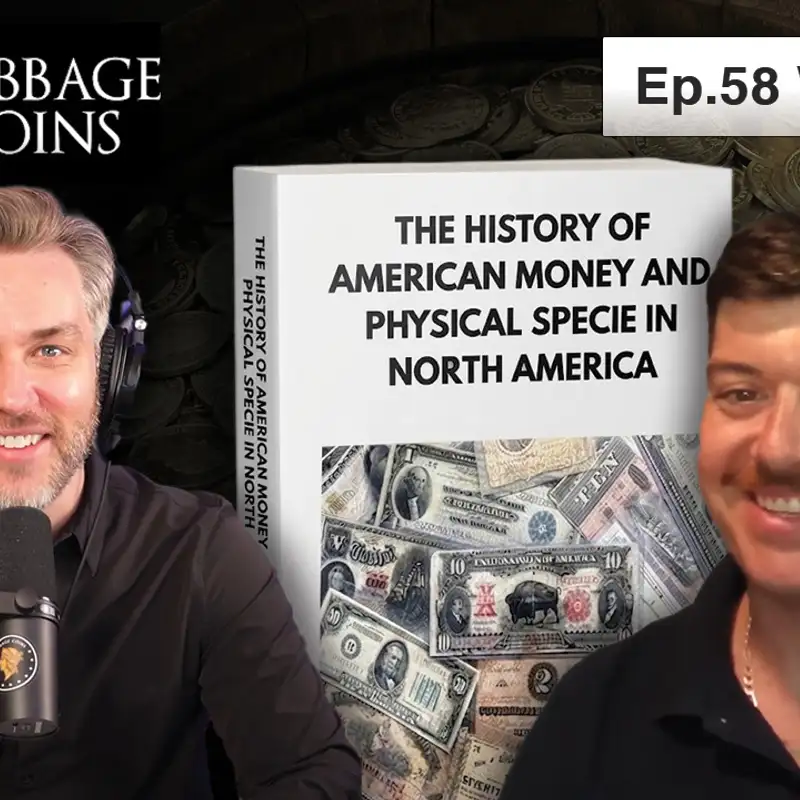
Ep.58 - The History of Money in the US w/William Dokas Author #coins #numismatics #gold
Hey, folks. Welcome back to another episode of the Cabbage Coins Podcast. This week is going to be a little different than a lot of the other ones we have in the past. We've done book reviews before. We had a whole episode with, Taylor Leverage on Chop Mark Coins, and he wrote a book about that.
Tony Gryckiewicz:Today, I have another author. We have William Dokas. And William, wrote a book called The History of American Money and Physical Species in North America. It is a monster tome. It is a 130,000 words approximately.
Tony Gryckiewicz:It's over 400 pages. William was gracious enough. He published this thing back in April 2026. He sent me a copy, to to enjoy, and I have. And I finally kinda gotten to the end of it, so I thought let's go ahead and record an episode together and interview this guy, find a little bit about his motivations for writing a 400 page book on the history of money, and talk a little bit about the content inside of it.
Tony Gryckiewicz:So, first off, welcome to the podcast. I'm assuming you're a long time viewer, so it's it's great to to have you, have a get you as a guest. I always ask this question to people, is how did you get into Coins? And, if you can kinda just kinda roll into how did you what inspired you to write write this book.
Will Dokas:Well, thank you for having me here. I appreciate it. Looking forward to our conversation. I got into coins when I was when I was a kid, probably eight or nine years old. There was an old coin store about two, three miles from my house, and three older gentlemen owned it.
Will Dokas:I used to drag my mom out there, and she would stand there for an hour. The old guys would talk to me for hours about everything everything under the sun. I was always a a kid that asked a lot of questions, and Coins kind of had had a lot of areas and a lot of trails you could go down. So you're never bored with it. There was always something new you could learn, you can collect.
Will Dokas:But when I was a kid, I was trying to learn as much as I could as possible, and there wasn't a whole wide range of of publications and books and and article. Most of the stuff that I would find would have been out of print, or it would have been just an article, so you could really only get a limited amount of information about something. So it was always kinda hard. As the Internet, you know, got bigger and bigger, it was easier to find more and more informa But you could never find anything that was chronological from start to finish of, you know, the history of American money. So that was kind of my motivation was to write the book that I wanted to read.
Tony Gryckiewicz:Yeah. What I appreciated about it was, you know, when I worked on my master's degree, there were the volumes that you would read that gives you kind of a a broad over overarching kind of summary of a subject area. And then there were those that obviously dug into a subject area, and then you can get into the primary sources. You can do, like, some kind of real original kind of research. This I would, categorize in that kind of that first bin of this is a huge summary of the history of American money, and you kind of touch on a little bit of everything.
Tony Gryckiewicz:Very interesting segments, you know, learning about early colonial days, early days of the nation, the the shortage of copper that we had, and how they tried to solve this problem along the way, and all these kind of various issues that popped up. Honestly, I read that, and I kinda got more inspired and interested again in colonial coins. They're pretty awesome, actually, whenever you do come across them. Can sometimes find them in fairly high grade. Anyways, digressed a little bit.
Tony Gryckiewicz:I love the book, man. I really did. You wrote this, like, on the road living in a 21 foot trailer out in Colorado. What's the story like? How where did this idea come about?
Tony Gryckiewicz:I mean, you mentioned a little bit, but you wrote it into a huge outline. I mean, walk me through the method here, and and when did you get started, and when did you finally kind of finish the final draft?
Will Dokas:After after high school, I went in the Marine Corps. After the Marine Corps, I I came home and then ended up going out to Colorado for Colorado State University. When I was out there, I kinda had the idea to write this book, and that's when all the research started. But being having never done something like this before, really, the only way I knew how to write a page or a paper that was fifteen, twenty pages long was do an outline, have a skeletonized edition of what you're doing, and then flush it out from there. And so I kinda took that to the extreme with this book was because it wasn't necessarily something that I was fiction that I was just coming up with off the top of my head, but it was going to be something that, you know, was chronological, had a start and a finish, and to be able to organize that much research into one area, just do an outline and keep adding to the outline.
Will Dokas:And then when you come across research that's similar research, you go back to that part of the outline, and it was just sort of like a a timeline reference point. It did work well. By the time, you know, you got sixty, seventy pages into this outline, it started to get exhausting. You would come across information, and you might not know if you had it in there already, or you would have it you would have to put it in two different places because for context, you might need to talk about it in two different areas of the book. Oh, it was, you know, a lot of scrolling back and forth, having four four pages on the screen at a time.
Will Dokas:But it did it did
Tony Gryckiewicz:work well for what I
Will Dokas:was doing. I wouldn't recommend it for, like, a non fiction or a fiction book rather, but for something non fiction like this, it worked well.
Tony Gryckiewicz:And so and your girlfriend were, like, on the road traveling, and you were working on this. And this was initially, like, a sabbatical you were planning to take. You took a one month sabbatical. You quit the, I guess, you're working at a pizza shop. You quit that, got on the road.
Tony Gryckiewicz:So walk through, like, what were you guys doing? Where where were you guys going? And and how did you research this from that trailer?
Will Dokas:This was a process. Writing this book took seven years. So when I started it, I started it in Colorado with all the research where I was working on it, and then time went on. I was working at a pizza place during January of my last year. I I quit, And I was gonna take a whole January off, and I was gonna write I was gonna finish the book.
Will Dokas:That's what I thought. It was take a month off, push through it, get it done, write it, and then seven years later is when I when I finished it. It took a lot longer than that one month. Yep. Once I graduated school, I ended up getting a job in DC.
Will Dokas:And so we moved to DC, took a little bit of time off from the book. I'm I worked on it here and there, but working sixty hours a week, you know, it was wasn't easy to keep working on the book every day. And then after after COVID, all the price locks came off of renting out of the places. And so the place we were renting ended up skyrocketing at price because three years worth of price lock came off and and rent increased. It went from, you know, 2,300 to 3,600.
Will Dokas:So my wife and I, we decided, you know, we've always wanted a trailer. Why why not get a travel trailer? And so we we moved out of the apartment, bought a travel trailer. We lived in that for about six months before we ended up moving back to Colorado. The time in the trailer, I did a lot of a lot of research, and the way I did it was really I printed everything out.
Will Dokas:Everything Oh, wow. That I used for research online. Anything I found in a book, I would photocopy it, which is kinda old school, allowed me to have the information I wanted and not necessarily have to lug around the entirety of some other book if I only needed five, ten pages of it. I always having Wi Fi was challenging. Being able to print things, either had to go to libraries, go to different places that had printers, went to FedEx a lot.
Tony Gryckiewicz:Yeah. Yeah.
Will Dokas:And then I'd say once we went back to Colorado, my my wife was pregnant. And so my goal was to have book draft completely done by the time baby number one was here. And just like all the other goals before that, it it did not happen. And I remember finishing 100% my first draft Christmas Eve of 2023, which was four four months after the baby came. So I I almost hit the goal, but not not quite.
Will Dokas:And then from 2023 to April of this past year, really all of '24 all of '24, '25, and a couple months of '20. I took it from the first draft to draft number four, and then did all the the editing and the formatting and got it got it published.
Tony Gryckiewicz:When you set out to do this, did you have an objective or a goal in mind? Something that you were trying to get an answer to. Did you have a question in mind you were trying to answer that you were hoping this research was gonna kinda bring the light for you? Or was it really just, okay, we gotta get a survey of this whole history of American money, so let me just try to outline this thing and fill in the fill in the spot. Does that make sense?
Tony Gryckiewicz:What I'm asking, were you did you have any big underlying deep burning questions you had about the subject matter that you were try you're hoping to to figure out along the way?
Will Dokas:I'm very interested in colonial history and very interested in, like, Western history. The two, like, wide like, kinda overarching questions I had was mainly about colonial currency and colonial money, trying to get a a real idea about that. And then I wanted to try to find out as much Western history as I could as it related to Colorado and and kinda where I was in that place in that moment to try to kinda feel connected to it. I love history. History is, you know, what got me into coins.
Will Dokas:Coins also got me into history, kind of the chicken and the egg thing. My biggest goal going forward with the book when I started writing it was to have a actual physical copy of it. I didn't really care if anybody read it, didn't really care if I made any kind of money on it. I just didn't wanna spend money on it, and I wanted to have a physical copy in my hand.
Tony Gryckiewicz:Interesting. And along the way, is there anything that you discovered through the course of your research that you would say really surprised you? What was kind of the most surprising thing you learned about American money?
Will Dokas:The most surprising thing was really with with the paper money and how many iterations of paper money there were and how many cycles there were and how much of that is completely lost to the average everyday American. I went to school for business, had a minor in American history. And through all the classes I took at CSU, I never once learned about half of this stuff. And so unless you're really hunting and looking for this stuff, it's something that you're never gonna come across in just everyday life, which is is surprising to me just because there is so much history involved with American money. In today's world, money is almost being phased out for digital currency and everything else, and the penny is not made anymore.
Will Dokas:There's a lot of tangible history that is being lost in today's world.
Tony Gryckiewicz:Sure. Yeah. Well, I mean, even though we all still use US dollars, you know, all these various currencies, at the most part, mean, I it all lives on our phones, in our in our digital wallets, I guess, you could say, or on credit cards. I mean, it very little actual coins and papers and paper and so forth kinda gets traded in our and I think in in our daily business. Unless you come to a coin show.
Tony Gryckiewicz:Right? Unless you come to a coin show and I'm thinking to myself, like, I need to have, you know, I gotta have $30,000 cash with me so I can buy coins. It's a lot of cash, you know, it goes on in a coin show. So, yeah, it's interesting. So for someone who's never thought about about it before, what were people in the American colonies actually using to buy things?
Tony Gryckiewicz:So before there was a before there was a federal government producing its own, its own money prior to that, what were people in the colonies actually using to buy something? I I live in a small village, and I wanna go buy a shirt.
Will Dokas:Initially, it would have been a barter system. You would have been bartering and trading, and then as things progressed, you would have started using foreign coinage, and that predominantly became Spanish silver, and Spanish gold. Spanish money was the, you know, the predominant monetary or medium of exchange in The United States until the eighteen fifties. So Yeah. It was really Spanish money, and then it became coppers that would slowly leak over from Europe, coppers that were produced in The United States.
Will Dokas:But it wasn't until, you know, the seventeen eighties, seventeen nineties where where domestically produced coppers started becoming an actual medium of exchange. Before that, it was all Spanish money.
Tony Gryckiewicz:What do you think was going on in the heads of the Europeans, the the the king, the folks that sent folks over to people over to colonize the New World? I mean, of course, you wouldn't want their economy that's gonna spring up to kinda deal with barter on a daily basis, which is so inefficient, and there's so much cost associated with with with bartering. But at the same time, they didn't really supply them with hard money at all. What's your take on that? What do you think the reason was behind that?
Will Dokas:It's one of those things where it's half a dozen to one, six to the other. It's hard to kinda pick one side from the perspective of the, say, the English. Bartering, you know, was you have to have a double coincidence of a measur once, and Yep. It was done out of necessity coming over because you wouldn't I mean, you're not gonna come over as an exploring mission and bring your whole life savings. So it it's something that just had to happen.
Will Dokas:And then as things started getting more and more established, people the whole point of the colonies was to produce wealth for the mother country. It wasn't for the people in the colonies to produce wealth for themselves and to do what they want. So it was, you know, that catch 22 where you need to send enough to keep that thing going and to keep it surviving, but you don't wanna send too much because the whole goal is for it to come the other way. Yeah. It is one of those things that not not Every colony is a little bit different for why it started, and it wasn't necessarily the cream of the crop coming over to the colonies too or what the king or the queen envisioned as the cream of the crop coming over.
Tony Gryckiewicz:Got it. So they're not they're they're sending, you know, scallywags and and and hipsters and losers over there. That makes I don't know. I'm assuming there's probably some really, you know, great folks that actually, of course, came came on over. Somebody's always just joking.
Tony Gryckiewicz:But Well, Okay.
Will Dokas:It's religious people that the people that came over for religious freedom.
Tony Gryckiewicz:Religious freedom.
Will Dokas:Yep. The monarch of England doesn't approve approve of that or appreciate that.
Tony Gryckiewicz:Got it. Yeah. Yeah. That's fair. That's interesting.
Tony Gryckiewicz:I didn't think about it that way. The the whole point was to produce wealth going the back the other way. The fact that, you know, barter system, would be inefficient or there'd be any issues with it wasn't as much of a a concern. I I just look look at it more as an investment. Of course, this is like a necessary part of what their economy would need.
Tony Gryckiewicz:But anyways, one of the things you mentioned is about, like, the columnists using clamshells as money. How do you think they actually work day to day?
Will Dokas:That's one of those things that's hard to envision and, like, kinda fathom because it's just so Yeah. Different than our world. I think at the beginning, it probably worked well. But then as the overproduction started happening and as, like, glass beads started coming over from Europe, it probably fell off pretty quickly. It also, like, in that situation in particular, the beads mean one thing to Native American tribes and have a special cultural significance, whereas the Europeans coming over don't care at all about beads.
Will Dokas:You know? They care as much as the next guy about a glass bead. They don't care the way the Native Americans would have. So they were also using, like, a monetary system that didn't really have universal value to everyone. So I I can't imagine it lasted that long.
Will Dokas:Yeah. I mean, on paper, it did last quite a while, but in everyday living, I I doubt it lasted that long.
Tony Gryckiewicz:Got it. So in other words, because in to the native Americans, the clamshells or the beads had value, colonists could buy things from the native tribes with those commodities, with those with those resources. Right? And that's what allowed them to have some value to to people that why they would be willing to accept them in trade was because they could trade them for other things that they wanted with the natives. Did I get that right?
Will Dokas:Yeah. Yeah. But to a certain extent, that ends up coming back to being almost like a a barter and not like a because true not everyone is gonna wanna accept those beads. But you do you do have a group that you know will accept them, so you're accepting them on this trade knowing that you can probably pass them off in the next trade.
Tony Gryckiewicz:Okay. Cool. So what about, like, using you mentioned about tobacco was used as legal currency in Virginia. What happens to an economy when your money can rot?
Will Dokas:That's a that's a great question. Obviously, you're gonna be you're gonna be tied to the way the crops do. And so a lot of this, because things would rot, they ended up making basically warehouses, and the farmer wouldn't have to hold on to the commodity until they wanted to use it. They can take it to the warehouse, sell it to essentially the county, and they would get a a receipt back. And then that receipt would have been basically the one of the first fiat monies that you could go and you could trade on that receipt because you had so much commodity in that warehouse.
Will Dokas:So that way, you kind of took away the the pressure of getting that commodity to the market, used, and sold, because your commodity is no longer your commodity. It just represents one of those commodities.
Tony Gryckiewicz:Got it. Okay. Alright. So there was kind of an element of tobacco could be the tobacco itself was not trading. Folks were not bringing bags of it in order to trade across the counter, but they were basically putting it into sort of like a bank in a way and getting a script of paper that says it's you know, this is how much I have in tobacco back at at the bank.
Tony Gryckiewicz:You could use this script of paper to go get some for yourself. It wasn't the same leaves, it was whatever other leaves are.
Will Dokas:Yeah. It's just x amount of those leaves.
Tony Gryckiewicz:Yeah. Yeah. And for those who don't know, I mean, that's how the fractional reserve banking system, you know, even works today. You know, it's all kind of a computer systems, but that's the same basic idea behind it. So and why we have free a fiat currency that can that can work.
Tony Gryckiewicz:But alright. So counterfeiting seems to come up constantly in this story. Do you think anyone was ever really winning that fight against the counterfeiters?
Will Dokas:I guess it depends on the time period, but no. I don't think it ever played as important a role as people made it out to be in their minds. And I think that's probably, like, one of the biggest issues of it was the, like, the uncertainty that it caused and you can never really put a real number on the damage it's doing. So it was more the fear of counterfeiting than anything. Because, like, if you look at, like, the colonial counterfeits and contemporary counterfeits in colonial times, like, Mackens, Mills, All every single coin that he produced was considered a counterfeit, but they still traded in daily trade and were used.
Will Dokas:And it wasn't like today, you think of a counterfeit as, oh, this I have a Babe Ruth baseball card and a counterfeit Babe Ruth baseball card. The counterfeit one is worth absolutely nothing. It's worth just a piece of paper, and the bay and the real one is worth x amount of dollars. Back then, a counterfeit coin was well, it's still a copper that's valued at this much. It's still the weight of the copper is still worth this much.
Will Dokas:It just was made by Joe instead of Bob. And so that was really the only difference in those days. As far as, like, colonial, like, during the war, the British counterfeiting, I mean, that was sort of a sinking ship to begin with with, like, continental currency. So there's no real number that people can put on how much counterfeit money that the British made. But the congress, you know, went from $12,000,000 in circulation to $200,000,000 in circulation over the course of the war.
Will Dokas:So it was one of those things where the British could print money all day long. It really didn't make a difference.
Tony Gryckiewicz:Can you mention a little bit about what Benjamin Franklin's contribution was to this? I mean, he's kinda talked about it for a lot of different things in the course of, American history specifically. But specifically with money, what was his big contribution?
Will Dokas:He was an early printer. I really like Benjamin Franklin. He was an early printer. He printed a lot of the notes for Delaware. In colonial times before the war, Delaware was, like, three lower counties in Pennsylvania.
Will Dokas:It had a lot to do with sort of the design of some things. For example, the nature printing. Nature printing was one of those first anti counterfeiting things where they used an actual leaf or a piece of organic material to be pressed into the plate so that you got something that was very, very unique, very, very hard to counterfeit or replicate. And then each emission would have that own thing that they own organic piece of material woven into their design. So to counterfeit that, you would have to spend a a tremendous amount of time to get that one right, and it was only gonna be right for so much time, and then you'd have to go redo it for the next design.
Tony Gryckiewicz:Oh, I see.
Will Dokas:He also made the the marble paper for the $20 continental note What's this? Which was a was paper from France. It's a like, I don't know specifically what it is, but it's it has a marble coloring to it. He had several contributions, but he was a a printer by trade.
Tony Gryckiewicz:Could you explain a little bit about the continental dollar? The continental dollar, there was that whole phrase, you know, it's not it's not worth a continental or or whatever. Did it come close to sinking the revolution? Yeah.
Will Dokas:The phrase not worth a continental is because of the the over product the over issuing of continental money. Continental currency, like I said, the at the beginning of the war, there was, like, $12,000,000 worth of of money supply in the colony. Throughout, you know, the next five, six years, the Continental Congress produced, like, $200,000,000 face value. The the the amount of money out there went up exponentially. And the idea was, you know, that things would be redeemed.
Will Dokas:At the end of the issue, it would be redeemed. But the only way to really redeem money is through taxing, the government pulling it back out of circulation. At this point, there really was no way to do that, to pull it back out of circulation. So an issue from, you know, three, four, five issues ago is still floating out there with the one brand new today. And so each one would become worth less and less, and then people be getting discouraged and not wanting to accept this one because if the next issue comes out, this one's gonna be worth less.
Will Dokas:And then if two issues come out, then this one's gonna be worth even less than I'm holding right now. The whole struggle of trying to convert them, so people didn't wanna use them.
Tony Gryckiewicz:Yeah.
Will Dokas:They got to the point where really a lot of, like if you see money for, like, the Continental Lines, most of those people were getting basically IOUs that you would say you would get a note for $55, £5. You are not actually getting paid that principal. You would carry around that note for three, four years and get paid out interest on it. And then, hopefully, at the end of the war, if you win and things go well, you can collect the principal. But that wasn't necessarily guaranteed.
Tony Gryckiewicz:I actually have a question. One of my notes I wrote when I was reading the book, found it here, and this is kinda going back a little bit in history. But we your your book kinda gets started a little bit, about this the Spanish colonies and the gold and the silver that was found and mined and then transported back over to to Europe. I I had a question for you, and that is I mean, do you have a sense at all for how much gold and silver the Spanish lost, both to privateering, so pirates, as well as to shipwrecks? It's gotta be a it's gotta be a lot.
Tony Gryckiewicz:I don't know what portion or what percentage of what they discovered or what they stole, you know, they ended up losing to either pirates or shipwrecks.
Will Dokas:Honestly, that's a really good question, and I I don't know if I would have a good answer for that. There was a a monumental amount of money that went to the bottom of the ocean through hurricanes, pirates, essentially. Then it got I don't I don't have a good dollar value, but I can say that it got to the point where it was no longer worth the expense and the risk to bring money across the ocean like that. Yeah. Obviously, the the mint started to or not the mints.
Will Dokas:The mine started to go down a little bit, the the production.
Tony Gryckiewicz:Yes. Yes.
Will Dokas:But you would at the beginning of it, you would have ships crossing quite quite frequently. And then it turned into the you're gonna have these, you know, treasure fleets only crossing twice a year. And then it turned into you're only having a a treasure fleet crossing every couple of years. And then once you got, you know, within so many miles of Mainland Europe, you're gonna have, you know, your war fleet come out and then escort them in. So the longer the the process went on, the more and more risky it became and more and more costly it became.
Tony Gryckiewicz:Yeah. One of the fascinating thing I I was kinda pondering as I read your read your book in this section was I was thinking to myself, like, with with if you found the treasure trove of all of this gold and silver across the across the ocean there, I would imagine there was actually more of a a battle and a fight and more wars over, like, the control of those of those colonies. Assuming that there were that I'm just not aware of or I'm not thinking of in terms of the various kind of wars that maybe took place for it. But it also just seems like the Spanish kind of took it over and they control that region and they tried to bring back, you know, piles and piles of gold and silver. And there wasn't a whole lot of of fight or or changing of control of of of who controlled, let's say, Mexico or parts of Central America or or what I just found that kind of, interesting when I think about it.
Tony Gryckiewicz:But at the same time, I think maybe it was the English and the French who kind of became the privateers of the pirates themselves. Didn't they I mean, didn't they kinda focus on just maybe trying to instead of going over there and fighting for the the colony per se, just trying to intercept the ships and sink them and steal the the the coins. Am I am I off? Am I is my history off, or is that your kind of interpretation of things as well?
Will Dokas:Yeah. No. You're 100% right. The I mean, the treasure fleets that came back and when they started escorting them to Mainland Europe was mainly because of France, because of how how much French pirates were coming in to try to to sink the ships and steal the ships. So that's that's a 100% accurate.
Will Dokas:And then, like, the the San Jose or San Jose is a really good example of, like, what you're talking about right now. That's a ship that is still it's it's in current news, and it's estimated to have, like, $17,000,000,000 in today's money on board. And it it was sunk seventeen o something, seventeen teens, by British warships on the coast of Colombia. And it's perfect example of that. The Spanish took all that money out of the colony, and then the British were sitting there waiting for them as soon as they got into open water.
Tony Gryckiewicz:Yeah.
Will Dokas:Sang the ship, and it's it's now in legal dispute as to who owns that in today's world.
Tony Gryckiewicz:All I know is that once all those coins come to the market, that's a lot of coins that's gonna flood into the into the shipwreck coin market. It's one of the hottest markets. There really are numismatics. I love shipwrecked coins personally, but be curious what happens when they do, bring up the San Jose and bring up all of that all of that treasure. So, see what else I had for you here because I had oh, yeah.
Tony Gryckiewicz:Hey. Could you so, there was a large section talking about the small change issue that happened in the early colonies. Can you explain just what that was? What was the specific, the small change problem with the American colonies, just in in a nutshell for folks?
Will Dokas:Yeah. Basically, the the small change issue was their metal was so scarce in the colonies, and it was had to be used for so many different things that, one, there wasn't particularly enough metal to go around to make domestic coins, particularly coppers. And then on the flip side of it, the money that was there that was coming in, the things that you needed to buy from foreign foreign sources, they were only accepting hard currency. They were only accepting actual coinage. They weren't gonna accept trade or parter or anything else.
Will Dokas:So you had to save all those coins to be able to buy the things off the ships and the docks. And then at home, you were left scrambling around trying to find something to trade with or barter with because you didn't have any actual coins. So for the better part of the eighteenth century, everyone was trying to get small change, to use in everyday transactions. It was the one of the largest problems in the colony.
Tony Gryckiewicz:So when we so when The United States finally started making its own coins, what were those coins like? Were we any good at making coins in our earliest earliest days?
Will Dokas:Yes and no. The small change issue. There was so little hard money to be able to buy food that people were literally starving. And you were so desperate for something that they were willing to do sort of like the land bank system where you were leveraging your property for an IOU that you go out and buy something with to be able to eat and to be able to, you know, buy the supplies for you to get through the next harvest season, that kind of thing. And people knew that, you know, the collateral asset you're putting up is worth something.
Will Dokas:And so that's kind of it is a a fiat money on paper, but there is something tangible that you can still see. So it was kinda like a good, like, segue into what a fiat currency is.
Tony Gryckiewicz:Yeah. And I I apologize. We're gonna jump all over history because my mind kinda keep going around and around here with this conversation. So fast forward all the way to was it 1913, 1914? The creation of the Federal Reserve.
Tony Gryckiewicz:How desperate was The United States for a central bank at that period of history?
Will Dokas:I think very desperate as they were trying to get into more and more foreign kind of endeavor. Just one of those things that was sort of becoming a a necessary evil.
Tony Gryckiewicz:Yeah. There was a lot of, I think, banking collapses. Right? There was kind of these the the feast and famine. The market cycle was booms and busts.
Tony Gryckiewicz:There was a lot of, banks that were closing up their doors. There'd be bank runs and so forth. So that central banking system, you know, today, you know, there's it's kinda mixed in terms of I wouldn't say mixed. A lot of people kinda deride to having a, you know, the federal reserve and so forth and the manipulation of currency, you know, and so on. But at the same time, at that period, you know, there was a real need to create some sense of stability with a a centralized bank that could kinda be the bank of banks and bail out banks and keep them afloat and provide some insurance and so forth.
Will Dokas:Yeah. And yet even if you look a little bit before that, like, with the mining industries, like, the eighteen seventies, eighteen eighties, that kind of roller coaster you're talking about, there's, like, a real need to separate the the value of money from the value of what the money was made from.
Tony Gryckiewicz:So can you explain a little more about what you mean by that?
Will Dokas:Like, the like, the crime of '73 and, like, the Allison Bland Act and all that, the money was now rising to the point where what the physical coin was made out of was worth more than what that coin was. So then you had people melting the coins out for bullion value, and then your hard money would be, you know, riding that roller coaster of whatever the the precious metal was valued at. And so you would have some serious ups and some serious downs. And to try to create that buffer space, you needed something something fiat to be able to separate what that the actual value of the money being used with the value of the physical coin you're putting across the counter. And that's kinda why, like, a lot of the the subsidiary metals started coming in.
Tony Gryckiewicz:Yeah. So you mentioned there the crime of 1873, and that's associated with the Comstock Lode and the Morgan dollar. I think a lot of people watch this podcast would be interested to learn a little bit about that period history. Could you explain a little bit about what the crime of of 1873 was, the Bland Allison Act, the creation of the Morgan dollar? Kind of just give us a little synopsis of that period of history.
Will Dokas:The crime of '73 was the demonetization of the the silver dollar. So in 1873, it was kind of a way for the government to step more towards a a gold standard rather than a bimetallics system.
Tony Gryckiewicz:Mhmm.
Will Dokas:So they demonetized the silver dollar entirely. They introduced the trade dollar, which wasn't meant for domestic circulation. It was made for trade with Asia. You sort of ended free silver. And so free silver before if you mined a million pounds of silver, you could go take it to the mint, and the mint will turn it into silver dollars for you.
Will Dokas:There's no cap, no limit to that. It was just free. So they ended that entire and then in the that was 1873. And then in the mid seventies, '75, '76, mainly in Europe, the value of silver geopolitically started to drop. So in America, you started feeling that too.
Will Dokas:The silver miners weren't able to cash in the way they had free silver. The actual value of silver was dropping, so no one in the you couldn't just sell it to another guy for bullion. And then so in 1878, to try to counteract that, the Bland Allison Act came back, and it reinstated the silver dollar at the old value and weight, but it did not reinstate free silver, which was sort of a compromise to still give gold a chance as the the standard, but they would they were now obligated to buy, like, 2 to $4,000,000 face value of silver a month.
Tony Gryckiewicz:Yep. And today, we have millions and millions of silver dollars that we all trade and collect, or we all collect and Sure. You know, build sets of and so on and so forth, and all of that's coming from that those pieces of legislation and a whole pile of silver that was discovered out there in the Comstock. So, one of the questions I have for you a little bit was about the Carson City Mint. Today, it's a very legendary mint.
Tony Gryckiewicz:Was it a big deal at that time, or is it kinda more of collector thing we invented later on?
Will Dokas:I think it's a little bit of both. The Carst City Mint was prior to, like, San Francisco and, all that. You're shipping your ore to Philadelphia, or you're shipping your ore, you know, across the country. So you open up, you know, thousands of miles of getting robbed, of getting killed, of dying of disease. There's all things that could go wrong when you're traveling by foot over a thousand miles Yep.
Will Dokas:Multiple thousands of miles. So the Carson City Mint was, one, a a shorter distance to get things to be processed, but it was never a production mint the way the other mints were. So they produced a a a fewer number of coins than every denomination. They didn't always produce every year, so it kind of produced rarity. And so, one, that that's one.
Will Dokas:And two, it's set in the heart of the, quote, unquote, Wild West, of what people think of of when you think of the West. Yep. So I think a lot of, like, the the folklore and, like, kinda, like, the myth of the Wild West gets wrapped up in the Carson City. So a lot of people buy into that, like that. And then just from how many coins were melted, I know a lot of the melts, they tried to keep some of the more rare coins from getting melted.
Will Dokas:But Yeah. You can't always go off the mintage numbers of how rare a coin is because you don't necessarily know how many of those coins were destroyed afterwards.
Tony Gryckiewicz:Yeah. Makes sense. So switch gears a little bit around the same time period, civil war. Mhmm. The confederacy, they had to build a money system from scratch in the middle of a war.
Tony Gryckiewicz:How did that go for them?
Will Dokas:It went like how it went for the Americans during the American Revolution. They it was just dead printing as over overproducing. Every single time they needed money, they went to the printing press and they printed it off. And, it went swimmingly at first, but it went awful by the end of it because of how much money was floating around. It was even worse almost.
Will Dokas:The big wealthy families in the South that fully bought into Confederates, they loaned their personal fortunes to the Confederacy, the Confederate government to help try to fund the war, and they were being paid back and paid out in Confederate money. So they gave very, very real money at the beginning of the war and received nothing at the end of the war.
Tony Gryckiewicz:Interesting. Yeah. People also hoarded coins during the civil war. They they hoarded coins so much that shopkeepers started making their own tokens. What do you think daily commerce was like then?
Will Dokas:I think there's been several times, though, in in the course of the country, like the 1837, during the revolution, the civil war, that during hard times, people get, you know, creative with with their money and what they use. One, with what they use as money, and two, how they use their money. But I think you probably had a very similar time as the colonial period. I mean, it probably wasn't extreme. In the colonial period, a lot of times when people would move, they would burn their houses down because the metal nails used in the house were that valuable, and they would take them with them to to the next house they're gonna build.
Tony Gryckiewicz:Holy cow.
Will Dokas:In the civil war, I don't think it was quite that extreme. But in the civil war, the actual war effort and war front was astronomically larger than the the revolution. So everything was going towards that war effort, all the metal, everything else. And, I mean, you can see that just in the way the coinage was changed, the federal coinage changed during the wartime.
Tony Gryckiewicz:Alright. So, fast forward quite a bit. You talk a little bit in the book about the fourth Fenn treasure. So first off, I mean, could you explain a little bit about what that was, and what's your read on the whole saga of the Forrest Fenn treasure?
Will Dokas:Yeah. The Forrest Fenn treasure. This is one of those things that, you know, kind of excited me when I when I was writing this book and I started this book and living in Colorado. The Forrest Fenn treasure hadn't been discovered yet. Again, I I really love, like, western history.
Will Dokas:I love Colorado. I love coins. And so the Forrest Fenn treasure being locked in a little treasure box somewhere out in the West, you know, really was right up my alley. I've I've
Tony Gryckiewicz:forgotten So what can you just give a little bit of background for folks who don't know?
Will Dokas:Yeah. I I I I don't remember the exact amount. I'm sure it's changed by now. But it was like Forrest Fenn was a was just a independently wealthy guy. He was older in his seventies, eighties, and he locked a a little box.
Will Dokas:And he said that the box, you know, you could hold it in your hand this big. And there was either, like, 1.7 or $2,000,000 worth of of coins, rock, treasure in this box. And he locked it out west, and then he he gave a couple clues, and then the hunt was on. I mean, multiple people died looking for this treasure. Yeah.
Will Dokas:It it was a a big deal. I mean, there's been lawsuits over over the treasure of people finding it, people saying they were deceived, everything else. I mean, it was as close to a modern day real treasure hunt as you get.
Tony Gryckiewicz:Yeah. Interesting. I I I remember learning about it before it was discovered back in the twenty twenty tens somewhere, 2015, 2016, 2017. And Right. You know, was somewhat thinking about getting out there and trying to go find it, but then I heard about the people who died in the process of trying to trying to find it because it was located somewhere in the West, somewhere in the Rocky Mountains, somewhere kind of all in the West.
Tony Gryckiewicz:And there was like a poem, think, that he wrote that had various clues about where it could be found, but it could have been anywhere from, based on the clues, from New Mexico all the way up to Montana. Yeah. And, know, I mean, you're gonna get out there and you're gonna go find it. He had images of what was kind of in it. It was a lot of gold.
Tony Gryckiewicz:And I think he was like an art dealer, I I I wanna say. And he did this in order to kind of get people inspired to get out and to go hunting for something, to go, you know, to to inspire some awe in people to get out and go find some treasure. But, that being said, I did not track at all with what's kinda happened of it. It was discovered. It was found.
Tony Gryckiewicz:Do you know any more about, a, where it was found or I mean, what else has kinda come to the surface about the this thing since it has been found? I know nothing.
Will Dokas:I'm pretty sure it was found in Wyoming.
Tony Gryckiewicz:Okay.
Will Dokas:And the when it was found, the guy who found it sat down with Forest Fenn, pretty much confirmed that it it was all there. There was one thing missing from it. Some sort of, like, little frog. I don't know if it was made out of metal or stone, and Shit. It was sold almost immediately.
Will Dokas:The guy that owned it sold it to an auction house almost immediately. I think he kept, like, two or three things from it, and then the rest went went for sale. I don't know
Tony Gryckiewicz:what auction they go to. Do you know?
Will Dokas:I'm not sure off the top of my head.
Tony Gryckiewicz:Okay. I can look it up later and throw it up on the screen or something because I actually, it's just this is a good research project. I wanna look follow it follow-up with this. But the fact that there was lawsuits involved, I mean, that's kind of kinda wild too, but it's pretty cool. It's very, very cool.
Tony Gryckiewicz:Alright, man. Well, what else? I I kinda wanna get some of your opinions before we close on coin collecting today. I mean, I think you mentioned some stuff in the back of the book about dealers and about experts and and about the coin market. You know, what is your advice for folks out there who are watching this podcast that do wanna start collecting a series or, get into the marketplace?
Tony Gryckiewicz:What is some of your advice for folks on how to best kinda navigate the waters of of numismatics?
Will Dokas:I I guess in in the last twenty years of collecting, I would say to learn as much as possible. That was, you know, the number one driving thing of this book is I I learned more than I could possibly imagine trying to write this book than than had I just sat down and read this book. It was already out there. I learned fivefold that writing it. So learn as much as possible about the coins themselves, how to grade them, their value, historical values of them, but also learn, you know, the nuances of why they are, what they are, how they came to be, how they fit into the historical picture of the country.
Will Dokas:And then, like, with collecting, I would say this took me a long time to learn, but quality over quantity, you don't need to have a, you know, a collection that that fills, you know, a safe the size of a closet, like when you walk into a coin shop. It'd be behoove you to have, you know, a little lockbox with incredible coins in there for for resell value, for for really everything than to have big old Foot Locker full of coins that really nobody cares about. Yeah. And then just pick pick something and really, you know, dive into it. Learn learn as much as you can about it.
Will Dokas:Enjoy it, and collect what you enjoy. Don't feel pressured to, you know, collect something because it's trendy or because this is what's holding value best right now. I'll collect some unless you're in here for just an investment, which is not necessarily the best place. There's a lot of other things that you can get a much better return, and, you you're gonna get a better return. Obviously, there's an investment aspect to it all.
Will Dokas:Yeah. But do collect what you enjoy.
Tony Gryckiewicz:Yeah. But anyway, what's a nice coin show for you?
Will Dokas:Honestly, I don't know. I I just had a baby about a month ago, so I've been preoccupied.
Tony Gryckiewicz:Okay. A lot of things. Congratulations.
Will Dokas:Thank you. There there are two smaller coin shows that are monthly near me that that I try to get out to that I'm hoping to go to this month. And then I I don't I honestly don't know. I don't know what the next big one will be. This this year, wanna try to get to many more bigger shows.
Will Dokas:I've never been to an actual big show before.
Tony Gryckiewicz:Yeah. You really gotta go. Yeah. Yeah. Mean, if you could just I know, you know, it's about four dollar four hour drive away for you, but the World's Fair Money is the largest show of the year, and I would say the two big ones are gonna be ANA show, summer ANA, and the winter fun.
Tony Gryckiewicz:Those are the two that's worth traveling to even if you're just a a collector and you wanna be in the center of it all. But but yeah. Mean, those local monthly show weekend shows, but you never know what you're gonna find at those places and that type of things that walk through the door there. So alright. So just last plug for your for your book.
Tony Gryckiewicz:Where can people find it? Just tell us again, you know, the name of it is The History of American Money and Physical Species in North America. And where can folks find it, and how much is it? Or wanna mention mention that, but just where can people buy it?
Will Dokas:It's on it's on Amazon right now. Antonio might be able to put a link in the description for you guys. Pretty sure. Amazon. It's either 29 or $30 on Amazon right now.
Will Dokas:It's it's a it's a book that it covers, you know, from 1492 Spanish colonization all the way through to, you know, when nineteen sixties when we left the bimetallic system. And it's really strong emphasis colonial through, you know, the the turn of the nineteenth century. It's or turn of the twentieth century rather. It it was a fun book to write, and, you know, I I enjoyed it, and I hope you guys enjoy it too if you choose to read it.
Tony Gryckiewicz:Yeah. Yeah. I highly recommend it. It is, very fascinating, and it covers a lot of history, and there's also pictures, of course, inside of it. And, yeah, it's it's it's a really good read.
Tony Gryckiewicz:So please check that out in on Amazon. And, yeah, if you're still watching at this point, please, of course, like, comment, and subscribe. We'll see you at the next coin show, coming up in the fall. By the time this thing releases is probably gonna be the Great American Coin Show in Rosemont, Illinois, and that one is always a a big hit, and that is the very, very beginning of October. So hope to see you guys there and come off to my table, and love to love to chat with you.
Tony Gryckiewicz:So alright, William. Thanks again for doing this, and we'll we'll we'll talk to you later, man. Thanks a lot.
Will Dokas:Cheers. Thank you. Thanks for having me.