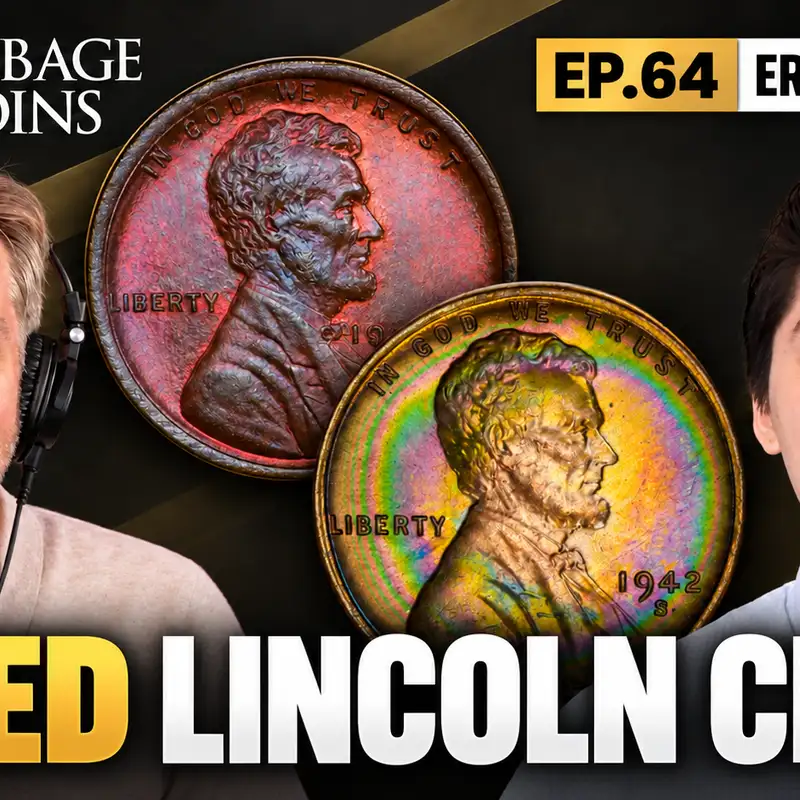
Toned Lincoln Cents with Eric Lindholm of Sublime Cents #coincollecting #numismatics
Eric Lindholm of Sublime Cents returns to the Cabbage Coins Podcast to cover early Lincoln cents. He and Tony Gryckiewicz go through example coins: Philadelphia vs. San Francisco strikes, planchet quality, color grades, rare key dates, and natural vs. problem toning. They close with a few rapid-fire questions.
Key topics and takeaways
Why Lincoln cents are popular (2:20): They're accessible, and they're an icon of American coinage. Eric says both cents series are strong in the market right now.
San Francisco alloy problems (4:23): Early S-mint coins often have improperly mixed bronze. That leaves streaks and "wood grain" patterns on the surface, as on the 1909-S VDB.
Spotting cleaned coins (9:14): Look for fine lines in the fields and an excess of whiteness when you tilt the coin. Tony also explains the range from chemical to mechanical cleaning.
Philadelphia coins should be near-perfect (13:05): Look for sharp rims, strong detail and good luster. Collect higher grades of these, since they're more plentiful.
S-mints are weaker (14:00, 22:08): Expect weak strikes and uneven planchets on the 1917-S. Even the best examples won't match Philadelphia coins.
Red vs. brown (16:02): Some mellowing of the red is normal on early S-mint coins, so grading is more lenient there. Eric shares a story about buying a 1921-S at the Long Beach show, and how the Gray Sheet price was a poor guide for nice early red coins (16:28).
Dealer risk and offers (19:25): Tony and Eric discuss who should name the price and the risk dealers take on when they buy.
Strike tip (24:02): Check whether the "O" in "ONE" is fully struck.
Orange peel texture and luster (26:00, 37:10): A bumpy "orange peel" surface and a band of luster around the face are good signs. Coins that look flat usually aren't.
Grading focus (27:00): Graders seem to care more about clean fields than hits on the portrait. Eric adds that a clean jacket is something to look for (52:07).
1926-S key date (29:01): An MS65+ red is listed at about $125,000, and a 66 brown could be worth around $200,000 in a red holder. Eric suggests a nice MS65 brown (about $3,000) as a budget alternative to chasing one color (35:21).
Toning (36:05–54:40): Eric covers raspberry, honeycomb/yellow, blue and rainbow toning, with premiums ranging from none to several times a coin's value. Natural toning tends to be non-uniform with mixed colors. Monochrome, electric colors call for caution. A rainbow-toned cent he sold for $750 on eBay shows how big the premiums can get.
Conservation caution (40:17): One coin had a light film lifted with a Q-tip. Eric and Tony both warn against experimenting on valuable coins.
Rapid-fire questions (55:33)
Favorite non-cent series: Barber quarters.
Favorite shows: the FUN show, Central States (Schaumburg, IL), and Long Beach.
Favorite book: Rick Snow's book on Indian cents and Flying Eagles.
Where to find Eric:
sublimecents.com
IG: @sublime_cents
Where to find Tony and Cabbage Coins:
https://cabbagecoins.com/
Email: tony@cabbagecoins.com
IG: @cabbage_coins
“Video editing and post-production by Manuel — specializing in podcast, YouTube, and digital content editing.”
Intro/Outro Music - "Obverse Fields" by Timothy Gryckiewicz