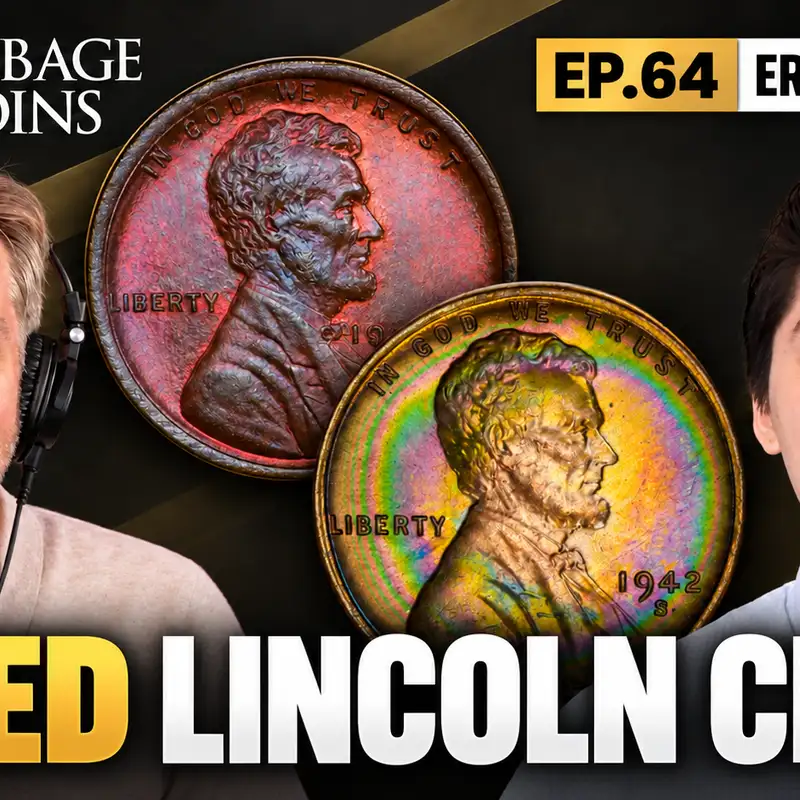
Toned Lincoln Cents with Eric Lindholm of Sublime Cents #coincollecting #numismatics
Hey, folks. Welcome back to another episode of the Cabbage Coins Podcast. My name is Tony Gryckiewicz, and today we have a return guest. We have Eric Lindholm. Eric is the owner of Sublime Cents, but you might recognize Eric.
Tony Gryckiewicz:He was one of our earliest podcast guests when this this thing was getting started roughly, I'd say, this point about a year ago. Eric's episode was one of the first ones that really kind of took off. People really gravitated to it. We looked at Indian Head Scents. We looked at colorful Indian Head Scents.
Tony Gryckiewicz:Eric was one of the first ones where I asked, hey, teach us how to collect this series. Teach us like what to look for, what to avoid, how to kind of avoid some of the the typical kind of mistakes and trip ups that people have. Eric is the real deal, guys. I mean, if you guys go out to Coins shows and you... He's pretty much at almost all of them, and I would say he's one of the top experts in scents, Indian Head scents, Lincoln scents that we're gonna talk about today.
Tony Gryckiewicz:So fantastic guy to get to know. Welcome back to the episode, man. How has life been for you since you've been a guest on the Cabbage Coins Podcast?
Eric Lindholm:Awesome. Thanks so much for that, Tony. And by the way, the Indian Scent episode was really helpful for me. Just being at a lot of shows, a lot of people saw the episode, and reached out, and have done business. So thank you so much for putting that on.
Eric Lindholm:It was a huge boost for my career, early career. And I just wanna preface today's episode too, in saying that I have a really deep connection with Lincoln Cent since I was coin roll hunting for them, since I was 15 years old, but I do not claim to be an expert on Lincoln cents the same way that I would claim to be an expert on flying eagles and Indians. So what I'm gonna be sharing today is sort of my learned knowledge, a lot of trial and error, but more importantly, a lot of really helpful people. So I'll be probably citing a lot of names of people that have taught me certain things about Lincoln's, but I am nowhere near an expert yet on Lincoln cents, but I love the series. It's a really long, deep, and rich series.
Eric Lindholm:So yeah, I'm just gonna talk about what I know, and yeah, excited. So what's been going on? Lot of coin shows, a lot of running around. The coin market's so hot, and it's so exciting just to be in the action, because there frankly is so much action right now. So yeah, it's been good, a little bit disorganized, but I hope when this episode comes out, I'll have a lot of new coins on my website, and lots to look forward to, so.
Tony Gryckiewicz:Nice. So, from your perspective, is the coin market just as strong in the sense area, in the in the head sense, Lincoln cents? I mean, you seeing a lot of the price appreciation auctions that we're seeing over in like the dollars, the Drapes bust dollars, and the barber stuff? Are you seeing the same in Indian Heads and Lincolns?
Eric Lindholm:I would say so, yeah. Especially if you look at like, just to make a common example, the $18.77 Indian head cent in the gray sheet has gone up leaps and bounds since our last episode. Maybe like 20, 30% per coin on every grade, and Lincoln cents are stronger than Indian head cents. I don't follow the market as closely, but yeah, both are very strong, I would say.
Tony Gryckiewicz:Now, why do you think that is? Because when I look at Lincolns, there are just so many. There are so many different dates, then you get into the dates later on where you're getting into years where there's just kind of become more common and they're easy to find, and there's not a lot of, you know, like high priced, high valued ones. But then again, like, we're gonna look at, I don't know what it is, a '21 s or something, one of these dates, maybe it's '26, I can't remember. That's like super, super expensive.
Tony Gryckiewicz:So, like, why is it that Lincoln cent series is actually still so popular to collect versus Indian heads?
Eric Lindholm:Yeah, I think it's, I mean, just to speak from my experience, it's like, it's what people grew up on. I mean, it was the coin that was circulating for, I mean, even my generation and all generations prior. I mean, filling out Whitman albums, and coin roll hunting like I did from the bank. I mean, it's just such a foundational coin, it's easy to get into. And just from my experience, I could actually afford to buy a box of pennies from the bank for $25, or if you wanted to buy a box of halves for $500, you know, I kinda needed help from my parents to do that.
Eric Lindholm:So I think it's just very accessible, and it's an icon of American history and coinage. It's kinda sad that it's ended, but I think that's also gonna give it some more fanfare going forward.
Tony Gryckiewicz:Okay. Alright, man. Well, without any further ado, we'll get into some of the coins that we're gonna show here today. I know we are getting started actually with one of my coins, a coin that recently had sold from my website. Eric asked, to start with this one, I had this for a short period of time.
Tony Gryckiewicz:This is a $190.09 s VDB. It's kind of like the... I don't know how to say the king of the Lincoln cents, but I know there's so... There's other ones that are so much more expensive than this, but still, this is like the one that people look for. Anyways, this is a 62 brown cac.
Tony Gryckiewicz:What did you wanna talk about and mention with this particular coin?
Eric Lindholm:Yeah. So, I know we're kinda talking, to start this episode, we can kinda start from a transition a little bit from the Indians to the Lincolns. So, in nineteen o eight, not 'nine, in 1908, that is the first year the US Mint created a scent in San Francisco. Imagine that, hundreds of years of mintage, and only until 1908 we have the first scent. So it was an Indian head scents.
Eric Lindholm:And then in nineteen o nine, we had a split year of production where in the beginning of the year, they made the Indian head scents, the nineteen o nine S Indian. And then halfway through the year, they transitioned into the nineteen o nine s, you know, $0.09 in in Philadelphia, then the $0.09 s in San Francisco, as well as the $0.09 s v d b as you have here. So early production in, you know, the West, the undeveloped West at the time. This coin, I think it's just an interesting note as we're talking about things to look for and what to know about the series, is that a lot of Estimate, especially the early Estimate coins from San Francisco, had improperly mixed alloys, which to break that down, an alloy is a combination of the metals used to create, say in this case, coin. And Lincoln cent is a bronze composition, which actually means it's 95% copper, as well as 5% zinc and tin, actually.
Eric Lindholm:So that 5% mixture really matters here, because when the metals are heated up and put into sort of like a mold, or like, you know, sometimes the zinc and the other stuff wouldn't mix very well, and when the clenched was being pressed, the improperly not mixed extra metals would show up on the surface of the coin, as in this example. They're often reflected in little streaks, or in this case, big streaks, but that is just purely a product of mintage. And you can kinda look by the nine and the zero of the date, see sort of that kind of pattern that's going through diagonally? That's sort of Yeah,
Tony Gryckiewicz:this right here.
Eric Lindholm:Feathery, yeah, wavy. They create so many interesting patterns and looks on these coins. The coin looks like it was painted by a brush for furniture or something. It's really interesting.
Tony Gryckiewicz:Yeah. I've always thought this has something to do with the storage or where they sat for years, and this is kind of a weird type of toning, but you're saying this is entirely the planchette. The planchet for people that know is like the raw disc that the coin is pressed upon, you know, the coin is used to press the coin or make the coin. So the composition of the metal within that, if it's improperly mixed, and not prepared properly fully, then you're gonna get this kind of a result that is showing different basically metal types inside the coin.
Eric Lindholm:Exactly. Like, it's showing metal types that should be mixed in perfectly on the surface of the coin.
Tony Gryckiewicz:Interesting. I actually like this one. It just recently sold, but I like this one because of the character it has. Feel like a lot of... I see a lot of o nine s VTBs, and so when you see them so frequently, the ones that just sort of look like every other one, I feel like they're a little bit more boring, maybe.
Tony Gryckiewicz:That's just me. I I like it with some character, so.
Eric Lindholm:I like the coin. It has almost like a split planchet kinda look, like the toning almost splits the coin in half, and it's very cool to see this improperly mixed planche, like, kind of play out in real life. Yeah. Yeah.
Tony Gryckiewicz:Half the
Eric Lindholm:coin got really dark, and the other half on the obverse has more of that original red. Then the reverse, it's like, yeah, it's mostly all there for the the mixture. So totally original. Your coin is a good strike. The surfaces look quite clean for a 62.
Eric Lindholm:Yeah. It's a nice original coin, and obviously, that's why CAC agreed as well.
Tony Gryckiewicz:Yeah. That's what matters. It's got that green sticker. Yes. So Cool.
Tony Gryckiewicz:Now, something that probably would never get a green sticker is gonna be this guy. Now, is an example, I think you mentioned it was clean?
Eric Lindholm:Correct. So, this coin also has some of the wood grain toning, as well as the previous one. This one has a more of a, like, literally more of a grainy and less streaky, especially on the reverse. There's like a darker patch on the... But, yeah, you could kinda see by the the jacket there, but, that especially.
Eric Lindholm:But this coin, and this is kind of like a deviation of wood grain. Like, there's... Like, your coin that is totally natural. It's cact. This is actually a cleaned coin that was wood grained, but has gotten worse due to the cleaning.
Eric Lindholm:I picked this example because I actually purchased it at the Long Beach show, and as a coin dealer, you can't always buy just PQ, super nice coins. People bring stuff up they wanna sell, you gotta offer liquidity if you can. I mean, you can do whatever you want, but I like to try to help people out, and if you wanna sell stuff, I'll pay what I can do. I mean, it's still very acceptable. I mean, coin doesn't have a bad look, but if you could see sort of like, there's quite an excess of whiteness of emanating from the metal, especially when you look at this coin at a tilted angle, It's hard to really explain.
Eric Lindholm:It's something just your eyes know after years of looking at this, but there's a lot of wood grain cleaned coins, and this is a good example of it. It's really hard for me to explain precisely why this coin is cleaned, but it's just not correctly looking, if that makes sense.
Tony Gryckiewicz:On first look, when I looked at this coin, when you sent it over, I all... I agreed the same thing. Was like, well, it's not a horrible looking coin, but
Eric Lindholm:Yeah.
Tony Gryckiewicz:You know, now as I'm looking in closer here on the kind of the zoomed up image, I mean, can see all of these lines that kind of extend through the course of this field that extend into the metal, which is just your sign of cleaning. And remember folks we talked about, there's varying degrees of cleaning with coins. There's things that are chemically clean where it's just a matter of being in jewel a couple too many times, it strips off the original surface, to a mechanical cleaning of some kind. If I were to take a rag, a towel or rag and I had some old dirty grimy coins and I started kind of wiping off that grime, that's technically a cleaning as well. It's a mechanical cleaning and that might leave some marks on the surface of the coin from that towel, from that rag, everywhere to somebody taking a wire brush or somebody taking some kind of a cleaning agent and actually scrubbing, you know, using a kind of a cleaning scrubbing action on a coin, all of that is going to the surface and so you look for telltale signs of that like these kind of etchings and these marks.
Tony Gryckiewicz:Something else that jumped out at me in this bottom left hand corner, I mean, I guess this is kind of a planchet, a lamination
Eric Lindholm:Exactly. Issue. That's how I put it. It's a rough, like, lamination, which is like, sort of like a stripping, or like a like a separation of the metal, if you will. Had a planchet lamination era in an Indian that literally had like a millimeter of gap between...
Eric Lindholm:It was like a flap on top of the coin. That's pretty crazy.
Tony Gryckiewicz:Yeah. Alright. So now getting into, I guess, some nicer stuff. So you laid out a variety of examples of like Philadelphia Mint versus San Francisco Mint, and then we get into some different types of toning and so forth. So, I'll let you take it away in terms of what we're gonna learn from this.
Tony Gryckiewicz:This is basically selecting coins for your set, for your collection, what to look for, kind of what to avoid. These are... This is a 21 p. It's a gorgeous coin. Mhmm.
Tony Gryckiewicz:And then what we have coming up, I believe is a 21 s. I'll come back to the 21 p, and what would be the lesson here? First off, do you what the grade is off the top of your head?
Eric Lindholm:I think this is a 68 plus possibly. Just wanted to use this coin to illustrate that number one, it's a Philadelphia mint, so obviously no mint mark. These coins came really pristine, even from the earliest days of the series. And the Lincoln series is almost like two series in itself. There's the 'nine to the 1930s, which is typically categorized as the early Lincoln sense.
Eric Lindholm:Then there's the 1930s to 1958, which are much more common and plentiful. Today, we're gonna be focusing on the earlier part of the series, just because I think it's really interesting. There's a lot of nuances to it. And generally with Philly mint coins, you're looking for perfection. You're looking for sharp raised rims.
Eric Lindholm:You're looking for beautiful feels, beautiful hair detail, good strike, a really well struck jacket, good beard detail. You're just looking for a really well made coin. Conversely, as we're gonna look at later, the early deed Estimans, but particularly the Estimans, were not made nearly as well. So for your filament coins, I would just say have a high standard, because they're much more plentiful, and they were made very well. And also in grade, you can expect, and you should probably collect higher grades of these when you can, just because they're more plentiful compared to the estimates.
Eric Lindholm:And you're getting a really good strike on the reverse here too, as we'll see. I guess this coin is kind of like, it's kind of a funny coin to start with, because things are gonna get worse from here, but that's just to show that filament link ins are generally very nice, and you should have them very nice.
Tony Gryckiewicz:Yeah. I think it's a great place to start with any educational description here, educational series is, like, what does the ideal look like? What does the best look like? This is pretty darn close to it. One of my favorite features of coins that are really high end that I look for is, if you see all this kind of...
Tony Gryckiewicz:I don't know what you wanna call it, but this is metal flow from the striking So of the the coin gets struck when all that pressure is applied to the planchet, metal starts to flow in various directions. That metal flow is what creates the luster that you see when the coin goes and twirls around. But when you see these signs of it here, like you can see kind of between the the C and the E and down from the ascent to the united, all of this, I really kind of enjoy that personally quite a bit. Oh, a symbol of very fresh originality.
Eric Lindholm:Oh, yeah. And and the left obverse field too, you see that like blast, like metal flow kinda, It just looks like... I mean, you could just tell that luster there is absolutely insane. It's wicked.
Tony Gryckiewicz:Yeah. This is this is pretty incredible. So now, comparing that with the '21 s, not as much, I guess, luster, but still pretty nice coin.
Eric Lindholm:And this is like the finest graded '21 s, I believe in I think it's a five plus red, which I think is an appropriate grade, and I actually have a little story about a twenty one s. This happened at the Long Beach show, and this just shows, guys, I'm not a full on expert on the Lincolns yet. There was a coin offered to me, it was a 21s in three red, that the collector... There's always a dynamic of who should offer the price, right? And this guy is a collector, he's like, I'd like to, and a very serious one by way, but I never met him before.
Eric Lindholm:He's like, I just wanna see what you would pay for this. And you know, we alluded to this earlier, I pull up my gray sheet, I'm like, okay, I know this is a rare coin, but what are just the numbers? And I think the gray sheet was like $5.50, the retail was maybe 700, and I made it off for around like $606.50 or something, and the guy's like, we're gonna need to do a little better than that. I was like, oh, okay. Looking at the coin, it's a really nice three.
Eric Lindholm:It's an old holder. I'm like, how about full CPG retail? I just wanna learn about these. Like, no, I actually paid a thousand dollars or more for this coin years ago. And that's when I learned just how tough early estimate red Lincolns are.
Eric Lindholm:Guys, for nice coins like that, you can almost throw away gray sheet and bid, which I learned, because another dealer bought the coin much more than I was willing to pay at the time. But as you can see, this coin's a five plus red. You can already see there's some light mellowing of the red in the left auburse fields, and this is just truly how they come. These planchets were prepared very well. It's actually a pretty well struck example, but a lot of these weren't well struck.
Eric Lindholm:But when you have that level of mellowing, you just really can't get that high of a grade. Lot of these coins in red holders, if they were filling mints, they wouldn't even be graded red. So it's just a tough date. It was a really good learning moment for me about, wow, these early Lincolns are probably undervalued in a in a sense, and are just extremely tough.
Tony Gryckiewicz:Sure. So one of the things you're saying is that the red... The the presence of some of the, I guess, the mellowing of the of the red is is expected or more normal on the San Francisco issues, and so they're gonna be a little bit more lenient on those coins in terms of grading.
Eric Lindholm:If you're expecting Philly mint reds on S mint or even some of the D mints, you're just for the early parts of this series, it's just not gonna happen. I think you should obviously strive for as much redness as possible, and be very discerning on coins that, especially that have really mellowed over time, and in the holder, like, okay, this coin is functionally a red brown at this point, maybe I'll pass on that one. But you see a coin that is like this, it's like, you know, that's almost as good as they can get.
Tony Gryckiewicz:Yeah. Going back to your story, I feel like after the first go of you putting an offer out there, I feel like the customer probably just needed a price. Like, what is it that the person actually wants for for the for the coin? So it's just usually where I'll go with it. I'm happy to do a little bit of research, but at the end of the day, we've talked about this at length in this podcast or other videos as well.
Tony Gryckiewicz:At the end of the day, you know, there's an element of my time and my expertise that... And you know, my background knowledge and so forth that I'm putting into giving a price for a coin, which I'm happy to do, but if it's not going to work, mean, I the first question I'm gonna have is just what is it that you actually do want for this coin, you know, order to be able to get it sold? I also think that it's important that the coin is sellable in that engagement as well. Kind of going on and on and and saying that you never kind of hit the number and then just moving on. I just feel like it's a huge bit of waste of time, and ultimately, you're giving away a lot of your knowledge, expertise, experience, all of those things.
Tony Gryckiewicz:You're kind of giving it away just kind of for free, you know?
Eric Lindholm:Oh, no, you're good. Go ahead. Certain circumstances, I feel like my time is, you know, people are really just using your time, and it's like, especially for things I didn't really know, I'm like, I'm really giving you a good price, I'm telling you why. But in this case, actually, it was an example where the collector educated me on this particular coin. I was like, Wow, this is, he knew what he was talking about, and we actually had a good connection after that.
Eric Lindholm:That was like a rare case where it's like a happy ending in that sense, but I remember you and Noah had a very good conversation about the dynamics of who should offer the coin, and Noah had a very strong opinion, which I tend to agree with and mature. Sure.
Tony Gryckiewicz:Yeah. Us dealers, I mean, we take a lot of risk is really what it boils down to. I cannot show up to any show without prices on my coin, so I have inherently taken a risk by figuring out what it is that I want and not leaving a lot of money on the table, you know, and at the same time when coins are being offered to me and I'm taking a chance, in the course of this transaction, a lot of the risk associated with owning the coin and bringing it to market is being transferred over to me. I got to figure out where I'm going to sell, I got to figure out really realistically, you know, so it's worth my time and so forth to even carry it and put it on the website and take it to shows and so on and so forth. So, I'm taking certainly a bit of a bit of risk involved and it often goes...
Tony Gryckiewicz:I'm not spoken about enough, think, the risk that the dealers take on with...
Eric Lindholm:Actually, we're willing to pay strong. We're not trying to offer you gray sheet. We're trying to use Pocket our
Tony Gryckiewicz:gray, yeah.
Eric Lindholm:And our client... Yeah, a pocket gray, which sometimes I feel is kinda criminal on some transactions. But we use our expertise to have clients to be able to sell these coins at strong numbers, and to pay strong numbers, so that shouldn't necess... That that does have a cost, like you're saying, and and, yeah, I think that's completely not appreciated enough in our world.
Tony Gryckiewicz:Sure. Alright, man. We'll move on here. So this is now a 17 s mint. Now this starts...
Tony Gryckiewicz:I wanna see here where we're going. This is going with the... Oh, this is 17 s versus 17 p. Okay. So I'll
Eric Lindholm:You can do it in reverse. That's that's perfect. So this is an 17 s. I think it is a 65 brown. So now we're looking at browns, which is a little bit more in my wheelhouse.
Eric Lindholm:This is basically the highest graded Brown. There's two five pluses, and it's a 17 S, and keep that in mind, it's quite a tough date. Now keep that Philly coin in mind, that bright red earlier one. Look at this... Compare the strike to this coin.
Eric Lindholm:Look at the top of the ear almost missing. Look at the cheekbone somewhat recessed. You know? The hair detail's actually not bad. And as you go down on the jacket, I think particularly, look at the jacket on the left side.
Eric Lindholm:It's much... There's fewer grooves. They're less defined by the neck.
Tony Gryckiewicz:Yeah.
Eric Lindholm:This is just very typical of Estimate coins. It's weak strikes.
Tony Gryckiewicz:Okay. Yeah. I mean, he definitely looks sullen. I mean, the eyes are not really well defined. Ears are almost nonexistent.
Tony Gryckiewicz:Mhmm. And the jacket looks kind of like a... And more
Eric Lindholm:of his blob here
Tony Gryckiewicz:in back.
Eric Lindholm:On this one. Oh, yeah. The eye in liberty too. There's sort of a texture to the planchet there, but we're really gonna get into planchet texture here. So Okay.
Eric Lindholm:Starting out on the right where you are, look at that sort of like that darker luster patch there. Is due to when you look at the coin in hand, there's like the metal kind of is lower in that spot, whether it's due to the planchet quality, like maybe when they were being rolled, there was slightly scraped in that spot. That is very common to see on this coin, sort of this different color due to the planchet being literally recessed. So it's not like a uniformly flat planchet at all. And so you can see with the rest of this reverse here, can see why this planchet's not very good.
Eric Lindholm:Look at the... And the strike. Look at
Tony Gryckiewicz:the
Eric Lindholm:one, the o of one there.
Tony Gryckiewicz:Yeah. O
Eric Lindholm:of That is one of the most... If you're looking to collect high quality Lincoln cents, try to collect examples where the o is fully struck or as struck as possible. I know in the Indian sense, I talked about looking at full feather tips. On Lincoln's, I hear this from collectors I sell to. They like to look at the o of the one and see if that's well struck.
Eric Lindholm:That's just a little tip for finding nice examples. Because even for some years, like for Philly years or other years, there'll be variations on one with really good strikes and really bad strikes, and sometimes people don't pay attention. The AM of America. So you can
Tony Gryckiewicz:see What was going on in here?
Eric Lindholm:You can sort of see... Look at the planchette too, how wavy it is down there. There's sort of some... I don't know if you can see that, but it's just kind of... The planchette is kind of wavy and odd.
Eric Lindholm:I think there's a die crack coming off the the bottom there. Sure. It's just that I just think the strike wasn't very good on top of a bit of an irregular planchette for this year.
Tony Gryckiewicz:Yeah. That is So it's just a good example. Great.
Eric Lindholm:Oh, go ahead.
Tony Gryckiewicz:Oh, this looks like raw planch is what this looks like to It's me a little
Eric Lindholm:very, very... That's a terrible strike, and and the reason I show this this coin is just because it's graded five. I mean, it probably has a really good luster, but So
Tony Gryckiewicz:this is an MS 65 Mhmm. Given it's a San Francisco and a lot of these were not made very well, at least in terms of the, well, planetary preparation, it seems like, as well as the the quality of the strike on the coin. Yeah. I mean, all of this, this is not wear, this is not damaged, this is probably unstruck planchet and just kind of a weak striking up here as well.
Eric Lindholm:Literally how it Yep. Came
Tony Gryckiewicz:Yeah. So now, transitioning and comparing to a Philadelphia coin. This is now a Philadelphia. This is gorgeous.
Eric Lindholm:Yeah. Just look at the strike. I mean, pretty much explains itself, and and one other detail is is you were talking about metal flow, and like, you know, how well these were struck. Look at that sort of that left field, that sort of in the Lincoln cent world, it's kind of called orange peel texture, which we're gonna talk about a lot today. When you think of just the rind of an orange peel, or of an orange, it has that sort of nice, bumpy, smooth.
Eric Lindholm:You'll see that on well struck Lincolns, and we'll get into some examples later of how that also potentially affects grade as well. But, I mean, this coin is just flawlessly struck super well. It's beautiful. I think this coin's graded MS 67 brown, which I think is an appropriate grade. It's probably...
Eric Lindholm:It's super lustrous in hand. Not a coin I've owned, but just a good example of how in your... If in your collection, your P coins should look super nice, and your S coins should look as close as nice as they can, but they never will be as nice as the P coins.
Tony Gryckiewicz:I wanted to ask you about, this is a 67. This right here that looks like a gash, is this planchette issue?
Eric Lindholm:I know, that's that's a hit, and I'm actually really glad because you brought this this is something I've learned from, and this is a little bit of a discussion on grading. I think, this is just my opinion, but from grading and upgrading, Lincoln cents, it seems like the graders, generally, are a lot more focused on the cleanliness of the fields on Lincoln's than they are about hits on the devices and the face.
Tony Gryckiewicz:I see.
Eric Lindholm:I've had... Because that, you're right, that is a fairly good sized hit there, but there's a lot of folds and sort of texture to the face, and you'd see that by the nose that it's sort of that... You know, these different lines that are part of the design that I think can sometimes camouflage actual hits to it as well. Yeah. So I think that's why the face gets a lot more leniency than the fields.
Eric Lindholm:In the fields, when there's a decently stray mark, it's very noticeable. So I I think it's a great pickup there. And from a technical grading perspective, maybe you could say this coin should be a a 66 plus, you know, not a But I I think I'm pretty sure this coin's a seven, but that's just... Yeah. That's a that's a good point on on grading and how these are sort of these are sort of graded.
Tony Gryckiewicz:So for this one, what can you tell us in terms of, like, a premium, especially for this color? Because I appeal perspective, this is kinda killer.
Eric Lindholm:It's quite nice. Yeah. And on Lincoln's, this is a bit of a difference than Indians. A lot of light blue and purple colors are completely acceptable, which I have an example of later. But, yeah, these these blue colors are totally natural, especially when they're not monochrome, meaning there's other colors sort of interlaced with it.
Eric Lindholm:Like, you can see this beautiful orange russet fall color, some light, like, purple and mahogany mix, and this is a totally original coin, likely maybe tissue paper, or who knows? I'm not an expert on how storage affects toning, but when you see this color, it's totally good.
Tony Gryckiewicz:Yeah. Perfect timing for the the pumpkins and the falls.
Eric Lindholm:I'm not right now.
Tony Gryckiewicz:Decorations all behind me here. Oh, I
Eric Lindholm:love you.
Tony Gryckiewicz:So, alright. Okay. So, this is starting the series of 26 s's. Mhmm. I believe this coin is super expensive, right?
Tony Gryckiewicz:Is a 26 S. It's red.
Eric Lindholm:Especially in red, yeah. I think a 64 is worth like 20,000 these days. This discussion here is that, is actually a bit about, I think, grade as well, and how for the 26 S, there are no 66 grades across the series, except for the brown example here. And I think it's just pretty interesting when you're collecting these coins that for some dates, let's say you say, I wanna do all red Lincolns. Okay.
Eric Lindholm:That's good... That's a fine goal, but you're gonna run into these sand traps, like this '26 s, where a four might cost you 20,000, a five will run you... I think this is a five or five plus, 50, I mean, 75, a 100, a 100, five plus would be a 125,000. You look at the coin, there's some weakness on the reverse, there's some mixtures to the planche, there's some color impurity, which also happens on all the estimates. It's also part of the alloy not mixing well, is that the color doesn't come out as uniform as, say, a Philadelphia mint.
Eric Lindholm:So, it's sort of a conversation on value here, if we go through these. This is a red, and by the way, it's not gonna be an explosive, bright, brick red Philadelphia. This coin is fully red, the way, is a nice, nice red for this state. They come much worse. They often come very streaky, very red brownie.
Tony Gryckiewicz:So the the grade, this is a red, but what is the grade, and then what is the value again?
Eric Lindholm:I believe this is a 65 or five... I think it's a five plus red, and the price guide value is a 125,000.
Tony Gryckiewicz:Oh, wow. At this point.
Eric Lindholm:I mean, it's it's almost 100,000 per penny. Yeah.
Tony Gryckiewicz:Okay. This is the one of the ones, penalties, guys, that I want phone calls about. I don't want the ones about the Encotby Trust Encotby Trust, you know, error or the other Lincoln errors that you've been reading about online. I want phone calls about the '26 s here in I'd love to buy coins like this.
Eric Lindholm:Like a four red get to buy one. Yeah. This is a a red brown now.
Tony Gryckiewicz:Okay.
Eric Lindholm:As you could see, it's a nice coin. It's a five plus red brown, so top of the range. It's about a 15 k coin for a five plus red brown. Wow.
Tony Gryckiewicz:Okay. It's a gorgeous coin, actually.
Eric Lindholm:It's nice. Yeah. No. This is... I mean, that's...
Eric Lindholm:I think it's appropriately graded as the best. It's got nice, even color. I mean, this is a nicer example of an men. See the jacket's better than that 17S, the cheekbones more defined, but you could still see the hair is weak, the In God We Trust, it's fully struck, but it's kind of bulging out a little bit. It's not as crisp as a Philadelphia.
Eric Lindholm:And there's... Look at the right obverse field, look at that planchet like texture, kind of by the date, it kind of has like a wrinkle there, and it's like... You know what I mean? It's kind of wavy. I think the planchets are so interesting.
Eric Lindholm:Look at that bump.
Tony Gryckiewicz:Yeah.
Eric Lindholm:Like, very for huge planchets on these blankets, which isn't talked about much, but that's just purely from observation, just seeing these coins. I think the reverse is
Tony Gryckiewicz:I like this coin quite a bit, man.
Eric Lindholm:Oh, yeah.
Tony Gryckiewicz:I would I would own this coin all the time. Mean, I would probably love this.
Eric Lindholm:But, yeah, look at that planchet waviness. I mean, if you put like a Yeah. Log
Tony Gryckiewicz:could see the waviness for sure here.
Eric Lindholm:Yeah. All the way around. Know, peaks and valleys everywhere. But well structured though for an estimate, you can see this is like as good as they get, and it's
Tony Gryckiewicz:not Yeah. Full one. Mhmm. AM. Yeah.
Tony Gryckiewicz:I imagine this AM is gonna be where it's weak because that's where on the other side, you have the top of Lincoln's head. Correct.
Eric Lindholm:Yes. A lot of relief it's working against.
Tony Gryckiewicz:Yep. Okay. So then, this is gonna be a estimate again, but this is a brown, very different situation regarding the strike here.
Eric Lindholm:Yeah. 66 brown. So it's the finest known '26 s grade wise, and this coin sold for a lot
Tony Gryckiewicz:of money.
Eric Lindholm:It's with a collector I know. I don't know if he wants me to say what it sold for, but it sold for more than what the red brown coin is worth. And if you look at the luster of this coin, and sort of the strike as well, especially the reverse, it's got a hammered strike for the date. It's got good luster and color. From a value perspective, this coin was in a red holder.
Eric Lindholm:This would be like maybe a $200,000 coin. Okay. And so, it's a big trophy coin just because it's the highest graded, and as you can see with this date, they're just so tough to come this night. And there is a little bit of streaking on body of Lincoln there, that is to note. It's very lustrous in hand, and quite well struck for this issue.
Tony Gryckiewicz:Now, a streak like this, my gut tells me something like a rubber band, toning kind of a thing, but this streak, is this a planchet? I just can't imagine a planchet flaw or planchet mixture being this perfect like this. Do you know what this probably is?
Eric Lindholm:To be honest, I wish I did know. What I will say though, is I have seen that on many Lincolns, especially on some of these earlier ones. They have these weird streaks that go through the the body. But yeah, no, beautiful coin, just... It's just pretty amazing that the finest known of this date is a brown.
Eric Lindholm:Just speaks to how
Tony Gryckiewicz:true
Eric Lindholm:they they are.
Tony Gryckiewicz:Yeah. Mean, that's interesting. Yeah. I mean, this coin... I mean, my first thoughts were really around the strike not being as as as prominent or as good as the the red...
Tony Gryckiewicz:Red brown. I mean, I feel like Mhmm. This strike is better.
Eric Lindholm:It is a little bit better.
Tony Gryckiewicz:Pretty sure. Oh, yeah. I think so. Maybe it's also the image. It's possible that it's
Eric Lindholm:the image. The TrueView is a bit dark on this one, unfortunately. I think it doesn't really illuminate the coin as much as as well as it could, but... Yeah. The reverse is amazing, like.
Tony Gryckiewicz:Okay. Well, I wanna start looking for 26. I'll tell you that much. Didn't realize even that this was really the the the key date of the series. I'm gonna start looking for them for sure.
Tony Gryckiewicz:Offering them on campuscoins.com.
Eric Lindholm:To close out, I guess, from a value perspective, finding a nice five brown 26 s with good color for maybe $3,000 could be a great alternative if you're putting together a collection, but you don't have million dollar bankroll or huge amount of money, is just trying to find, is playing within the different colors, and trying to find as nice of an example you can get, you know, for the date as well. So having just a very strict, I want only red, or only brown, or red brown, can make it, your adventure quite expensive and costly. But if you know what to look for, you can try to, you know, find different examples, different color types.
Tony Gryckiewicz:Yeah. Alright. So then moving on to a series now of Toned Lincolns. Mhmm. So looking here, we have a 16 d.
Tony Gryckiewicz:I think this is the first Denver mint coin that So we're looking what does this color tell you?
Eric Lindholm:This is like a good example of a very original sort of... The color is brown, but it's actually a bit purple when you really look into it. Look at the right, yeah, the left obverse field, you see that purple poking out? It's really in hand when you see the luster, and this is an example of orange peel I wanna talk about. If you look at the surface texture in the right obverse field, you kinda see that Heavily.
Eric Lindholm:Bumpiness that I think really affects the grade. So this is just a little bit of a commentary on grading as well. This coin was in a five brown holder that I cracked out. Was an old NGC, and it graded PCGS 66 brown, which was really nice on the first try. And 66 Brown early Lincolns are a very competitively collected coin.
Eric Lindholm:The pops are really low on them, anywhere from pop one to pop five or 10. I think this coin's now pop four in 66, and it's worth about 1,500 to $2,000. So looking for examples, and this doesn't need to be about all high grade Lincolns, because we all have different tastes and budgets and collections, but looking for coins with that of that orange peel texture and that sort of that... When you see a band of luster in front of the face there, so you can kind of see that band of darkness, when you see that band of luster in front of the face and sort of behind the head, it's kind of like a round aura, that really can affect the grade in a positive way, and it's just very appealing in hand. I try to stay away from Lincolns that look really flat.
Eric Lindholm:Like, they might be
Tony Gryckiewicz:in a four or a
Eric Lindholm:five holder, just because they're technically clean, but they don't have much luster. When you see that band of luster around the face, that's a really good sign for a nice coin. Yeah. And pretty well structured too. Yeah.
Tony Gryckiewicz:How much about the the color premium on that one?
Eric Lindholm:I would say there isn't much of a premium for this color. I would just say it's a nice color, and we're gonna get into some other toned ones. But obviously, like, a straight chocolate brown is also awesome, and in some cases can command a great premium just because it's a straight up nice color that is very uniform, and is very collectible. But this one has a little bit purple and orange in it as well, which I like.
Tony Gryckiewicz:Wow. So we have Yeah. This kind of raspberry colored kind of toner. I love it.
Eric Lindholm:Just... I love the raspberry toned Lincolns. When you could find this sort of color, it is just simply fantastic and beautiful. Yeah. Not much more to say about that, just when you find that raspberry toning.
Tony Gryckiewicz:Yeah. So let's talk about that. I mean, where does this come from? I mean, I have not seen a whole ton of coins that have tone like this. A, could anybody consider this possibly look at this and say this has been artificially toned in some way?
Tony Gryckiewicz:You know, b, how common is it to find coins of this kind of caliber? And c, what kind of premium?
Eric Lindholm:Yeah. I cannot kind of open up on this coin a little bit. It's not my coin, it's a coin that a coin dealer years ago found in a NGC 65 brown holder, and this coin is in a PCGS 67 brown holder. This coin had a little bit of surface dirt and film that was on the coin. So this coin did not look like this before this.
Eric Lindholm:This coin was actually light, carefully conserved using a q tip just to roll off some of that surface dirt, and it revealed this incredibly, completely natural raspberry toning that was right under, like, is the patina of the coin that was just covered a little bit with some, you know, film and light, something like dust and stuff So like this is totally natural coin. It's not been chemically enhanced or dipped or anything like that. It's just sometimes, like, these Lincoln cents have such large open fields that however they're stored, can just pick up amazing colors, which is different than the Indian because there's so much device on those coins. The fields are relatively a lot smaller compared to Lincoln's.
Tony Gryckiewicz:So you mentioned about Q tips before folks out there are breaking out their coins and Q tips and ruining Be
Eric Lindholm:careful about that.
Tony Gryckiewicz:Do you... Yeah. Do you know what they would have used to remove the gunk? Was it just like an acetone or a DNA alcohol or something?
Eric Lindholm:Sometimes you can use a very light amount of olive oil. It's very harmless and and water, and warm water to remove that kind of dirt without affecting the coin. Because a lot of... You look at the early copper coins, a lot of those coins were brushed with a camel hair brushed with olive oil or some sort of oil to to sort of preserve it and keep the surfaces inert and intact, I guess, over the years.
Tony Gryckiewicz:I did not know that whatsoever. Olive oil. Again I could use extra the kind of... Yeah. For sure.
Tony Gryckiewicz:This is the kind of thing that you don't get started trying to experiment on expensive coins by any stretch. Oh, yeah. There's a whole lot to learn as a steep, steep, steep learning curve when it comes to the proper conservation of coins, and that's Oh, absolutely. Why we pay so much money to get it done by professionals, frankly.
Eric Lindholm:And, Yeah, you can really mess up coins. I don't wanna say that it's harmless either. You know, you can, you have to be very careful with what you're doing, and even I don't, like, you know, I prefer not to have to do anything to my coins. I would say, as much as possible, you don't want to do anything. It's only when there's certain mitigating factors to a coin where it's like, okay.
Eric Lindholm:Like, you know, in your case with some PVC Morgans, of course, you know, use some diluted acetone, remove it, but, yeah, generally, I love just keeping the coins as they are, frankly, and that's why they're beautiful. But this coin had a beautiful raspberry hiding just under a very light film.
Tony Gryckiewicz:Alright. So moving over to something that this is just sort of wild. Guess we... You say it's Sublime. This is Sublime.
Tony Gryckiewicz:So tell me about this one, I mean, do you think this is all natural, and and if so, how would something like this happen, and what's the value of something like this?
Eric Lindholm:This coin's a 66 plus brown. It's the finest known 47 s. Mean, it's got a glowing nuclear... Oh my gosh. It's just as good in hand, and there's actually a light film on this one too that the TrueView cuts perfectly through, but this coin's never been touched.
Eric Lindholm:Mean, it has a light, delicate film to it. It was probably stored in tissue paper, is my guess. Some experts on how Lincoln sensed tone. I actually think, Tony, there'd be a perfect individual to talk about toned Lincolns. He's a collector that we could talk about later.
Eric Lindholm:He's a great person to have on for this, but I think I would guess if I was listening to his advice, this would probably be a tissue toned example. You can kind of see on the reverse too, there's a big patch of red still remaining that I think could have been where possibly it was either covered by the tissue, or it was exposed. I don't know which way it'd be, or maybe the tissue wasn't touching that part of the coin, but there's a big patch of red on the reverse here. So that's how the coin is until it, you know, sat in this paper.
Tony Gryckiewicz:Okay. So for something like this in terms of the color premium specifically, you get a coin like this. This is a Wow coin. Yeah. These are pretty few and far between.
Tony Gryckiewicz:Yeah. What kind of premium do you see on a coin of this nature of this kind of color?
Eric Lindholm:Yeah. I mean, if the coin's value is quite low, I mean, you can even get many hundreds of dollars, if not thousands of dollars of premium for color, for green, fully enveloped green toning. There's a 45p that's not on this. I don't have a photo of, but it's with a collector. It's completely just straight like Saint Patrick's Day green on both sides.
Tony Gryckiewicz:Okay.
Eric Lindholm:Coin might be worth 50 to $100 in whatever holder it's in, maybe like $30, but that coin's worth multiple thousands of dollars, if not more. And this coin sold for... I believe I sold for $3,000, and it's gonna be through a collector that collected Lincolns. He's very well known, Terry's Toners. He's selling his whole collection.
Eric Lindholm:He's been selling his collection for the last years. This coin will come back on the market on GC in some time, and we'll see what it brings again, but I'd definitely be interested in buying it from my personal collection, to be honest. It's that amazing.
Tony Gryckiewicz:I see. Alright. Well, I promise I won't be bidding against you, man, if it comes up for auction.
Eric Lindholm:Yep. You know, I that. At the right price, you can have it. I'll... I have to let it go after a certain price, but it's a crazy coin.
Eric Lindholm:There'll be other Lincoln aficionados going crazy.
Tony Gryckiewicz:Yeah. Alright. So, then we have, I think you described this to me as like a honeycomb kind of tone. Yeah. What you mean by that?
Tony Gryckiewicz:I'm really bad with colors, by the way, so maybe was something
Eric Lindholm:that's It's like this yellowy, like, you know, honey, hay kind of color that, when you get it to fully cover a coin, it's just super beautiful, in my opinion. I think it's a little bit of an underrated color scheme, that people look for rainbow, or they look for crazy purple and red, or blue, but I love yellow and lightly green coins. I think it's just a bit of an underrated color that certain collectors seriously appreciate. So, when you see a honeycomb, or really yellow, it's super original. This color is extremely hard to fake, Like, when it's just like this.
Eric Lindholm:So that's extremely original. I don't know how to explain why, but when you find them like this, I would definitely look favorably on coins like that.
Tony Gryckiewicz:Got it. So this is kinda... Has like a yellowish hue to it. Mhmm. That's what you're telling me.
Tony Gryckiewicz:Exactly. Okay. For all sorts
Eric Lindholm:of copper, by the way, large scents, Indian scents, flyers. When you see that yellow, golden, amber color, it's... Trust me, there's some serious collectors that like stuff like that.
Tony Gryckiewicz:Okay. Now, this is a color that jumps right out right out at me, and this is this blue 1913 s.
Eric Lindholm:This coin has a name. A collector called it Blue Bomber, and it used to be a Pop two. It's a '66 Brown. It might be a Pop three now, but I know in my one thing that people took away from the Indian scent podcast is like, be very careful about blue and purple toning. Got some emails about that.
Eric Lindholm:I got some questions. I think that's... It's a great point, because so many of the fake Indians and Lincolns are blue and purple manifestations, but this is an example of a naturally toned blue coin. Like I said, it could have been tissue paper, it could have been albums. A lot of these coins were Whitman albums, and some people even told me about the location of the coin in the Whitman album affects the toning as well.
Eric Lindholm:I don't know where the 13 s would be, but yeah, this is a naturally toned blue Lincoln. And like I said earlier, when you see a blue coin, you off... You wanna see if there's some other colors present, like in the corner by In God We Trust, there's some light purple mixed in. I think a big sign of artificial toning is, it's not a catch all, but is a fully monochrome coin, because that's usually a sign of... It's just a way that a lot of the bad coins look.
Eric Lindholm:It's like the whole coin is almost exactly the same. It's almost too uniform. It's not like mother nature, you know. Mother nature is a little bit Okay. Less perfect and precise.
Eric Lindholm:So... Yeah.
Tony Gryckiewicz:One is so brilliant and bright and kind of electric kind of blue. I feel like this one, I'd be personally feel a little bit hesitant about. I would definitely be walking this one over to your table to get your opinion on this before I would purchase this coin. I just don't have enough experience here to see that this kind of toning is fully legit. I mean, it's so powerful.
Tony Gryckiewicz:So Mhmm. But I take your word for it on that one. It's kind of blue and I think it's got a little bit of maybe a little bit green possibly. Mhmm. But it's mostly just kinda blue, and and like you mentioned, purple in here as well.
Tony Gryckiewicz:It's interesting about the strike. You see it as kinda like these
Eric Lindholm:these metal
Tony Gryckiewicz:metal flow.
Eric Lindholm:Yeah. It's like... It's almost like it was struck and, yeah, just slid out. It's amazing. It's kinda like
Tony Gryckiewicz:a
Eric Lindholm:razor sharp edge to the jacket. Yeah. Good example of crazy strike on this 13 s, so the textured, weight, and fields, the jacket flaring out, definitely a good catch.
Tony Gryckiewicz:Now, normal 13 s is is it an expensive coin or or not? Tougher Without the toning.
Eric Lindholm:Oh, oh, say again What for
Tony Gryckiewicz:I'm asking is, like, without the toning, is it kind of a standard? I mean, is it very expensive? Is it not... It's not a key date.
Eric Lindholm:Semi key ish date. I mean, when you get into the high grades, it gets expensive for sure. I mean, all the early from the teens and twenties estimates, all pretty tough, generally.
Tony Gryckiewicz:Alright. And then, so with the toning, what do you... What kind of premium do you think a person should expect on this? Mean, is this a Because 5,000
Eric Lindholm:it's such a high grade, it's maybe like a $10,000 coin, but let's say it was like a five or four brown, can maybe expect like a point five x to a one and a half, two x. It just totally depends on how much you like it too, you know. But, all depends if it's, you know, it's natural, you like it, and stuff like that. Toning's so subjective, so.
Tony Gryckiewicz:Okay. Yeah. To just clarify, point five x would be half the price of what the thing is. You mean like a 1.5 x?
Eric Lindholm:Oh, One point x. Yeah.
Tony Gryckiewicz:Okay. 50% Yeah. More than
Eric Lindholm:Exactly. Alright.
Tony Gryckiewicz:So, final two, we have this $19.12, but this has got a lot of different colors on it. This is a 12 p. Mhmm. Really interesting look to this coin.
Eric Lindholm:It's like, yeah, it's it's not the best TrueView. It's in hand, the coin is like, it looks sort of like chocolatey, but then when you put under a light, just like this like this blue and sort of this yellow, which doesn't show very well, pops up. Also, potentially natural toning for these Lincolns. Mean, you... When I...
Eric Lindholm:When you talk to some Lincoln guys that have pulled original hoards of Lincolns out of tissue papers and things of that nature, you just get a super wide color spectrum that you don't see with the Indians and flyers per se. So just another example of a a sort of a blue toning that's more acceptable. That's, you know, I don't wanna speak super definitively like I know it's fully natural or not, but this color is acceptable, a graded PCGS 66 plus brown. And when you find the blues sort of like a little bit... It's it's when you find these electric blues that are almost so bright and vibrant, just like jumps at you, like, woah.
Eric Lindholm:A natural blue is a little bit more subdued than that, I would say. It's a little bit of an eye test. Don't get me wrong, this coin's very lustrous and very eye appealing, but that blue is not just hitting you in the face. In hand, there's sort of a chocolate brown patina to an extent, then under the light, it really comes out.
Tony Gryckiewicz:I see. Wow. Yeah. This is pretty incredible. I mean, I love this coin.
Tony Gryckiewicz:I love the overall look of it, even with this particular true view. Mhmm. The subtlety of the of the the colors throughout. I mean, it also looks very well, very well struck. Mean, everything seems to be really kind of razor sharp all across Lincoln here.
Eric Lindholm:Yeah. I love well struck Lincoln's end. Yeah. It's P mint. So...
Eric Lindholm:Oh, wow.
Tony Gryckiewicz:Yeah. This jacket, you can see the folds, how it's exactly expected to... Oh, this is a... How they should look. If
Eric Lindholm:you go back to the jacket, when you... This is something I wanted to talk about today too, is you wanna look for clean jackets. No matter what grade you're buying, jacket is, especially the bottom, one of the high points of the coin, and that's where it comes into a lot of contact. So in a lot of Lincoln, this is what I look for, personally, I've heard from ANA grading class, a little pro tip out there, the actual graders grading your coins, a lot of them will look at the jacket for hits as sort of like, you know, a place where they kind of, you know, wanna grade the coin is. When you have a really clean jacket like this, coins like this scream six, you know, potentially seven, or higher.
Eric Lindholm:A lot of times you'll see on Lincolns in four or five holders, they might have really nice field, or they might be pretty nice, but sometimes the jacket just is hit up, especially like these long downward hits, or long horizontal hits on the jacket, really drag down grade.
Tony Gryckiewicz:Yeah, mean, this jacket, really, if you look at it, I mean, it kinda makes the character come to life. You just have this kind of these natural folds of the fabric right here that I'm seeing. I mean, you see in his bow tie, you can actually see the the ends of the bow tie here, which... Very nice. Yeah.
Tony Gryckiewicz:And you got a full ear and you actually have, you know, bits of the curls through his
Eric Lindholm:Oh, yeah.
Tony Gryckiewicz:Through his beard. He's got a little bit of neck beard neck beard going on, but, you know
Eric Lindholm:Oh, yeah.
Tony Gryckiewicz:It's okay.
Eric Lindholm:I think one of my favorite dates for Lincoln's, I think is like 1915 or 16 peas. They're just hammered Like, beards are like, you could find them perfect beards.
Tony Gryckiewicz:Mhmm. Yeah. Cool. Very cool. And then our final is gonna be this incredible coin.
Tony Gryckiewicz:This is awesome. This is rainbow tone. I mean, yeah, I don't see this kind of thing very frequently.
Eric Lindholm:No, and this is one where my knowledge sort of reaches the end. It's a coin that graded questionable color once, and then, you know, wouldn't cross from an NGC holder, then it grades another day. It's a wild concentric rainbow, like full of bands that you see on... Especially on later Lincolns, you see this concentric toning, and you see sort of like a terminal luster, or terminal toning at the end of the rainbow. There's people that are more knowledgeable about me about this color spectrum, but the point here is that these go for wild premiums.
Eric Lindholm:Look at some great collections comps. I sold this coin for $750 on eBay to a specialist, I and sold the next probably underpriced it, it's fine. You know, it's just an amazing color pattern to look for. If you're really going for color, you're looking for amazing, you know, sublime toning patterns, this is one of them to look for. Don't understand this reverse, to be quite honest with you.
Eric Lindholm:It almost looks like a 3¢ trime, the way it's toned. Don't know how has that crescent. Yeah. No, it's just something I don't truly understand, but it's beautiful, and it's terminal on one part of the coin, and opens up into this bright... It's yeah.
Eric Lindholm:Just a wild card I wanted to put at the end to talk about. It's a coin I've handled and it's very unique. And I guess it's very appreciated, I would say too.
Tony Gryckiewicz:Yeah. I I feel like this is an auction coin if you ever own this one again. Yeah. You know, put it up in an auction, maybe great collections, and see what happens with something like this because somebody might absolutely fall in love with it. I mean, all of the colors here, this is...
Tony Gryckiewicz:I mean, because this is copper, but a lot of these colors is what I usually see on silver. Mhmm.
Eric Lindholm:Yes. Exactly. It's like a Morgan dollar kinda toning. Yeah.
Tony Gryckiewicz:Exactly. Alright, man. Well, to kinda round things out and and and finish up, I wanted to ask you a couple questions I've been asking some guests recently. One is, what is your favorite series US coins that's not sent? So, something...
Tony Gryckiewicz:Pick something that's not copper. What what do you like in terms of US coins?
Eric Lindholm:Good question. I've been branching out a bit lately. I've not just been doing copper coins the last year or two. What's my favorite? Wow.
Eric Lindholm:I wanna say nice barber quarters have kinda caught my eye.
Tony Gryckiewicz:Okay.
Eric Lindholm:I like Nice, I love toning differences. I like how they kinda come... Well, come with all sorts of different tones, and strike differences, and they're pretty beautiful, honestly, interesting to grade too, and to think about. So, I'd say barber quartz is catching my eye. I know very little about it, but Yeah.
Eric Lindholm:I guess that'd be my answer today. It'd probably change tomorrow.
Tony Gryckiewicz:Cool answer. I love barbers, and I love barber quarters, and definitely come on by my table over Oh, yeah. Baltimore if you're gonna be there. What are... So speaking of Baltimore, what are your top three favorite shows that you think people ought to travel to?
Tony Gryckiewicz:Yeah. I say three because I feel like the top two are almost everybody's favorite shows, I think is what you're gonna say, but I'll I'll I'll get... Hand it over to you. What are your top three favorites?
Eric Lindholm:Yeah. Obviously, the fun show in Florida is is number... It just has to be number one, but a great one is Central States in Schaumburg, Illinois, because the location is one of the best locations for a coin show. It's at the Renaissance Hotel, super nice hotel, big lobby. If So you're staying at the hotel, if you can book in advance, so you can...
Eric Lindholm:The prices aren't too high, amazing opportunity to network and just run into people. And then the show itself It's so so well put together. I just like the ambiance of the room, the collectors that show up, the Midwest crowd, I think is one of the strongest. This is not to put down any... I think the Midwest collector base should be appreciated for how strong they come out to shows.
Eric Lindholm:Yeah. Definitely, the Central States show have had very good memories there. Top three. I guess one more, obviously, ANA, but let's see. One more, like, underrated show that I think is really good.
Tony Gryckiewicz:Well, I didn't say underrated. I just thought what your favorite was. What?
Eric Lindholm:Oh, my favorite.
Tony Gryckiewicz:I would
Eric Lindholm:say I like Long Beach too. It's just a personal one for me being on the West Coast guy. I've had a lot of good memories there. The show has kind of gone through some turmoil over the years. It's a little bit smaller, but the Long Beach show has a good vibe to it.
Eric Lindholm:It's a bit different, I would say. Okay. But it's a nice location to check out, and generally, there's a good showing from the West Coast dealers. So I'll put Long Beach on the map a little bit and say I definitely support that show and like that show.
Tony Gryckiewicz:Last question, and that is your favorite US coin book.
Eric Lindholm:Oh, that's a good question. I was just looking at classic head or classic gold coin book by Daryl J. Haynor in the corner here. It's got beautiful illustrations, actually. It's super...
Eric Lindholm:I mean, I don't know much about classic gold, but, I mean, in terms of illustrations and, you know, high quality production, I would say that one. But the book that's kinda like my bible is Rick Snow's book on Indian scents and flying eagles. Would say that's a great book. It has so many attributions, so much history, So, yeah.
Tony Gryckiewicz:Alright. Cool. Well, thanks again for doing this, man. And and those out there still watching, please check out Eric's website, and remember, remind me again, your website name is?
Eric Lindholm:Sublimesense.com.
Tony Gryckiewicz:Yep. Sublimesense.com, easy enough, and definitely check him out at shows. Fantastic guy, and I've learned a lot, and he's steered me in the right direction, a lot of purchases, so definitely check out Eric and talk to you guys in the next episode. See you, man.
Eric Lindholm:Awesome. Thanks so much, Tony.